Personal
-
a trip to southern chhattisgarh
i just got back from a week-long trip to southern chhattisgarh. if you, dear reader, hail from india then you almost certainly know the context for this trip. late last month, left-wing extremists (naxals, for the rest of this post) ambushed a convoy ferrying leaders of the congress party in chhattisgarh. about 27 people died,… Continue reading
-
the brutal after-effects of the killing of mahendra karma
With both the Congress and BJP advocating an intensification of the military campaign against the Naxals, and the UPA government at the Centre even committing more troops to Chhattisgarh, local development in the state could become a casualty in the crossfire… Such an intensification will result in greater harassment of local tribals, while retarding the… Continue reading
-
the retreat of the elephants
Working on the hydel stories, thinking about how these dams will change the Brahmaputra, feeling the country will have to live with the consequences of these decisions for a long, long time, I am reminded of this passage from Mark Elvin’s The Retreat Of The Elephants. A paradox has to be confronted. The same skill… Continue reading
-
contours of a hydelpower frenzy
(Note: This is a composite post aggregating all the stories ET did over the past week on the hydel scam in Arunachal Pradesh, a state in North-Eastern India) Between 2006 and 2009, the Congress government in Arunachal Pradesh signed 130 MoUs with companies allowing them to build hydelpower projects in the state. This blizzard of… Continue reading
-
the ministry of apathy
Take what will happen to the Lohit, which flows out of Arunachal and into the Brahmaputra, when the Lower Demwe Hydro Electric Project on it switches on. According to the project’s environmental impact assessment (EIA) report, the Lohit’s flow is around 463 cubic metres per second (cumecs) in winter, 832 cumecs in summer and 2,050… Continue reading
-
the strange case of hpdcapl
Arunachal Pradesh, the epicentre of hydel power in India, has decided to reverse its contentious decision in 2009 to give 49% equity in its hydro-power corporation to the Naveen Jindal Group. The decision, taken last month, came after a backlash from government departments and other companies having hydel projects in the state against the joint… Continue reading
-
the hydel contrarian
Which power-generation company with operations in India delivered the best returns in a post-Lehman Brothers world? That distinction does not belong to sector heavyweights such as Tata Power, Reliance Power, NTPC or Suzlon Energy. A little-known, 260-crore company, operating primarily in the clean energy space, has left these powerhouses trailing on shareholder returns since January… Continue reading
-
on arunachal’s egregious hydel plans
between december and now, i worked on a set of stories about the hydel projects coming up in arunachal pradesh. between 2006-09, this state in north-eastern india signed 130 MoUs with about 55 companies allocating them places where they could build dams. several things about these MoUs were surprising. these MoUs translated into 130 dams… Continue reading
-
coal to liquid projects. #coalgate
In the report it submitted last week, the parliamentary standing committee on coal observed that the inter-ministerial group (IMG) whose recommendations formed the basis of allotment of two large coal blocks to private players for conversion to oil “has not performed its duty honestly”. While the report does not elaborate on the IMG’s alleged failings,… Continue reading
-
enter, contingent liability
The government’s plan to make the Aadhaar number the centrepiece of the cash-transfer system is now facing opposition from a new quarter: banks. Several banks, led by State Bank of India, have expressed reservation against jettisoning their current systems in favour of the platform created by the Unique Identification Authority of India (UIDAI), which issues… Continue reading
-
a seemingly innocuous transaction
A company owned by former and current directors of the Naveen Jindal Group, and then by Naveen Jindal himself, gave an unsecured loan of Rs 2.25 crore in 2008 to a nondescript trading company, which used it to buy new shares on extremely generous terms of a company owned by Dasari Narayana Rao, one of… Continue reading
-
india’s payments dilemma. continued.
The Financial Sector Legislative Reforms Commission (FSLRC) could recommend that the Reserve Bank of India should grant limited purpose bank licences to telecom firms and other industries in order to promote financial inclusion. A working group led by Morgan Stanley India chairman PJ Nayak, tasked by the Commission to propose changes to the country’s payment… Continue reading
-
the mind and heart Of lotika sarkar: legal radical, friend, feminist
Lotika Sarkar (1923 – 2013), who passed away in Delhi recently, had done foundational work in terms of the feminist interpretation of the law in India. As one of the four writers of the famous letter protesting the Supreme Court Judgment on the Mathura rape case; as one the key authors of the important “The… Continue reading
-
on the 2012-13 economic survey
so i filed this routine copy on what the economic survey says about human development et al. Continue reading
-
on rising murmurs of rent seeking in india’s environment ministry
while working on the coal and hydel stories (the latter is yet to be published), i kept hearing about rising corruption in the environment ministry. some of those conversations found their way into a story in today’s ET, by my colleagues soma, urmi and me, on why the environment ministry and environment minister jayanthi natarajan… Continue reading
-
And more on coal…
After a draft report by the Comptroller and Auditor General saying the government had foregone revenues of Rs 10 lakh crore by not auctioning the blocks was leaked, most public discussions had pivoted around two themes. One, why did UPA1 ignore the suggestion of the then-Coal Secretary to allot blocks through auctions, preferring instead to… Continue reading
-
On the real contours of “Coal-Gate”
This post aggregates all the stories my colleagues John Samuel Raja D, Avinash Singh and I did on India’s captive coal block allocation scam between June last year and now. The articles were an attempt to understand ‘coalgate’ in as much detail as possible. Given that we now live in an age of media clutter,… Continue reading
-
on coal, forests and farmers
Take Chotia, a captive block in Hasdeo Arand with about 35 MT of reserves, allotted to Prakash Industries. Chouhan says 1,500 hectares of forest land is being lost to produce about 1 MT of coal a year. Wouldn’t it have been better to give Prakash a coal linkage? Or take Mahan, the block that will… Continue reading
-
In memory of the girl (and the countless millions like her)
Black of grackles glints purple as, wheeling in sun-glare, The flock splays away to pepper the blueness of distance. Soon they are lost in the tracklessness of air. I watch them go. I stand in my trance. Another year gone… (“Grackles, Goodbye“, Robert Penn Warren) and so 2012 crawled to an end. its final days… Continue reading
-
in which upa races towards its india shining moment
D-day is 18 days away. On January 1, the Congress-led UPA government will start migrating the delivery of welfare services to a new architecture: straight into an individual’s bank account, verified by a unique identification (UID) number called Aadhaar. It’s a soft launch. The first of the three stages will unravel in 43 districts where… Continue reading
-
The End of the Silly Common Banking Correspondent Model?
since may this year, i have been tracking a plan from the department of financial services to split india into 20 clusters, and to appoint a common banking correspondent company for all public sector banks operating in each cluster. it is a textbook case of policy adventurism. the department, a part of the finance ministry,… Continue reading
-
an update on cash transfers
today’s et carries this small piece on cash transfers. the significant dataset here is a list of the 51 districts where cash transfers will be rolled out first. take a look? Continue reading
-
farewell to the bike
a little over a month ago, i left my motorcycle (buce, short for bucephalus), with my bike mechanic asking him to use it. it seemed like the best thing to do. over the last 3 years, my time on the bike has plummeted to almost nothing. it was just standing around gathering rust and dust… Continue reading
-
In which the Congress starts thinking Cash Transfers could be its salvation in 2014
About ten days ago, a very interesting public meeting took place in a village called Dudu. Senior Congress leaders, including party chairperson Sonia Gandhi, PM Manmohan Singh, FM P Chidambaram along with five other cabinet ministers, not to mention Rajasthan CM Ashok Gehlot, flew down to this Rajasthani village to tell a 30,000-strong audience about… Continue reading
-
Why Coal India Could Not Up Its Production
For all the problems that plague thermal power plants across India — coal stocks of just one week or projects struggling to come up for want of assured coal — Coal India Limited is mostly cited as the fall guy. This Public Sector Undertaking, which holds a near monopoly on coal in India, has seen… Continue reading
-
On Coal and Power
more on king coal. today’s economic times carries the first instalment of our final set of stories on Coal. the stories till now have been mainly diagnostic, focusing on the extent of mismanagement in the coal sector. the stories, starting today, take a look at the outcomes of how india manages coal on land, power… Continue reading
-
सतपुड़ा के घने जंगल
over the past week and a half, i have been travelling in chhattisgarh. one set of stories on coal are over. and now, my colleagues and i are trying to fathom the linkages between coal, power, land and forests. and so, last sunday, i was in hasdeo arand, the forest over which the go/no go… Continue reading
-
Chronicles from a field trip
in october, i travelled to chhattisgarh to take a field-based look at coalgate. what were its wider implications — on power generation, on forests, on land, on farmers. vignettes from that trip. for a more detailed look at coalgate, head here, my composite post on all the stories my colleagues and i did on the… Continue reading
-
In which the Banking Correspondent Auctions finally go below the psychological zero percent margin mark…
for a while now, i have been reporting on the never-ending happiness that is the finance ministry’s “one cluster, one BC” model — essentially, to split india into 20 clusters and then to have one common banking correspondent company for all public sector banks operating in each cluster. this company would then be the only… Continue reading
-
an embattled naveen jindal hits out
“You can find out from analysts if in their valuation of JSPL, they ascribe any value to any of these (coal) blocks? What they tell me is ‘no’.” in this interview to ET, naveen jindal, the head of Jindal Power and Jindal Steel and Power, makes a startling claim. Continue reading
-
the five habits of successful coal block allottees (that manage to pip more eligible companies to coal blocks)
today’s ET carried a story which tries to answer one of the many puzzling questions thrown up by the coal scam — how did small, obscure companies like Jas Infrastructure or Vini Steel & Power bag a coal block where larger, more established ones failed? a part of the answer lies in, yes, the screening… Continue reading
-
On why the institutional action being taken to clean up coal is necessary but not sufficient
On Tuesday, ET carried a small update on how the institutional response to coal-gate was shaping up. That article ended by concluding it will take more than these responses to clean up the suppurating mess in the indian coal sector. A story by my brilliant friend/colleague Avinash Celestine and me in today’s ET Magazine elaborates… Continue reading
-
a third skeleton in the UPA cupboard
A company brand new to the steel business and owned by the sons of Rashtriya Janata Dal leader Prem Chand Gupta applied for a coal block when he was the Union minister for corporate affairs and bagged it about a month after his tenure ended along with that of his government. This is the third… Continue reading
-
Coal. The Measure of Institutional Action
The story of alleged irregularities in the allocation of coal blocks to private players for captive use is taking a distinct turn, with institutions at three levels responding within their jurisdiction, and a chance of a fourth one stepping in. a quick and dirty update on what the CBI, the Parliament and the government itself… Continue reading
-
the man who controls 14 coal blocks
heard of a company called emta? no? i hadn’t either when i started work on the coal stories. and yet, over the last 15 years, it has silently raced up to become one of the largest cos in india’s coal economy. its coal reserves, say industry wallahs, rival those of western coalfields, which is one… Continue reading
-
parsing the coal allocation numbers
parsing the list of allocated coal blocks throws up some interesting patterns. for instance, some companies got coal blocks that would last them less than five years. others got enough coal to last them over 200 years. similarly, the top ten business groups garnered as much as 20% of all the reserves alloted, the top… Continue reading
-
is the cag’s coal report too conservative?
one of the major strands of media reporting in the aftermath of the coal report being tabled in the parliament is whether the cag report got its arithmetic right. all manner of reporters and pundits have been loudly arguing that it presents too inflated a number. the finance minister has recently said that there was… Continue reading
-
another update on the common BC auctions
close to four months after the finance ministry decided to split the country into 20 clusters and to appoint a common banking correspondent for all public sector banks in each cluster, how are things coming along? the latest update, here. Continue reading
-
Coal and Corruption. Part Two. Enter, Political Funding
following from the previous story, this one too says that corruption in coal goes far beyond the allocation of captive coal blocks. and that one of the larger forces driving corruption in this sector is the opaque manner in which our political parties are funded. It was a roundtable on ‘campaign finance reforms in India’,… Continue reading
-
The Mess in Coal. The Rot Runs Deeper
while writing on coal, it is essential to remember that corruption here is not limited to just the allocation of captive coal blocks. if anything, corruption is rife in this sector which seems to be creating india’s own personal resource curse. this story focuses on one of the other ways in which corruption in coal… Continue reading
-
Understanding India’s coal shortage: Captive blocks
something doesn’t add up here. over the last few months, the country has been awash in news reports about the sudden coal shortage being faced by power projects and others across india. these assertions are somewhat puzzling. for instance, india needs 731 million tons of coal every year. however, the total coal allocated to companies… Continue reading
-
the banking correspondent auctions resume
after a brief hiatus, the reverse auctions to choose common banking correspondents (see innumerable posts below) have resumed. the latest update. Continue reading
-
Another update on the banking correspondent auctions
A newly-formed association of banking correspondent (BC) companies has criticised the finance ministry’s ongoing plan to split India into 20 clusters, and to appoint a common BC company for all public sector banks operating in each cluster. In a white paper released on Thursday night, the Business Correspondent Network Managers (BCNM) Forum, a grouping of… Continue reading
-
india’s developing biometrics mess
today’s ET carries a story that i had written a while ago. essentially, a rising number of government agencies and private companies are moving around collecting fingerprints and iris scans. you always had the UIDAI and NPR. now, you also have different states’ PDS departments, NREGS, banks and their banking correspondent companies, post offices, pension… Continue reading
-
The Dov Ospovat Book
A couple of hours ago, I finally finished reading Dov Ospovat’s The Development Of Darwin’s Theory: Natural History, Natural Theology, and Natural Selection, 1838-1859. I had blogged about this book some weeks ago saying anyone reading The Origin Of Species will be struck by several paragraphs where Darwin describes painstaking experiments he carried out seeking… Continue reading
-
On the banking correspondent auctions…
for some time now, ET has been reporting on a worrying move by the philosopher kings in the department of financial services (the offshoot of the finance ministry tasked with managing the banking sector) to overhaul the banking correspondent (BC) model. well, the auctions to appoint common BCs for all public sector banks in a… Continue reading
-
is the environment ministry responsible for the shortfall in coal production?
a red letter day. i had two stories in the paper today. the first explored a rather curious contradiction. all this time, we have been hearing that the environment ministry has been diluting environment and forest clearance processes and clearing every project that hoves into sight. at the same time, there is this insistence by… Continue reading
-
of banks, state firmans, bids and outcomes. part four: orissa
words fail me. it is now, sigh, 0.11%. that is what a bangalore-based company called strategic outsourcing services has bid to clinch a tender to become the common banking correspondent for all public sector banks in orissa. Continue reading
-
of banks, state firmans, bids and outcomes. part three: chhattisgarh
the latest update on the finance ministry’s one cluster, one banking correspondent model: FINO has become the BC for chhattisgarh. Continue reading
-
on india’s coal shortage
Blocks were to be given to companies that needed captive coal-mines- to feed their steel, cement, power and sponge iron plants. A lot of companies showed plants on paper – as something they were planning to set up – and they were allocated mines… The companies that got the mines are not extracting coal. They… Continue reading
-
of banks, state firmans, bids and outcomes. part two: jharkhand
about a month ago, i wrote about a controversial plan by the finance ministry to split the country into 20 clusters, and to appoint a common banking correspondent company for all public sector banks in each. to understand the attendant implications, please click here. yesterday, the second tender in this series was awarded. it went… Continue reading
-
biometrics, banks and this seemingly ignored question of data security
In the beginning, only the National Population Register – and, a little later, Nandan Nilekani’s Unique Identification Authority of India – were supposed to capture and store biometrics. However, over the past few months, India has come to a point where myriad central ministeries, state departments and others are camping in the country’s villages and… Continue reading
-
uidai’s shiny new enrolment engine
another small online story for ET on UIDAI’s new enrolment system. this has been in the works for over four months. what do the glitches they have fixed tell you about how enrolments have been done till now? Continue reading
-
the case of the surprising amendment to the mfi bill
A last-minute change in the bill to govern microfinance institutions has sent banks and MFIs into a tizzy. The bill has raised the loan credit limit tenfold, a move that could alter the character of these lenders from tiny loan providers to the poor to financers of the relatively affluent. yep. after all the reports… Continue reading
-
of banks, state firmans, bids and outcomes
it is official. the bidding process to find a common banking correspondent company for all of maharashtra is over. vakrangee has won with a bid so low banking correspondent companies can scarcely believe it. see this, this and this for context. now to see how well this new approach works. Continue reading
-
dov ospovat and the development of darwin’s theory
i am finally reading dov ospovat’s the development of darwin’s theory. back in 2009 when i was studying the drafting of the forest rights act, i had read the origin of species. interspersed in that book were little paragraphs where darwin described numerous experiments he had conducted in the years after he got off the… Continue reading
-
SBI, RFPs, Maharashtra…
i wrote out another small update for the et website today on how the finance ministry plan to choose one common BC for all public sector banks in maharashtra is coming along. Continue reading
-
bidding starts for maharashtra
out today, a small online followup to a story i filed last week — about the finance ministry deciding that India should be split into 20 clusters, and that all public sector banks in each cluster should appoint a common BC for servicing their rural/poor customers. Continue reading
-
Fixing India’s Agricultural Soils
Some days ago, agriculture minister Sharad Pawar took most people by surprise when he said the UPA government was planning to redirect India’s fertiliser subsidy towards organic and balanced fertilisers. Time will tell if he was serious. In the meantime, here is a small story I wrote for ET’s website on why this announcement was… Continue reading
-
and now for something completely different
i spent a large chunk of sunday reading the first two volumes of jason lutes’ graphic novel called berlin. set in the late nineteen twenties, the books recreate a time in the city when fundamental forces had been unleashed in germany. rearmament was secretly underway. fascism and socialism were competing for the soul of the… Continue reading
-
Ctrl:Alt:Del
Today’s Economic Times carries this story about an unexpectedly large change that is sweeping across the Bank-BC model. The Department of Financial Services, the part of the Finance Ministry which looks after the banking sector, has decided to split the country into 20 clusters and get all public sector banks in that region to work… Continue reading
-
A landmark RTI judgement against the MoEF
filed this online story yesterday about a landmark judgement by the central information commission on why the MoEF must release even draft reports to the public under the RTI. extremely well-argued judgement, this one. Continue reading
-
a friend turned foe?
Anyone watching the telecast of the 2012-13 budget would have concluded that the Finance Ministry was solidly backing Nandan Nilekani’s Unique Identification Authority of India. The budget speech mentioned Nilekani by name. It mentioned the UID programme ten-odd times. And spoke about how Aadhaar would be used to overhaul existing subsidy regimes in India —… Continue reading
-
the case of the missing agricultural credit
and now for a question that is puzzling policymakers. over the last 10 years, rbi numbers estimate agri credit has gone up 755%. go with the budget numbers and agri credit has spiked from rs 51,000-odd crore to rs 575,000 crore now. and yet, look at changes in agricultural output, production, expenditure on agri inputs,… Continue reading
-
soni sori
another face of the indian state. Continue reading
-
uidai: bouquets, brickbats and bugbears
while i was out bobbing in the bottle green waters of lakshadweep’s lagoons — see previous post — this story on the uidai came out. Barely six months ago, UIDAI was under siege-not just from civil society activists, but also from other parts of the government. The home ministry, one of whose arms was undertaking… Continue reading
-
wrasse-leela. or a trip to coral reefs.
am just back from a polymesmeric holiday in lakshadweep, an archipelago of coral islands off india’s west coast. learnt how to swim. kayaked. dived. saw turtles, dolphins, morays and more. and had my head turned inside out by the intricacy of coral ecosystems. am now back convinced that i need to read about coral reefs,… Continue reading
-
“Na Na Na”, said the government, “I Cannot Hear You Standing Committee”
A committee of MPs has questioned the budget’s endorsement of the Aadhaar project despite the panel’s rejection of a draft law which sought to give it legal backing. The 31-member Parliamentary Standing Committee on Finance, chaired by former finance minister Yashwant Sinha, has asked the government to explain the proposed increase in budgetary allocations to… Continue reading
-
The Great Forest Cover-Up
In February, the latest instalment of a little environmental kabuki played out when the Forest Survey of India (FSI) released its biennial report card of forests. It declared India’s forests were in fine fettle, with a net addition of 1,128 sq km, or 0.16%, in the last two years. At 692,000 sq km, forests covered… Continue reading
-
fazed out. india’s fertiliser ministry and phase two in fert cash transfers
and now, another update on how india’s journey towards fertiliser cash transfers is unfolding. see it here. some thoughts on this, though. this january, ET had reported that companies, wholesalers and retailers alike were nervous about the fertiliser ministry’s plans to reroute subsidy from companies to retailers. You can read about that, with context and… Continue reading
-
haryana’s tryst with e-payments
Haryana is one of the first states in India to move towards e-payments of welfare programmes. Early last year, it began stopped disbursing its social sector pensions through sarpanches, and began using banks and banking correspondents instead. However, after six or so months, the state government called off the project and went back to the… Continue reading
-
on forest diversions
The government plans to make the diversion of forest land for industrial, development or mining projects more predictable by adopting a ‘Go, No Go’ style classification for forests on the basis of their ecological value. A group of ministers (GoM) on measures to tackle corruption has approved a clean-up act in forest clearances that would… Continue reading
-
Some questions about the Banking Correspondent model
These are the heydays for the banking-correspondent (BC) model. Banks want to use them to extend banking into villages. The government wants to use them to deliver welfare payments. In this followup to the financial inclusion story late last month, i argue that this confidence being reposed in the BC model is a tad premature. Continue reading
-
On India’s Gambit to Get Everyone a Bank Account
First, the good news. Over the past few years, India has been moving rather aggressively towards bringing all Indians under the banking fold. Back of the envelope calculations suggest that 480 million Indians, about 96 million households, did not have access to banking as recently as 4/5 years ago. Well, since then, after some pushing… Continue reading
-
The Act That Disagreed With Its Preamble
I have waited the longest time to upload this. I had spent all of 2009 studying the drafting of the “Scheduled Tribes and Other Traditional Forest Dwellers (Recognition of Forest Rights) Act, 2006. I finished writing it. Sent the paper to a journal called Conservation And Society. Got busy with my job at the Economic… Continue reading
-
getting rural india to grow again…
the budget is around the corner. and here is what this opinionated hack thinks the finance minister should focus on in budget 2012-13. story one. on agri. It is no secret that Indian agriculture is in doldrums. Lakhs of farmers have committed suicide. Millions supplant their meagre earnings from farming by working in local factories… Continue reading
-
UID or NPR? NPR or UID?
The government’s indecision on which of its two arms should capture the biometrics of all 1.2 billion Indians is causing collateral damage. Frustrated by the issue not being resolved quickly and difficulties in the business, Wipro, one of the largest enrolment agencies empanelled with the Unique Identification Authority of India, is considering quitting the business. It’s… Continue reading
-
the transitions of indian microfinance
india’s beleaguered mfis are making a set of fundamental changes to their business models. in a bid to survive, one bunch is diversifying beyond microfinance into lending for cycles, vehicles, homes, tractors and whatnot. another lot is sticking to microfinance but making some significant changes within that — like who they lend to and how… Continue reading
-
and now for something completely different
some months ago, i wrote a small blogpost wondering about the surprising lack of books which focus on the experience of cycling, running and whatnot. it is a theme that i revisited while writing for ET about the mumbai marathon. Gather all books ever written on running and you will have enough to pave a running… Continue reading
-
or why 2012 could be a massively disruptive year for farmers and the fertiliser industry
Vijay Thakur (name changed) is a worried man. This fertiliser wholesaler in Karnal, Haryana, buys subsidised fertiliser from companies and sells it to retailers in this agricultural district about 120 km north of Delhi. It is a steady, if not hugely profitable, business. Thakur fears that might change this year. from the latest instalment on… Continue reading
-
of india, her increasingly fragile agricultural soils and an indifferent fertiliser ministry
in the middle of this year, i wrote about india’s weakening agricultural soils. According to “Degraded and Waste Lands of India” , a report by the Indian Council for Agricultural Research (ICAR) and the National Academy for Agricultural Sciences, about 141 million hectares of our total geographical area of about 328.2 million hectares is under… Continue reading
-
A cynical, instrumental use of Law
Cast your mind back to the days when Kapil Sibal and others were negotiating with Team Anna about the Jan Lokpal Bill. Team Anna, at one point, wanted its version of Lokpal Bill to be passed by the Parliament by a particular date. Fail to pass the bill, the team members said, and Anna would… Continue reading
-
The Parliamentarians put their hand up
In perhaps its most serious setback so far, a Parliamentary Committee has rejected the Bill that governs the project to assign unique IDs to all Indians. Worse, the Standing Committee on Finance has advised the government to “reconsider and review the UID scheme” itself. Its report was placed in Parliament on Tuesday. The questions that… Continue reading
-
What I talk about when I talk about Jharkhand
Watch Jharkhand. It is the testing ground for two pilot projects that challenge the historical templates for delivery of welfare services and banking services. Jharkhand is trying to use technology to retool the delivery of these services so that every citizen in the state can access them – easily, efficiently and corruption-free . What it… Continue reading
-
On the draft privacy bill…
There is some good news for those who are worried about the impact of UID on privacy. A senior bureaucrat in the department of personnel and training told ET that the draft bill on privacy, currently being drafted by the DoPT, makes it clear that no institution can share a person’s data with a third… Continue reading
-
Why the Banking Correspondent companies are unhappy with the UIDAI
Today’s ET carries this story about the ongoing tussle between the UIDAI, the body tasked with developing the architecture for delivering cash transfers, and the banking correspondent companies, which will have to do a part of the actual delivery. Broadly, the UIDAI thinks villagers should be able to access their bank account through any BC… Continue reading
-
when claims of indian exceptionalism run into bhopal gas survivors
in a month, it will be 27 years since the gas leaked out of that tank in union carbide’s bhopal plant. it is an event which has never quite lost its ability to shock people — the scale of the disaster; the state’s brutal abandonment of the gas affected; the subsequent discovery that households living… Continue reading
-
and now for something completely differe
in the middle of october, i took two weeks off and went travelling. i flew my cycle to panjim. pedalled from there to palolem, a beach in south goa. then cabbed it to dandeli, the wildlife sanctuary in north karnataka. a day of birdwatching and trekking followed. and then, i cycled to anshi tiger reserve.… Continue reading
-
Civil Liberties in an Age of Biometrics
Biometrics are the latest craze in Delhi’s crumbling corridors of power. The census department is capturing them. So is the Unique Identification Authority of India (UIDAI). As are a myriad others – banking correspondents, state governments, government programmes like the Rashtriya Swasthya Bima Yojana, the ministry of rural development for NREGA workers, the home ministry… Continue reading
-
UIDAI runs into flak
as a followup to last week’s story about india’s spectacularly uncoordinated lurch towards cash transfers, my colleague vikas (dhoot) and i wrote this story about why nandan nilekani’s much-feted uidai is running into fresh opposition. opposition, interestingly, coming from an unexpected quarter — other government departments. the complete story, here. Continue reading
-
india’s inchoate journey towards cash transfers
and, at long last, a good combative story. A World Bank study released earlier this year enumerated the rot in Indian welfare programmes. About 91% of subsidised grain meant for the poor in Bihar never reached them. Only 32-51 % of the pensions for the elderly, destitute, widows and the disabled reached them. These are holes… Continue reading
-
this planet bleeds biodiversity
This year, I have read a few books about species going extinct. Sam Turvey’s Witness to Extinction about the collapse of the Yangtze River Dolphin. Anne LaBastille’s Mama Poc about the end of the Guatamalan Giant Grebe. And George Schaller’s The Last Panda. An angry look at chinese and global efforts to save the Giant Panda. All… Continue reading
-
Shashi Rajagopalan
(Shashi’s friends continue to pen their recollections. In this post, I am appending the text of the obituary written by Sanjeev Chopra, a joint secretary at the Ministry of Agriculture I got to know via Shashi. This was published on 15th August in the Garhwal Post, Dehradun. You might also like to see former IIM-A professor… Continue reading
-
MFI Regulation, Part four. Why states should have a role
all right. so, here is something puzzling. Microfinance practitioners insist their embattled industry should not be regulated by state governments. State governments, they say, do not know how to regulate financial organisations. Keeping microfinance institutions (MFI) under the purview of the state government, they add, will leave microlenders vulnerable to political pressures. It is a… Continue reading
-
on the latest cabinet reshuffle
the latest cabinet reshuffle underwhelmed most people. no big heads rolled. the larger ministeries stayed untouched. and parts of the media swiftly wrote it off as minor and inconsequential. in this article, my colleague devika and i argue that there are at least two significant moves in this reshuffle. jairam ramesh moves from the environment… Continue reading
-
So long, Dr Rajagopalan
shashi rajagopalan passed away on friday morning. i have written about her earlier here. and, over here, you can see the complete transcript of that interview. the transcript is a must-read, i think. do take a look. on friday, i added an obit to that small list. which you can see here. Her stories — and… Continue reading
-
where vijay mahajan argues it is not a foregone conclusion that basix will shut down
an interview with vijay mahajan shortly after he announced basix would shut down in a couple of months. here. Continue reading
-
Worst over for MFIs?
reported for this story by my colleague atmadip on how the credit taps might be opening up again for the mfis. which is good for them. coz the last few months have seen mfi loan portfolios shrink as bank lending dried up. At Chennai-headquartered Equitas, the asset base is down from 950 crore to about… Continue reading
-
More on Shashi Rajagopalan
Your question was on how to revive PACs. We have to make them thrift-oriented where every member must save x rupees every month instead of waiting for banks to refinance or for Nabard to step in. That may continue but that cannot be a long-term plan. The long-term plan has to be your own funding. When… Continue reading
-
the first six years of nrega: an interview with reetika khera
economist and iit delhi professor reetika khera is out with a new, edited volume on the first six years of nrega. and given that i am interested in figuring the myriad ways in which india — politicians, state governments, the centre, rich and poor farmers, babus, what have you — is responding to nrega, i… Continue reading
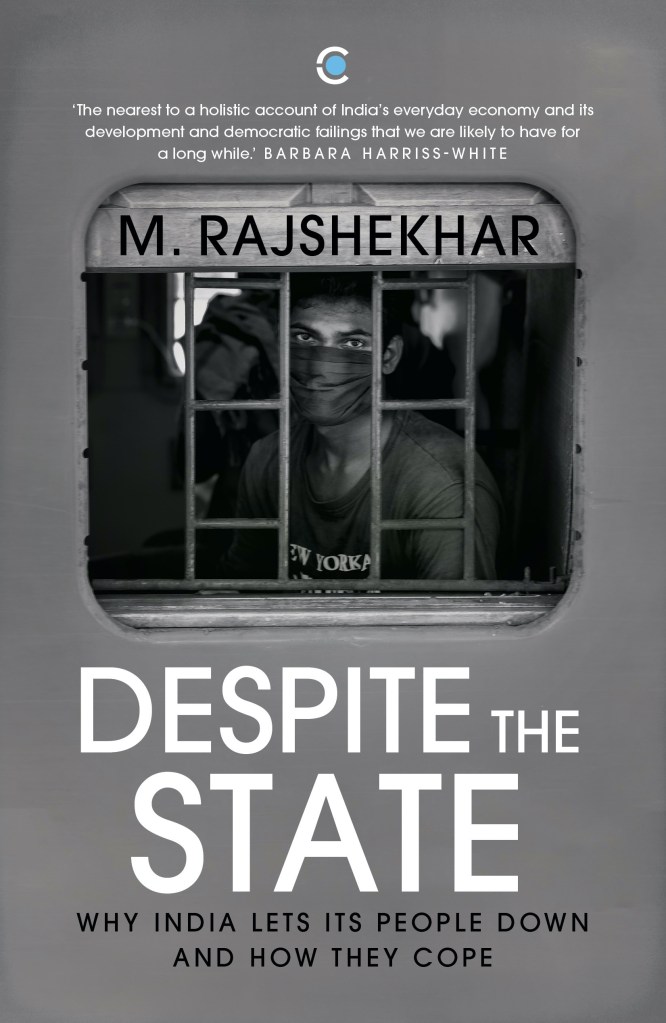
I am an Indian journalist with interests in energy, environment, climate and India’s ongoing slide into right-wing authoritarianism. My book, Despite the State, an examination of pervasive state failure and democratic decay in India, was published by Westland Publications, India, in January 2021. My work has won the Bala Kailasam Memorial Award; the Ramnath Goenka Excellence in Journalism Award; five Shriram Awards for Excellence in Financial Journalism; and, more recently, been a finalist at the True Story Award and GIJN’s Global Shining Light Awards. Write to me at despitethestate@protonmail.com.
Reviews
“…une plongée dans les failles béantes de la démocratie indienne, un compte rendu implacable du dysfonctionnement des Etats fédérés, minés par la corruption, le clientélisme, le culte de la personnalité des élus et le capitalisme de connivence. (…a dive into the gaping holes in Indian democracy, a relentless account of the dysfunction of the federated states, undermined by corruption, clientelism, the cult of the personality of elected officials and crony capitalism).” Le Monde
“…a critical enquiry into why representative government in India is flagging.” Biblio
“…strives for an understanding of the factors that enable governments and political parties to function in a way that is seemingly hostile to the interests of the very public they have been elected to serve, a gross anomaly in an electoral democracy.” Scroll.in
“M. Rajshekhar’s deeply researched book… holds a mirror to Indian democracy, and finds several cracks.” The Hindu
“…excels at connecting the local to the national.” Open
“…refreshingly new writing on the play between India’s dysfunctional democracy and its development challenges…” Seminar
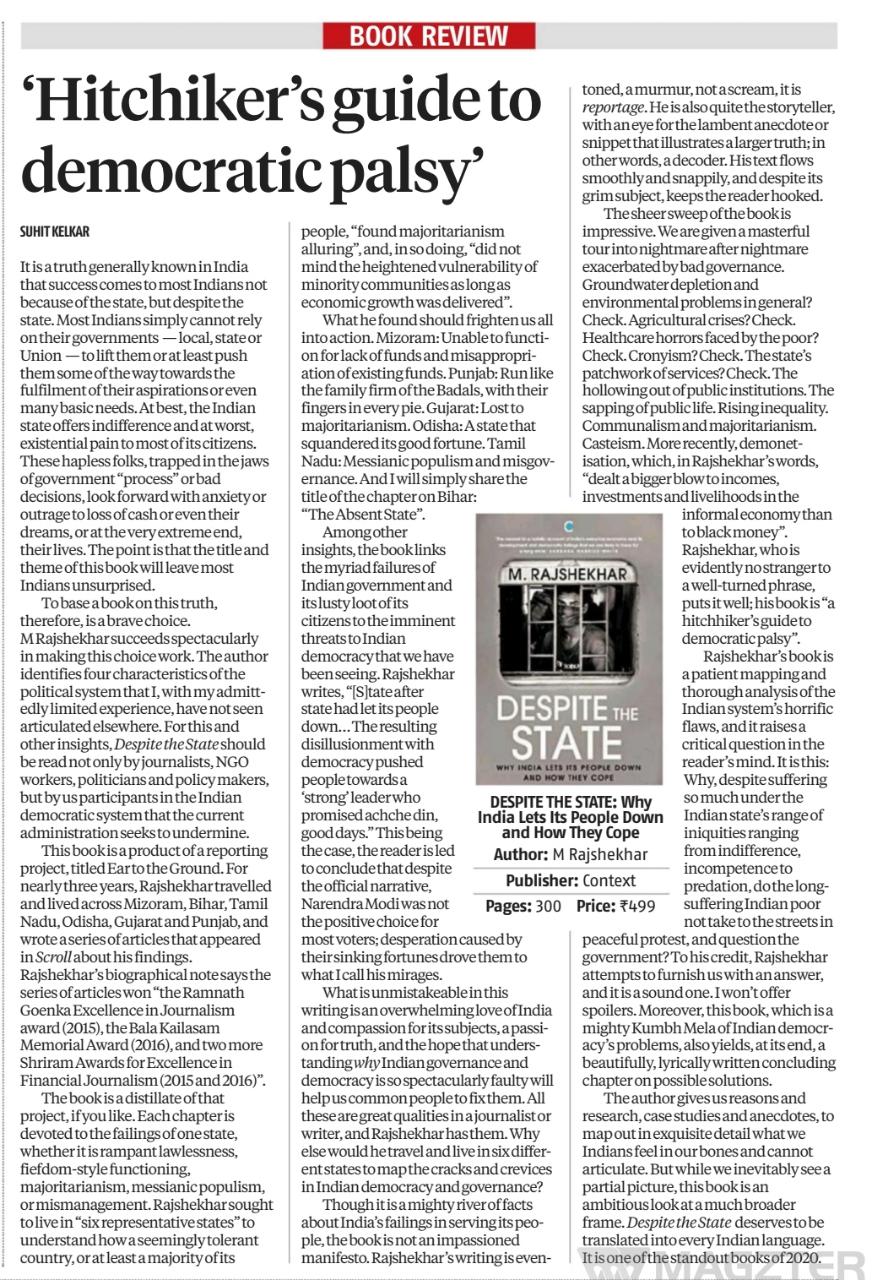
“A patient mapping and thorough analysis of the Indian system’s horrific flaws…” Business Standard (Image here)
“33 മാസം, 6 സംസ്ഥാനങ്ങൾ, 120 റിപ്പോർട്ടുകൾ: ജനാധിപത്യം തേടി മഹത്തായ ഇന്ത്യൻ യാത്ര… (33 months, 6 states, 120 reports: Great Indian journey in search of democracy…)” Malayala Manorama
“Hindustan ki maujooda siyasi wa maaashi soorat e hal.” QindeelOnline
“What emerges is the image of a state that is extractive, dominant, casteist and clientelist.” Tribune
“…reporting at its best. The picture that emerges is of a democracy that has been hijacked by vested interests, interested only in power and pelf.” Moneycontrol.com
Book lists
“Ten best non-fiction books of the year“, The Hindu.
“Twenty-One Notable Books From 2021“, The Wire.
“What has South Asia been reading: 2021 edition“, Himal Southasian
Interviews
“Journalism is a social enterprise…,” Booksfirst.in.
“Democratic decay at state level: Journalist M Rajshekhar on book ‘Despite the State’,” The News Minute.
“Covid-19 en Inde : “des décès de masse” dont un “État obscurantiste est responsable,” Asialyst.
Allusions/Mentions
“JP to BJP: The Unanswered Questions“.
Mahtab Alam’s review of “JP to BJP: Bihar After Lalu and Nitish”.
“Urban History of Atmospheric Modernity in Colonial India“. Mohammad Sajjad’s review of “Dust and Smoke: Air Pollution and Colonial Urbanism, India, c1860-c1940”.
“Westland closure: Titles that are selling fast and a few personal recommendations,” by Chetana Divya Vasudev, Moneycontrol. (Because this happened too. In February, a year after DtS was released, Amazon decided to shutter Westland, which published the book. The announcement saw folks rushing to buy copies of Westland books before stocks run out.)
“Time to change tack on counterinsurgency” by TK Arun, The Federal.
“All Things Policy: The Challenges of Governing States” by Suman Joshi and Sarthak Pradhan, Takshashila Institute (podcast).
“The Future of Entertainment“, Kaveree Bamzai in Open.
“On What India’s Watching“, Prathyush Parasuraman on Substack.
“The puppeteers around us“, Karthik Venkatesh in Deccan Herald.
“Will TN election manifestos continue ‘populist’ welfare schemes?“, Anna Isaac for The News Minute.
“Why wages-for-housework won’t help women“, V Geetha in Indian Express.
“The poor state of the Indian state“, Arun Maira in The Hindu.
Book discussions
14 April, 2024: The costs of political corruption, Bangalore International Centre.
27 May, 2023: Safe Spaces/Why Indians live despite the state. TEDx Bangalore.
12 November, 2022: Stop Loss: Overcoming the systemic failures of the Indian State. Tata Literature Festival, Mumbai.
26 December, 2021: Rangashankara, Bangalore, a discussion with Dhanya Rajendran.
16 November: Rachna Books, Gangtok, a discussion with Pema Wangchuk.
29 August: Books In The Time of Chaos, with Ujwal Kumar.
21 May: Hyderabad Lit Fest with Kaveree Bamzai and Aniruddha Bahal.
28 March: Paalam Books, Salem, Tamil Nadu.
19 March: The News Minute, “Citizens, the State, and the idea of India“
6 March: Pen@Prithvi, with Suhit Kelkar
20 February: A discussion between scholars Usha Ramanathan, Tridip Suhrud, MS Sriram and me to formally launch Despite the State.
6 February: DogEars Bookshop, Margoa.
5 February: The Polis Project, Dispatches with Suchitra Vijayan.
30 January: Founding Fuel, “Systems Thinking, State Capacity and Grassroots Development“.
25 January: Miranda House Literary Society
- March 2026
- January 2026
- December 2025
- November 2025
- October 2025
- September 2025
- August 2025
- May 2025
- April 2025
- March 2025
- February 2025
- January 2025
- December 2024
- November 2024
- October 2024
- August 2024
- June 2024
- May 2024
- March 2024
- February 2024
- January 2024
- November 2023
- August 2023
- July 2023
- March 2023
- February 2023
- January 2023
- October 2022
- September 2022
- July 2022
- June 2022
- May 2022
- April 2022
- March 2022
- February 2022
- December 2021
- November 2021
- October 2021
- August 2021
- July 2021
- June 2021
- May 2021
- April 2021
- March 2021
- January 2021
- October 2020
- September 2020
- August 2020
- July 2020
- June 2020
- May 2019
- March 2019
- February 2019
- January 2019
- December 2018
- November 2018
- October 2018
- July 2018
- June 2018
- April 2018
- January 2018
- December 2017
- November 2017
- October 2017
- September 2017
- July 2017
- June 2017
- May 2017
- April 2017
- January 2017
- December 2016
- November 2016
- October 2016
- September 2016
- August 2016
- July 2016
- June 2016
- May 2016
- April 2016
- March 2016
- January 2016
- December 2015
- November 2015
- October 2015
- September 2015
- August 2015
- July 2015
- June 2015
- May 2015
- April 2015
- March 2015
- January 2015
- December 2014
- November 2014
- October 2014
- September 2014
- August 2014
- July 2014
- June 2014
- May 2014
- April 2014
- March 2014
- February 2014
- January 2014
- December 2013
- November 2013
- October 2013
- September 2013
- August 2013
- July 2013
- June 2013
- May 2013
- April 2013
- March 2013
- February 2013
- January 2013
- December 2012
- November 2012
- October 2012
- September 2012
- August 2012
- July 2012
- June 2012
- May 2012
- April 2012
- March 2012
- February 2012
- January 2012
- December 2011
- November 2011
- October 2011
- September 2011
- August 2011
- July 2011
- June 2011
- May 2011
- April 2011
- March 2011
- February 2011
- January 2011
- December 2010
- November 2010
- October 2010
- September 2010
- August 2010
- July 2010
- June 2010
- May 2010
- April 2010
- March 2010
- February 2010
- January 2010
- December 2009
- November 2009
- September 2008
- February 2008
- December 2007
- November 2007
- May 2007
- April 2007
- March 2007
- February 2007
- January 2007
- September 2006
- August 2006
- July 2006
- June 2006
- May 2006
- March 2006
- January 2006
- September 2005
- March 2005
- January 2005
- September 2003
- December 2002
Aadhaar Agriculture Banking correspondents Bihar BJP Books Cash transfers Climate change Coal Coalscam Common BC Auctions Corruption Demonetisation Ear To The Ground Energy Energy Transition Environmental governance Financial Inclusion Forests Gujarat Healthcare Idiocy India Informal economy Journalism Madhya Pradesh Mandis Microfinance Mining Mizoram MoEF NDA NREGA Odisha Oligarchy Pollution Privacy Punjab Reserve Bank of India Rivers Tamil Nadu Tribals UIDAI UPA Welfare Programmes
 Fractured/Earth