-
“Campaigns are more effective when they are joined up” An interview with author Quentin Beresford
In 2015, Australian professor of politics Quentin Beresford published his book on Gunns Ltd- the biggest logging firm in Tasmania. The company was engulfed in snowballing controversy after announcing plans for a pulp mill that threatened native forests. It was a familiar script. Supporting the project, state politicians had dismissed concerns from local scientific bodies.… Continue reading
-
In memory of Richard Grove
It was August, 2006. Or, perhaps, September, 2006. Not too many days had passed since I reached the University of Sussex for a Masters in Environment, Development and Policy. Classes had just started. It was almost certainly the first week. One afternoon, wanting a cup of tea, walking to one of the many cafeterias in the campus,… Continue reading
-
Why India’s GHG emissions are about to rise faster
This morning, Carbon Copy published the second – and concluding – part of my report on global fossil fuel companies making a beeline for India. It is a development which comes with large fallouts. In the past, every time India liberalised a nationalised sector, private players have gained at the cost of public sector entities… Continue reading
-
India’s great fossil fuels push
In global circles fighting climate change, India scores a passing grade. Take Climate Action Tracker, a website tracking countries’ actions on climate change. Citing India’s ambitious renewable energy targets — 450 GW by 2030 – it says the country is on “track to overachieve its ‘2˚C compatible’ rated Paris Agreement climate action targets”. If the… Continue reading
-
Who will bid for India’s newly auctioned coal blocks?
A quick opinion piece today — for Carbon Copy. Continue reading
-
On the mechanics of Gautam Adani’s extraordinary expansion across India
For a long while now — ever since my colleagues at Economic Times and I profiled Gautam Adani in 2013 — some of my friends and I have been wondering how the Adani Group funds its growth. Is there a mismatch between the quantum of its balance sheet and the quantum of its investments? That… Continue reading
-
How a legal loophole allows BJP MP Rajeev Chandrasekhar to hide his full wealth from election panel
On March 12, 2018, as a part of his Rajya Sabha application as a Bharatiya Janata Party candidate, Rajeev Chandrasekhar submitted an intriguing affidavit listing his assets and sources of wealth to the Election Commission. The affidavit, a mandatory requirement for electoral aspirants, pegged the businessman-turned-politician’s annual income at Rs 28 crore and valued his… Continue reading
-
More on the asymmetry that rules India’s business insolvency process
Since October last year, Scroll has been (intermittently) reporting on how India’s insolvency proceedings are coming along. Cumulatively, these reports flag a couple of peculiar patterns. A lot of companies are up for sale — In a country with 7500 companies with a topline over Rs 250 crore, 2511 companies are slated for insolvency proceedings.… Continue reading
-
Five reasons why claims by forest dwellers for their land are low – and rejections are high
On February 13, the Supreme Court ordered the eviction of more than 10 lakh families of Adivasis and other forest-dwellers from forestlands across 16 states. The order came while the court was hearing petitions challenging the constitutional validity of the Forest Rights Act, 2006. The petitioners had demanded that state governments evict those forest dwellers… Continue reading
-
Centre’s weak legal defence of forest act means ten lakh families could be evicted, say activists
On February 13, the Supreme Court ordered state governments to evict over 10 lakh forest-dwellers whose claims over forestland have been rejected, a direction that will hurt some of India’s most vulnerable people. The order came in a case on the constitutional validity of the Forest Rights Act, which was passed in 2006 aiming to… Continue reading
-
The curious case of Russian oil deals that benefited Essar, hurt ONGC
When Russian President Vladimir Putin visited Delhi in December 2014, his camaraderie with Prime Minister Narendra Modi was widely noted. What received less attention were the curiously asymmetric deals that an oil company controlled by the Russian government went on to sign with Indian companies over the next two years. First, between September 2015 and… Continue reading
-
Interview: ‘We have underestimated the extent of India’s jobs crisis. It is far more serious’
and gosh. one more frikking q&a. On Thursday, a political storm boiled over after Business Standard reported that, between 2017-’18, unemployment numbers in India reached a 45-year high. The newspaper based its report on a survey, conducted by the National Sample Survey Organisation, called the Periodic Labour Force Survey that the government had not made public. According to… Continue reading
-
Reviving the Ganga #3. Three ways in which the Modi government is adding fresh stresses to the river
A century ago, the gharial could be found all the way from the Indus to the Irrawady. The thin-snouted, fish-eating member of the crocodile family was spread out over 20,000 sq km at the time, studies estimate, and numbered between 5,000 and 10,000. Now, no more than 200 breeding adults survive in the wild. The… Continue reading
-
Reviving the Ganga #2 Modi said he would revive Ganga but his government is doing the opposite by reviving dams
The focus of their anger lay 400 kilometres to the north. Since 2002, Uttarakhand, where the Ganga originates, has been on a drive to build hydel power projects. The state, which currently produces 4,000 MW of hydel power from 98-odd projects, has since 2009 signed agreements to build another 350 dams. Most of these are… Continue reading
-
Reviving the Ganga #1. Modi’s clean Ganga plan hinges on private companies tackling sewage. Will it work?
In September 2014, shortly after coming to power, Prime Minister Narendra Modi held his first meeting on the Ganga. The river had featured prominently in the Bharatiya Janata Party’s election manifesto. The Ganga was both jeevan dayini, the giver of life, and mukti dayini, which sets the soul free, the document said. But all was… Continue reading
-
Insolvency process: Competition Commission should see if monopolies are forming, says Yashwant Sinha
Over the last four-and-a-half years, the Bharatiya Janata Party-led National Democratic Alliance government has done much to constrict India’s economy. Demonetisation hurt the smallest businesses: those of the self-employed. Their incomes are yet to return to pre-demonetisation levels. Many slightly bigger businesses, like small and medium enterprises in industrial clusters like Surat in Gujarat and… Continue reading
-
Interview: Income support schemes for farmers are a cop-out, says economist Abhijit Sen
On January 1, when Indian news agency ANI asked Prime Minister Narendra Modi about the government’s plans to reduce agrarian distress, he said loan waivers do not work as a very small segment of farmers take loans from banks. “A majority of them take loans from money lenders,” said Modi. “When governments make such announcements,… Continue reading
-
Opinion: New RBI chief Shaktikanta Das’s actions after note ban show why he is a poor choice
My big lesson from recent years in journalism is that things are never so bad that they cannot get worse. A case in point, the appointment of Shaktikanta Das as governor of the Reserve Bank of India. An event which resulted in this disbelieving little commentary. Continue reading
-
Biggest winner of Modi’s loan-in-59-minutes plan for small companies is an Ahmedabad fintech startup
On November 2, Prime Minister Narendra Modi made a slew of announcements aimed at reviving India’s faltering micro, small and medium enterprises. One of these was about a dedicated digital platform – www.psbloansin59minutes.com – to enable them to access loans of upto Rs 1 crore in just 59 minutes. Unlike their larger counterparts, India’s smaller… Continue reading
-
Arun Jaitley is being disingenuous in blaming RBI for the troubles of India’s small and medium firms
What India’s Finance Minister says… The finance minister this week criticised the central bank for failing to check indiscriminate bank lending from 2008 to 2014 which has now ripened into a bad loan crisis. The attack was accompanied by the government invoking never-used powers under the Reserve Bank Act to issue directions to the bank’s… Continue reading
-
India’s curious inflexibility in trying to fix its bad loan crisis is leading to unforeseen problems
India’s crackdown on companies that have defaulted on loan repayments is reshaping the country’s economy in fundamental ways. As the first three articles in this series detailed, competitive advantage is being tilted towards larger firms because only a handful of buyers is picking up most of the insolvent firms on sale. Between the resulting consolidation… Continue reading
-
India’s proceedings to recover bad debt are reshaping Chhattisgarh’s economy – and politics too
A baton is changing hands in Chhattisgarh. Big companies are entering the state’s steel and power sector, using India’s ongoing insolvency proceedings to buy distressed firms. At the same time, Chhattisgarh’s local steel makers, several of whom entered the power sector in the mid-2000s, are looking beyond these two sectors. Part Three of our series… Continue reading
-
As India tackles its bad loans problem, large local groups and global funds are gaining advantage
By March, seven companies had evinced interest in buying Lanco Infratech. The company began life in 1986 as a construction contractor, but grew into a power and infrastructure behemoth after liberalisation. Much of this growth was funded by bank loans. In June 2017, after missing its loan repayments, the company found itself on the Reserve… Continue reading
-
India’s bid to fix bad loan crisis is reshaping its corporate sector – and creating new challenges
After a long break, I finally — and rather sulkily — resumed work in the middle of August. Out today, the first of my trademark long-winded and tremendously depressing series: on how India’s business insolvency cases are coming along. The series — it is a four-parter — essentially argues that India needs to pay far… Continue reading
-
The MJ Akbar playbook: Men look back at how he preyed on women colleagues in newsrooms and got away
It’s a case that is being described as “India’s Women vs MJ Akbar”. Beginning with veteran journalist Priya Ramani, 16 women have gone public this month with sexual harassment allegations against former Minister of State for External Affairs MJ Akbar. After Akbar filed a criminal defamation case against Ramani, 17 more women who worked in… Continue reading
-
Modi is right. Amul was indeed an inspiring success story (but it’s all going wrong now)
Dairy cooperative Amul came in for high praise from Prime Minister Narendra Modi on Sunday. Talking to a gathering of farmers after inaugurating the cooperative’s new chocolate factory in Anand in Gujarat, Modi said the organisation represents a viable alternative to capitalism and socialism. According to a report in The Hindu, he also said, “It… Continue reading
-
One year after GST, India’s smaller companies are on the backfoot
On July 1, 2017, India introduced the Goods and Services Tax to replace the patchwork of indirect taxes that existed at the time and to improve tax compliances. As the tax regime completes its first year, Scroll.in reporters interviewed people running a variety of businesses: handicraft-makers in Guwahati, textile manufacturers in Surat and Tirupur, paper-goods… Continue reading
-
The year of reading gluttonously
Earlier this evening, I sat down to write a blogpost about the better books I have read over the last few months. There has been – due to all manner of complicated reasons — a lot of reading. The months that immediately followed the end of my states reporting project for Scroll saw me pick… Continue reading
-
Bumps ahead
Realised some days ago that a bunch of hyperlinks on frac/earth are not working. Correcting them now. My apologies for this. If there is any article you need access to, drop me a line. Things should be working fine in a week or so. Update: All fixed. Continue reading
-
On the six factors which cumulatively added up to India’s unprecedented cash squeeze
India’s current cash crunch is a real enigma. To begin with, there is its sheer unprecedented nature. In all the years since Independence, India has never seen something like it. “We have heard of coin shortages but never a cash shortage,” said MS Sriram, visiting faculty at the Indian Institute of Management-Bangalore’s Centre for Public… Continue reading
-
15 theories about why India is facing a cash crunch a year and a half after demonetisation
atms are again running dry in india. and theories claiming to explain why are doubling every day. out today, a quick report with my colleague rohan which seeks to separate plausible theories from the disingenuous (or just plain stupid) ones. Continue reading
-
Political meddling to financial impropriety – it is all going wrong at Amul
out today, the second — and concluding — part of our report on how Kaira Union, the Amul Dairy set up by Verghese Kurien and Tirbhuvandas Patel is doing. Continue reading
-
Amul federation could be soured by corruption charges against its oldest cooperative in Gujarat
On March 31, K Rathnam abruptly resigned as managing director of the Kaira Union, the oldest of the 18 cooperatives that market their products under the Amul brand name. The announcement came shortly after some board members of the union, including vice chairman Rajendrasinh Parmar, alleged a Rs 450-crore scam during Rathnam’s three-year stint running… Continue reading
-
And now for something completely different
Earlier today, my friend Rafat sent over snaps of some of our earliest reportage. This is circa 1998, from our first job at now-shuttered A&M, India’s first magazine on advertising and marketing. Am pasting them below and noting – with much pride and approval – the pun in one of these headlines, for a report… Continue reading
-
Power. The ignorance it engenders. And some photographs.
Towards its end, “The Post”, Spielberg’s film on the Pentagon Papers, says: “The role of the press is to serve the governed, not the governors.” Which makes one think. Who are these people we are meant to be serving in India? Take a look at the snaps above. These people — belonging to Mizoram, Odisha,… Continue reading
-
And now for something completely different
No ‘End Of The Year’ cycle ride (see this and this and this) this year. One of my two co-conspirators was scrambling to finish his long overdue book — writing, not reading, it. The other was busy prepping for a marathon. And so, January 2018 saw the ‘End Of The Year’ trek. Eleven days of… Continue reading
-
‘Ear To The Ground’. What we reported on between 2015 and 2017.
In March, 2015, Scroll.in kicked off a reporting project called ‘Ear To The Ground‘. It was meant to ID the largest changes afoot in six handpicked states — and to use them to understand the major processes shaping India now. As that project draws to a close, it is nostalgia-time (for me, at any rate).… Continue reading
-
Few people seem happy with BJP’s rule in Gujarat, yet the party still controls the state. Why?
In April 2017, Scroll.in’s Ear to the Ground project reached Gujarat. Each of the other states covered by the project thus far – Mizoram, Odisha, Punjab, Tamil Nadu and Bihar – showed one democratic malfunction or another. What about Gujarat? Gujarat is unique in our subset of six states in having been under the rule… Continue reading
-
Urban planning: Why Gujarat’s cities are losing their fight against a changing climate
Out today, the second — and concluding — part of our series on Gujarat and climate variability. Urban planning has seen a lot of changes in Gujarat. Take Rajkot. In 1973, when this town in Saurashtra became a municipality, its municipal corporation was responsible for urban planning. That changed in 1976 when Gujarat passed the… Continue reading
-
Gujarat is battered by heat waves, floods, drought. How are its cities coping?
What does the climate map of Gujarat currently look like? Southern parts of the state get fewer days of rainfall now. In Surat, for instance, locals say that rainfall patterns over the city began changing about 15 years ago, with the city getting fewer days of rain each year. However, the rainfall is more intense,… Continue reading
-
Amul is now a Congress-mukt federation’: How BJP took control of India’s largest milk cooperative
Out today, the second — and concluding — part of our report on why Amul, India’s much-loved dairy federation, is in trouble. Continue reading
-
The Amul story: How politics is hurting the economics of Gujarat’s milk cooperatives
In the winter of 2013, the inner workings of Amul briefly became public. A boardroom putsch was underway. The directors of no less than 14 of the 17 district milk cooperatives that were then part of the Gujarat Cooperative Milk Marketing Federation, which owns the Amul brand, had turned against chairman Vipul Chaudhary. A member… Continue reading
-
The majoritarian project in Gujarat only serves the rich, says political scientist Ghanshyam Shah
In the run-up to Assembly elections in December, Gujarat is in the throes of powerful forces. On the one hand, some of its principal economic pillars, such as small manufacturing and agriculture, are in trouble. At the same time, the state is seeing a curious fissuring. What was once a separation between Hindus and Muslims… Continue reading
-
‘This government is killing our businesses’: What small, medium enterprises think of GST revisions
After Friday’s GST Council meeting, which decided to cut the goods and services tax rate on two dozen commodities and announced relaxations for exporters and small and medium companies, Prime Minister Narendra Modi said the changes brought in an early Diwali. The business press was bullish as well. “Three months on, GST now good for… Continue reading
-
How palm oil from Malaysia fired the Patel agitation in Gujarat
Dhirubhai is in dire straits. He can no longer recover his investments on the groundnuts he grows on three acres of land along the Junagadh-Verawal road in Gujarat. In a good year, he grows 100 kilos of groundnuts – or peanuts – for every Rs 4,000 he invests. The minimum support price – or the… Continue reading
-
Why small businessmen in Gujarat are quitting industry and turning to financial speculation
Two major trends are playing out in Gujarat’s economy. On one hand, small industrial units are shutting down. This is not a recent development. Micro, small and medium units in the state started getting into trouble about five years ago, well before the central government demonetised high-value currency notes in November and introduced the Goods… Continue reading
-
Missing in the panel set up to frame India’s new mineral policy: Adivasis, ecologists, civil society
Does the KR Rao Committee ring a bell? It was set up last month by the Union Ministry of Mines after the Supreme Court’s tough judgement on illegal iron ore mining in Odisha. Disposing of a petition filed by the non-profit Common Cause, Justice Madan B Lokur and Justice Deepak Gupta not only ordered the… Continue reading
-
Two months in, How is GST affecting Surat’s textile hub?
Three months ago, when the central government was getting ready to roll out the Goods and Services Tax, the textile industrial cluster of Surat, Gujarat, India’s biggest manufacturer of synthetic fabrics, was distinctly nervous. At play were two conflicting views of how the new tax regime would affect India’s predominantly informal business sector. The government… Continue reading
-
What we talk about when we talk about Bihar
A wrap of all our #EarToTheGround reportage from Bihar is finally out. The arsenic crisis is not the only problem area where the state’s response has been weak and underwhelming. Bihar has improved on law and order, roads and power, but as the previous stories in Scroll.in’s Ear To The Ground series have reported, its… Continue reading
-
As Gujarat’s Vadnagar station gets a makeover, a local resident asks: ‘How many jobs will it create?
Gujarat’s Vadnagar station is getting the mother of all makeovers. Its solitary rail track – a 57-km long metre-gauge line connecting the town of Mehsana to the Jain temple at Taranga – has been ripped out. It is being replaced by a broad-gauge line and extended till Abu Road in the neighbouring state of Rajasthan.… Continue reading
-
Caste Calculus: How the BJP is expanding its footprint in Bihar
In a hamlet between Badlapura and Chirandgaon villages near Chhapra, Bihar, a small temple is packed with about 40 women. Unmindful of the summer afternoon heat, they are absorbed in worshipping the Hindu god Shiva. It is a Shiv Charcha, Ajay Pandey, the priest of a nearby temple, explained. The women live in five villages… Continue reading
-
Fear and loathing in Chhapra: How a peaceful Bihar town became a communal tinderbox
Over the past four years, religious tension has steadily increased in Chhapra, Bihar. For evidence, see how this once peaceful town in Saran district now celebrates Ram Navmi or Maha Shivaratri: the high point of the festivities is large processions of young men wearing saffron headbands brandishing swords and shouting “Jai Shri Ram” to a… Continue reading
-
Beyond Surat’s GST strike: New technologies, Chinese imports are causing a churn in textile sector
At one time, the neighbourhood around Surat’s textile markets was noisy. The street resounded with the clacketing of powerlooms – five or six machines in dark, poorly ventilated rooms with split levels. Most of these were family-run businesses. The looms were on the groundfloor with families working by day and sleeping upstairs at night. Now,… Continue reading
-
In Surat’s textile hub, small businesses are afraid of GST – but big companies are not
Rajesh Mehra is desolate. A big-boned man in his mid-fifties, he is a trader in women’s blouses. Until ten years ago, Mehra used to take orders from garment wholesalers in big cities like Mumbai, Kolkata and Bengaluru, buy the cloth and thread he needed from garment clusters like Silvassa, and get the blouses stitched in… Continue reading
-
What’s common between coaching classes in Bihar and its bahubali leaders?
Career Plan Coaching Centre is not much to look at. It is a tiny room, tightly packed with benches and desks, housed in an unplastered brick structure, one half of which is a garage. A board advertises the services offered by the centre, located in Geetwas, a small village near Araria in northeastern Bihar: tuitions… Continue reading
-
Bihar’s Nitish Kumar has been in power for 12 years. Why has he failed to change its fortunes?
Kanwar jheel is a freshwater lake spread over 6,311 hectares in Bihar’s Begusarai district. Till the 1970s, the lake used to attract as many as 100,000 freshwater birds each year. But, in recent decades, it has been under attack. Landowners from the Bhumihar caste have been draining Kanwar jheel to farm on its lakebed. This… Continue reading
-
Bihar is struggling to improve the lives of the poor even after 27 years of backward caste rule
The district hospital of Muzaffarpur, 100 km north of Patna, Bihar’s capital, is struggling with a shortage of doctors. With 160 beds and an estimated inflow of 500-600 new patients each day, the hospital should have 48 full-time doctors and 52 nurses, said one of its administrators. What it has, instead, is 12 full-time doctors,… Continue reading
-
How technology is changing popular culture in Bihar
Sudhanshu is hard at work in his shop on Patna’s busy Boring Road. The small strip of a shop has two desktop computers, both loaded with music and movies downloaded from the internet. The songs and films are Sudhanshu’s livelihood. Boring Road, with its government college and several dozen coaching centres, is a beehive of… Continue reading
-
What Bihar’s changing village bazaars say about the state
Village markets are changing in Bihar — as they are in the other states #ETTG reported from. This piece looks at some of those changes — and advances hypotheses to explain these changes. Continue reading
-
Bihar can’t even count how many dengue cases it has had, let alone fight the disease
In Bhagalpur, the historic Bihar city on the southern banks of the river Ganga, doctors disagree about the threat of dengue in the area. Vijay Kumar, the civil surgeon for Bhagalpur, says dengue is under control. His statement has been flatly contradicted by doctors at Bhagalpur’s Jawaharlal Nehru Medical College and Hospital. The hospital identified… Continue reading
-
Lessons from Bihar’s 2016 dengue outbreak : Migration, poverty, garbage are spreading new diseases
In 2016, dengue hammered Krah. As many as 100 people living in this densely-packed, predominantly Muslim ghetto of about 1,000 families near Biharsharif contracted the disease, say residents. The scale of the outbreak was unprecedented. As Mohammad Ilyas, a young tailor who works and lives in Krah, said: “We never had such an outbreak earlier.”… Continue reading
-
Cancer has exploded in Bihar as lakhs of people drink water poisoned with arsenic
It is a day like any other at Mahavir Cancer Sansthan. The driveway is lined with people who have travelled a long way to get to this charitable hospital in Patna. Families sit huddled, holding their bags close. The lobby is even more crowded, rather like the ticket buying hall of a train station. The… Continue reading
-
And now for something completely different
This year’s EOTY (end of the year) bike ride started at Guwahati, Assam, and ended at Miao, Arunachal Pradesh. The route (Guwahati, Mangaldoi, Dekhiajuli, Pabhoi, Majuli, Sibasagar, the coaltown of Margarita, Miao, followed by a visit to Namdapha Tiger Reserve) stretched along the north bank of the Brahmaputra till the river island of Majuli and… Continue reading
-
‘Is the pain worth it?’: 50 days after demonetisation, rural South India has a few questions
On November 9, life suddenly came to a standstill in Chikka Tirupathi, Bagalur and Hosur. As in the rest of India, the first day of demonetisation in these towns abutting the Karnataka-Tamil Nadu border was marked by problems in conducting day-to-day trading for small businesses and a frenzied hunt for Rs 100 notes for families.… Continue reading
-
Aadhaar shows India’s governance is susceptible to poorly tested ideas pushed by powerful people
This series has flagged a puzzling trend. State governments are struggling to use Aadhaar-based fingerprint authentication in ration shops. At the same time, a rising number of companies are integrating Aadhaar into their databases. This is puzzling because from its inception, Aadhaar, India’s Unique Identification project, was pitched as integral to the modernisation of social… Continue reading
-
An update from Patna’s Maroofganj mandi
ten days into #notebandi, patna’s Maroofganj mandi had frozen. As demonetisation enters its second week, traders in Patna’s Maroofganj mandi are seeing something unprecedented. In the last seven days, the supply of new stocks in this wholesale market, which supplies cooking oil, spices, rice, wheat and pulses to shopkeepers across Patna, has plummeted. The supply… Continue reading
-
What happens to privacy when companies have your Aadhaar number?
Out today, the second part of my story on companies, aadhaar and privacy. As the previous story in this series reported, some companies are using Aadhaar to share customer and business partner information. This could aid the rise of data-broking companies like Acziom in the United States that hold ever more detailed profiles of people.… Continue reading
-
How private companies are using Aadhaar to try to deliver better services (but there’s a catch)
Aadhaar, as India’s Unique Identity Project is called, aims to give a 12-digit unique identity number to all residents by collecting their fingerprint and iris scans. As of September, its database, maintained by the Unique Identity Authority of India, held the names, addresses and biometric information of more than 105 crore people. The project was… Continue reading
-
The lid on illegal sand mining in TN might finally be lifted (but perhaps for the wrong reasons)
In a day of fast-paced developments, Income-Tax Department officials raided the house of Tamil Nadu Chief Secretary P Rama Mohana Rao on Wednesday morning where they seized Rs 30 lakh in cash in new, post-demonetisation currency notes, according to the Hindu. Later in the day, Central Bureau of Investigation sleuths also arrested Shekar Reddy, one… Continue reading
-
What we talk about when we talk about Tamil Nadu
It is out. Scroll’s wrap of all our #EarToTheGround reporting from Tamil Nadu. How is Tamil Nadu doing? Ask a layperson this question and, chances are, they will have good things to say. It does have a reputation for being one of the country’s better governed states. A welfarist state where, in marked contrast to… Continue reading
-
Ground report: In Bihar, murmurs of protest break the sullen silence against demonetisation
Banka was the last stop before returning to Patna in this reporter’s travels from North Bihar to South Bihar, to get a sense of how notebandi was impacting the structures of everyday life. The journey had started with Raxaul, on the India-Nepal border, on November 18, exactly 10 days after notebandi was announced. Heading south,… Continue reading
-
Think Tamil Nadu has good public healthcare? It’s hard to find it on the ground
the concluding part of our story on why Tamil Nadu’s healthcare system is weakening. In India’s development circles, Tamil Nadu is viewed as one of the best performing states in the delivery of public welfare like education and healthcare. But, as the first part of this story reported, the state is improving on some public… Continue reading
-
Tamil Nadu’s healthcare numbers look good – but its people aren’t getting healthier
Out today, the first part of our final #ETTG story from Tamil Nadu. This one says the state’s much-vaunted healthcare system is weakening. On some fronts, the state’s public health system continues to work well. Today, nearly all babies in Tamil Nadu are delivered in clinics – from 87% in 2002-’04, institutional deliveries climbed to… Continue reading
-
Money is trickling into the banks of Bihar – but is not being distributed evenly
A month after Prime Minister Narendra Modi announced the scrapping of Rs 500 and Rs 1,000 notes on November 8, cash availability is starkly uneven across Bihar. In relatively affluent parts of the capital city of Patna, the long queues outside ATMs seen in the first week of notebandi, when the government invalidated 86% of… Continue reading
-
Demonetisation: In a hamlet in Bihar, income and expenditure is down, but hopes are up
The last 30 days have not been easy for the people of Bhindu Paimar. The standard demonetisation narrative has played out in this tola (hamlet) in Karjara panchayat in Gaya, Bihar, about 20 km from Gaya city, on the road that leads to the ancient Buddhist university of Nalanda. Earnings have fallen. Most people in… Continue reading
-
Paneerselvam has a major task: To reverse Tamil Nadu’s slipping development standards
O Panneerselvam has a tough task ahead of him. Contrary to popular perception, which credits Tamil Nadu with high scores on development indices and a smoothly functioning administration, the state has lost ground over the last ten or so years. Take education. Between 2010 and now, the number of students passing the state board exams… Continue reading
-
The demonetisation effect on border town Raxaul: Income loss, dependence on Nepalese currency
My second field trip in Bihar took me from Patna to Raxaul in the far north. A couple of days there, and then I began trickling southwards. Bettiah. Gopalganj and then Darbhanga. And then Patna again. I will head further south tomorrow — towards Gaya — before turning northeast towards Nalanda and then straight east… Continue reading
-
Cauliflower sells for Rs one a kilo in Bihar as demonetisation depresses demand
At first glance, it looks like any other day at the mandi in Bettiah. Trucks stand next to the concrete arch that leads into the fruit and vegetable market in this small town in northern Bihar. Inside the mandi samiti, as the precinct is called, hawkers sit with baskets bursting with vegetables. The shops seem… Continue reading
-
Tamil Nadu tried to reform its schools – but made them much worse
the concluding part of our story on TN’s school education system. A former official in the state examinations department traced the disarray to a handful of factors – among them the decision to do away with exams, the obduracy of matriculation schools, and rising pressure on the education department to show good results. Continue reading
-
Tamil Nadu’s schools are in crisis (but nobody is talking about it)
How good are Tamil Nadu’s schools? If you take a look at the exam results in the state, you would get the impression that they are in sound shape. Between 2010 and 2016, the percentage of students passing the state’s tenth standard board exams rose from mid-eighties to mid-nineties. So did the scores and the… Continue reading
-
How four families have survived two weeks of demonetisation
reported for this story. Prime Minister Narendra Modi’s decision to do away with Rs 500 and Rs 1,000 notes has not been good for Guddu Sharma’s family. Sharma, 24, lives with his wife and two sons near Patna’s Boring Road, and runs a men’s salon about 30 minutes away. Since the prime minister’s announcement, he… Continue reading
-
Demonetisation has left India’s food markets frozen – and the future looks tense
As demonetisation enters its second week, traders in Patna’s Maroofganj mandi are seeing something unprecedented. In the last seven days, the supply of new stocks in this wholesale market, which supplies cooking oil, spices, rice, wheat and pulses to shopkeepers across Patna, has plummeted. The supply of cooking oil, for instance, is down by 80%.… Continue reading
-
‘All these notes suddenly have no value:’
this field report on Day One of demonetisation. In the borderlands of Chikka Tirupathi and Hosur, the first day of the demonetisation of Rs 500 and Rs 1,000 notes by the Indian government was marked by problems in day-to-day trading for small businesses and a frenzied hunt for Rs 100 notes for families. Shankar, who… Continue reading
-
Reading Zygmunt Bauman
during these months spent on #eartotheground, one of the largest social processes my colleagues and i have written about is this rising intensification of caste and religious identities.we saw that in punjab. and we saw that in tamil nadu. our story at tamil nadu advanced an hypothesis that stagnant economic fortunes of the intermediate castes… Continue reading
-
As MNREGA work dries up, even the elderly in Bihar are migrating to brick-kilns
In a year when large swathes of rural India reeled under drought, the Centre used WhatsApp messages to ask states to go slow on generating employment under the Mahatma Gandhi National Rural Employment Guarantee Scheme. This startling revelation emerged in the public domain in the last week of October through the reports of the Business… Continue reading
-
And now for something completely different
Some photos from my first field trip in Bihar. Patna-Muzaffarpur-Araria-Bhagalpur-Patna. A tea seller on the banks of the Kosi. A village market. A villager who, seeking sustenance, set up an x ray clinic in his village. Field trip number two. Patna-Raxaul-Bettiah-Gopalganj-Darbhanga-Patna. A smoggy sunrise in Gopalganj. Hazarimal’s Dharamshala in Bettiah (This is where Gandhi had… Continue reading
-
Surviving on jugaad with help from Sai Baba 400 km from home
The camp looked intriguing. About a dozen tents – no more than plastic sheets covered by old sarees – standing in the midst of a strange amalgam of jury-rigged vehicles one day in March. One of the vehicles was still recognisable as a cycle rickshaw, despite its reinforced axle, thickened frame and motorcycle wheels. The… Continue reading
-
‘No ideology, no political idea’: Hosur shows what happens when a society has been sedated
In the last 40 years, Hosur has been on a rollercoaster. In 1973, this Tamil Nadu town on the border with Karnataka was chosen as the site for the state’s second industrial cluster. Through the ’70s, a diverse clutch of companies, producing everything from trucks to garments to medicines, set up factories here. Hosur began… Continue reading
-
These companies are changing the way labour is hired (and fired) in India
Heard of a company called UDS? Like India’s IT companies, it hires workers and sends them to client locations. There’s just one difference: while the IT companies supply white-collar workers to firms across the world, UDS provides blue-collar workers to offices, factories, airports in India. They run assembly lines, do housekeeping, handle packing and loading,… Continue reading
-
Why Tamil Nadu is erecting cages around statues (hint: it’s linked to caste)
Two statues stood on a road between Pondicherry and Villupuram. On the right was CN Annadurai, the first Dravidian chief minister of Tamil Nadu. On the left, Bhimrao Ambedkar. Together, they made an arresting tableau. Annadurai’s statue stood on an open cement plinth, with a red and black flag of the Dravida Munnetra Kazhagam jammed… Continue reading
-
Sand mining in Tamil Nadu is incredibly destructive – but it’s also unstoppable
For the longest time, V Chandrasekhar fought a lonely battle. When sand miners first came to his village near Pondicherry in the 1980s, most of his fellow villagers stayed quiet. They stayed quiet when the local riverbed went down by 30 feet, local groundwater levels collapsed, wells dried out and then filled up with saline… Continue reading
-
Think sand mining damages the ecology? It ruins politics as well
…Villages talk about collapsed groundwater levels, wells that do not fill even when the river is brimming, wells in coastal areas which have turned saline. Little here is surprising. These ecological changes are well-known side-effects of sand mining. But the damage done by sand mining isn’t just ecological. As Scroll found while reporting from Tamil… Continue reading
-
Politicians aren’t only messing with Tamil Nadu’s water – they’re making Rs 20,000 crore from sand
Out today, the first instalment of our three-part series on sand mining in tamil nadu. Stepping onto the bank, the first thing that’s visible is a ten-wheeled tipper. It grinds to a halt at the end of a queue of similar trucks. Beyond it stretches a vast riverbed. That is the Thenpennaiyar, one of the… Continue reading
-
How Karnataka and Tamil Nadu mismanaged their water and then blamed each other
Why is the Cauvery such a recurring flashpoint between Karnataka and Tamil Nadu? In recent days, an array of hypotheses have been advanced to help answer that question. Some of these are broad in their scope – tracing the long history of the conflict. Others focus on the here and now – rainfall patterns and… Continue reading
-
Why does the IAS Association defend HC Gupta but not Ashok Khemka?
Our second piece on this ghastly caterwauling over ex-coal secy HC Gupta. The fervent defence of former Coal Secretary HC Gupta seems to be taking India into dangerous waters. India’s Prevention Of Corruption Act, 1988 should be amended, wrote Partha Sen Sharma, a serving Indian Administrative Service officer in The Times Of India on Tuesday,… Continue reading
-
Can the courts save India’s rivers from pollution? Tirupur shows the answer is no
the second — and concluding — part of our trip down the Noyyal (see previous post). A slum sprawled on one side of the river. In the distance, a factory belched smoke in the air. The riverbed was overrun with weeds and crammed with plastic bags that were half buried into the earth. An earthmover… Continue reading
-
How a river in Tamil Nadu turned into a sewage canal
A narrow little rivulet splashes down, bouncing from boulder to boulder as it descends the rockface. It pauses to catch its breath in a tiny pool limned by trees, before rushing downhill again, merging with other streams to form a small river called the Noyyal. For centuries, the river’s 170-km course used to take it… Continue reading
-
What the people defending former coal secretary HC Gupta are not telling you
Last week, former Coal Secretary HC Gupta surprised everyone in the Central Bureau of Investigation Court. He intended to “face trial from inside the jail” and withdraw the personal bond he had submitted in order to obtain bail, he told Special Judge Bharat Parashar. Gupta is an accused in several coal block allocation cases relating… Continue reading
-
A tsunami of debt is building up in Tamil Nadu – and no one knows where it is headed
G Venkatasubramanian trots out some astonishing numbers. Over the last 15 years, he and his fellow researchers at Pondicherry’s French Institute have been studying debt bondage among families in 20 villages in Tamil Nadu. Half of these settlements are in the coastal district of Cuddalore, and the others are in the adjoining district of Villupuram.… Continue reading
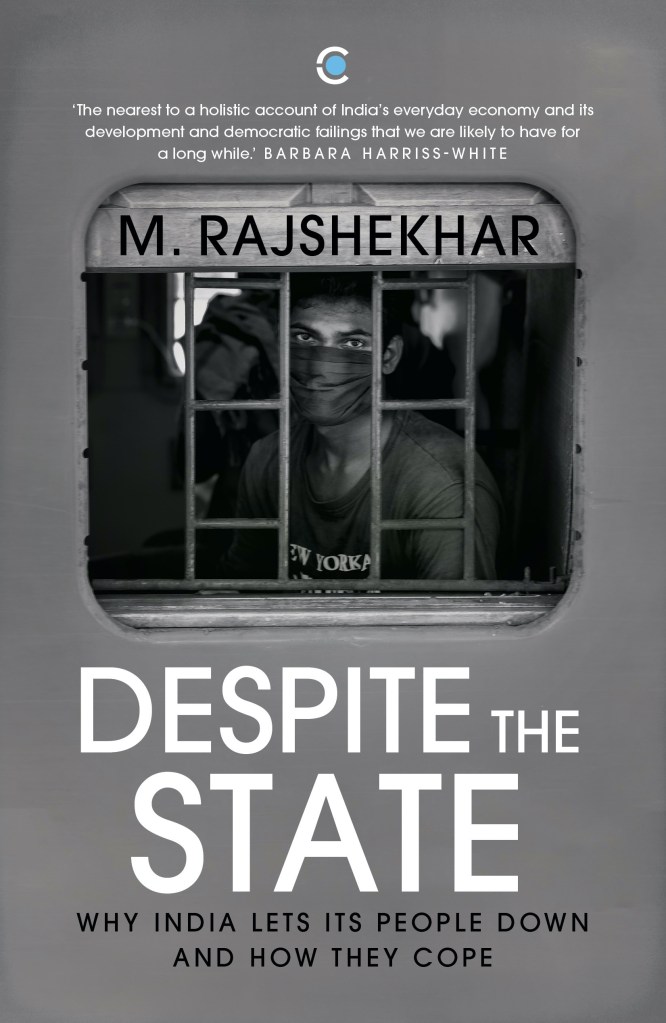
I am an Indian journalist with interests in energy, environment, climate and India’s ongoing slide into right-wing authoritarianism. My book, Despite the State, an examination of pervasive state failure and democratic decay in India, was published by Westland Publications, India, in January 2021. My work has won the Bala Kailasam Memorial Award; the Ramnath Goenka Excellence in Journalism Award; five Shriram Awards for Excellence in Financial Journalism; and, more recently, been a finalist at the True Story Award and GIJN’s Global Shining Light Awards. Write to me at despitethestate@protonmail.com.
Reviews
“…une plongée dans les failles béantes de la démocratie indienne, un compte rendu implacable du dysfonctionnement des Etats fédérés, minés par la corruption, le clientélisme, le culte de la personnalité des élus et le capitalisme de connivence. (…a dive into the gaping holes in Indian democracy, a relentless account of the dysfunction of the federated states, undermined by corruption, clientelism, the cult of the personality of elected officials and crony capitalism).” Le Monde
“…a critical enquiry into why representative government in India is flagging.” Biblio
“…strives for an understanding of the factors that enable governments and political parties to function in a way that is seemingly hostile to the interests of the very public they have been elected to serve, a gross anomaly in an electoral democracy.” Scroll.in
“M. Rajshekhar’s deeply researched book… holds a mirror to Indian democracy, and finds several cracks.” The Hindu
“…excels at connecting the local to the national.” Open
“…refreshingly new writing on the play between India’s dysfunctional democracy and its development challenges…” Seminar
“A patient mapping and thorough analysis of the Indian system’s horrific flaws…” Business Standard (Image here)
“33 മാസം, 6 സംസ്ഥാനങ്ങൾ, 120 റിപ്പോർട്ടുകൾ: ജനാധിപത്യം തേടി മഹത്തായ ഇന്ത്യൻ യാത്ര… (33 months, 6 states, 120 reports: Great Indian journey in search of democracy…)” Malayala Manorama
“Hindustan ki maujooda siyasi wa maaashi soorat e hal.” QindeelOnline
“What emerges is the image of a state that is extractive, dominant, casteist and clientelist.” Tribune
“…reporting at its best. The picture that emerges is of a democracy that has been hijacked by vested interests, interested only in power and pelf.” Moneycontrol.com
Book lists
“Ten best non-fiction books of the year“, The Hindu.
“Twenty-One Notable Books From 2021“, The Wire.
“What has South Asia been reading: 2021 edition“, Himal Southasian
Interviews
“Journalism is a social enterprise…,” Booksfirst.in.
“Democratic decay at state level: Journalist M Rajshekhar on book ‘Despite the State’,” The News Minute.
“Covid-19 en Inde : “des décès de masse” dont un “État obscurantiste est responsable,” Asialyst.
Allusions/Mentions
“JP to BJP: The Unanswered Questions“.
Mahtab Alam’s review of “JP to BJP: Bihar After Lalu and Nitish”.
“Urban History of Atmospheric Modernity in Colonial India“. Mohammad Sajjad’s review of “Dust and Smoke: Air Pollution and Colonial Urbanism, India, c1860-c1940”.
“Westland closure: Titles that are selling fast and a few personal recommendations,” by Chetana Divya Vasudev, Moneycontrol. (Because this happened too. In February, a year after DtS was released, Amazon decided to shutter Westland, which published the book. The announcement saw folks rushing to buy copies of Westland books before stocks run out.)
“Time to change tack on counterinsurgency” by TK Arun, The Federal.
“All Things Policy: The Challenges of Governing States” by Suman Joshi and Sarthak Pradhan, Takshashila Institute (podcast).
“The Future of Entertainment“, Kaveree Bamzai in Open.
“On What India’s Watching“, Prathyush Parasuraman on Substack.
“The puppeteers around us“, Karthik Venkatesh in Deccan Herald.
“Will TN election manifestos continue ‘populist’ welfare schemes?“, Anna Isaac for The News Minute.
“Why wages-for-housework won’t help women“, V Geetha in Indian Express.
“The poor state of the Indian state“, Arun Maira in The Hindu.
Book discussions
14 April, 2024: The costs of political corruption, Bangalore International Centre.
27 May, 2023: Safe Spaces/Why Indians live despite the state. TEDx Bangalore.
12 November, 2022: Stop Loss: Overcoming the systemic failures of the Indian State. Tata Literature Festival, Mumbai.
26 December, 2021: Rangashankara, Bangalore, a discussion with Dhanya Rajendran.
16 November: Rachna Books, Gangtok, a discussion with Pema Wangchuk.
29 August: Books In The Time of Chaos, with Ujwal Kumar.
21 May: Hyderabad Lit Fest with Kaveree Bamzai and Aniruddha Bahal.
28 March: Paalam Books, Salem, Tamil Nadu.
19 March: The News Minute, “Citizens, the State, and the idea of India“
6 March: Pen@Prithvi, with Suhit Kelkar
20 February: A discussion between scholars Usha Ramanathan, Tridip Suhrud, MS Sriram and me to formally launch Despite the State.
6 February: DogEars Bookshop, Margoa.
5 February: The Polis Project, Dispatches with Suchitra Vijayan.
30 January: Founding Fuel, “Systems Thinking, State Capacity and Grassroots Development“.
25 January: Miranda House Literary Society
- April 2026
- March 2026
- January 2026
- December 2025
- November 2025
- October 2025
- September 2025
- August 2025
- May 2025
- April 2025
- March 2025
- February 2025
- January 2025
- December 2024
- November 2024
- October 2024
- August 2024
- June 2024
- May 2024
- March 2024
- February 2024
- January 2024
- November 2023
- August 2023
- July 2023
- March 2023
- February 2023
- January 2023
- October 2022
- September 2022
- July 2022
- June 2022
- May 2022
- April 2022
- March 2022
- February 2022
- December 2021
- November 2021
- October 2021
- August 2021
- July 2021
- June 2021
- May 2021
- April 2021
- March 2021
- January 2021
- October 2020
- September 2020
- August 2020
- July 2020
- June 2020
- May 2019
- March 2019
- February 2019
- January 2019
- December 2018
- November 2018
- October 2018
- July 2018
- June 2018
- April 2018
- January 2018
- December 2017
- November 2017
- October 2017
- September 2017
- July 2017
- June 2017
- May 2017
- April 2017
- January 2017
- December 2016
- November 2016
- October 2016
- September 2016
- August 2016
- July 2016
- June 2016
- May 2016
- April 2016
- March 2016
- January 2016
- December 2015
- November 2015
- October 2015
- September 2015
- August 2015
- July 2015
- June 2015
- May 2015
- April 2015
- March 2015
- January 2015
- December 2014
- November 2014
- October 2014
- September 2014
- August 2014
- July 2014
- June 2014
- May 2014
- April 2014
- March 2014
- February 2014
- January 2014
- December 2013
- November 2013
- October 2013
- September 2013
- August 2013
- July 2013
- June 2013
- May 2013
- April 2013
- March 2013
- February 2013
- January 2013
- December 2012
- November 2012
- October 2012
- September 2012
- August 2012
- July 2012
- June 2012
- May 2012
- April 2012
- March 2012
- February 2012
- January 2012
- December 2011
- November 2011
- October 2011
- September 2011
- August 2011
- July 2011
- June 2011
- May 2011
- April 2011
- March 2011
- February 2011
- January 2011
- December 2010
- November 2010
- October 2010
- September 2010
- August 2010
- July 2010
- June 2010
- May 2010
- April 2010
- March 2010
- February 2010
- January 2010
- December 2009
- November 2009
- September 2008
- February 2008
- December 2007
- November 2007
- May 2007
- April 2007
- March 2007
- February 2007
- January 2007
- September 2006
- August 2006
- July 2006
- June 2006
- May 2006
- March 2006
- January 2006
- September 2005
- March 2005
- January 2005
- September 2003
- December 2002
Aadhaar Agriculture Banking correspondents Bihar BJP Books Cash transfers Climate change Coal Coalscam Common BC Auctions Corruption Demonetisation Ear To The Ground Energy Energy Transition Environmental governance Financial Inclusion Forests Gujarat Healthcare Idiocy India Informal economy Journalism Madhya Pradesh Mandis Microfinance Mining Mizoram MoEF NDA NREGA Odisha Oligarchy Pollution Privacy Punjab Reserve Bank of India Rivers Tamil Nadu Tribals UIDAI UPA Welfare Programmes
 Fractured/Earth