MoEF
-
Lessons from Silkiyara, lessons from Sikkim, lessons from Vizag
Over the last 12 days, India has been gripped by the ongoing struggle to extricate 41 trapped workers from the Silkiyara tunnel in Uttarakhand. As any geologist will tell you, the Main Central Thrust — the world’s biggest active geological fault, created by the collision of the Indian plate with the Eurasian plate — runs… Continue reading
-
Mr Environment Minister, India is carrying out deforestation, not reforestation
On Wednesday morning, Environment Minister Prakash Javadekar gave India one more reason to think of him as among the country’s worst environment ministers till date. As the Indian Express reported, the minister sent out an intra-ministry letter on July 16 asking bureaucrats to replace the term “diversion” of forest land with “reforestation” in their communications. When asked about… Continue reading
-
india’s coal boom and attendant air quality fears…
A new report has warned that premature deaths due to emissions from thermal power projects (TPPs) will rise two-three times as India’s reliance on thermal power increases. The report by Urban Emissions. Info, an independent research group working on India’s air quality, and Mumbai-based NGO Conservation Action Trust, expects India’s thermal power generation to rise… Continue reading
-
a closer look at the tsr subramanian committee report
The TSR Subramanian Committee’s report on overhauling environmental governance in India is a puzzling document. It correctly identifies environmental crises facing India and the lacunae in environmental regulations, monitoring and enforcement responsible. And goes on to outline a new architecture for clearing, monitoring and resolving disputes around projects. The report also makes, however, a set… Continue reading
-
can self-certification control emissions?
A high-level committee headed by former cabinet secretary TSR Subramanian has, among other things, proposed a radical overhaul of how India ensures compliance with environmental clearances. Arguing that the present system, built around physical inspection by government employees, has created a rent-seeking ‘inspector raj’, the committee — which was set up by the government to… Continue reading
-
Why people fretting about Delhi’s low air quality are missing the bigger picture
In May this year, the World Health Organisation (WHO) announced that Delhi’s air quality is the worst in the world. In the months that followed this perception about Delhi’s air has strengthened further as winter smog set in the capital. This perception, however, could be incorrect. Air quality of other Indian cities and towns could… Continue reading
-
on the tsr subramanian committee report
Belying the pessimism which surrounded its formation, a committee set up by the environment ministry has submitted a hard-hitting report. Among other things, the committee, headed by former cabinet secretary TSR Subramanian, has recommended that project approvals should be granted not by the environment ministry but by a new National Environment Management Authority (NEMA). It… Continue reading
-
On India’s air monitoring during Diwali
As India celebrated Diwali on Thursday, the environment ministry’s efforts to capture changes in air quality were spotty at best – with the information either inadequate or simply outdated. Given such lapses in data gathering, it’s anyone’s guess what kind of air most Indians were sucking into their lungs. In Delhi, at about 10 pm,… Continue reading
-
An updated version of the air quality story
today’s et carries an updated version of the air quality story published yesterday — the story got reworked once i got the cpcb’s answers. as things stand, its answers resolved some of the questions in the previous avatar of the story and triggered newer ones. do take a look. and, here, the q&a with the… Continue reading
-
On the proposed Air Quality Index (and flaws therein)
About six days ago, India released a draft Air Quality Index. The idea is unexceptionable. The Index seeks to make air quality more easily comprehensible by reporting air quality not as dry numbers of raw concentrations but as colour-coded assessments of health impacts — good, moderate, poor, very poor, hazardous, etc. In this story out… Continue reading
-
Why India’s numbers on air quality cannot be trusted
For some time now, India has been putting out her air quality numbers. Visit the website of the Central Pollution Control Board (CPCB) or the State Pollution Control Boards (SPCBs) and you will find them. In the odd city, you will see LED displays giving real-time updates on air quality in the city. How accurate… Continue reading
-
on the national tiger conservation authority and its strange disdain for laws…
today’s ET has this story on the NTCA — the national tiger conservation authority. “On July 9, India’s ministry of environment and forests (MoEF) issued an intriguing circular. It sought candidates for an apex position in tiger conservation — additional director general (Project Tiger) and member secretary at the National Tiger Conservation Authority (NTCA) —… Continue reading
-
modi sarkar and its env/dev record
and then, there is this story on its environmental track record till now. If environment minister Prakash Javadekar’s tweets are anything to go by, India is treading a fine balance between development and environmental protection. For instance, on May 31, shortly after taking charge at Paryavaran Bhawan, he tweeted: “The government believes in #environment and… Continue reading
-
on the quantum of natural forests in india
India has no more than 3.3 lakh sq kms of land under real forests, less than half the number claimed by the environment ministry in the 2013 forest survey released last week. for the longest time, india’s environment ministry has been claiming india is adding forests, not losing them. this assertion, as a bunch of… Continue reading
-
on what it will take to clean the ganga
Till now, India has followed a relatively simple approach to clean up the Ganga—or, for that matter, any of its rivers. It has acted on the assumption that preventing pollution is sufficient to restore the river. Accordingly, India has been setting up effluent and sewage treatment plants, which clean up waste water before releasing it,… Continue reading
-
the strange case of the missing 2013 forest cover report
A crucial appointment and general elections have delayed the biennial government report on the state of Indian forests. This report, which was due in 2013, was first delayed because the Forest Survey of India (FSI), which conducts the survey, was headless for six months. And then, the ministry of environment held back the report, citing… Continue reading
-
the greens step in
Even as the ministry of environment met its March 31 deadline to submit a plan to the Supreme Court for a new environment regulator, a set of academics, activists and environmental lawyers have weighed in with their own design. Concerned that the ministry version “would not meet the minimum standards of an independent regulatory authority”,… Continue reading
-
the environment ministry tries to weaken the proposed environment authority…
Tasked by the Supreme Court with creating a new and independent environment authority, the Ministry of Environment & Forests wants to retain its say in choosing the panel of experts to vet projects, a Cabinet note on the matter shows. This is a change from its earlier position, where the ministry said it would relinquish… Continue reading
-
on the environment regulator: an interview with william lockhart
ET just uploaded an interview with William Lockhart, Emeritus Professor of Law at the University of Utah’s SJ Quinney College of Law, re the proposed contours of the environment regulator. Professor Lockhart has been studying the Indian environment clearance process for a long time — my 2006-07 thesis on the Environment Impact Assessment Notification had… Continue reading
-
an update on the proposed environment regulator
India’s environmental clearance process is universally loathed. Industry and technocrats find it cumbersome and corrupt, and blame it for project delays and slowing growth. Environmentalists and project-affected people consider it superficial, corrupt and given to approving virtually all projects, unmindful of their social and environmental costs. Both views are correct. India’s environmental clearance (EC) process… Continue reading
-
the expert non-appraisal committee
Monday’s order by the Gujarat High Court directing 12 units in the Mundra SEZ of the Adani Group to temporarily stop operations till the SEZ receives an environmental clearance is yet another indictment of the environment and forest ministry. The order, besides hauling up the Adani Group for allotting land to companies even before obtaining… Continue reading
-
india’s quest for an independent environment regulator
After the Supreme Court ruling on Monday, it is now clear that India will soon have an independent environmental regulator. What is less clear is whether this regulator will be a watchdog with teeth or without… in this story, i argue that since “environmental clearances can be a source of political rent, it is important… Continue reading
-
the moef sends a showcause notice…
there is an update on the adani-moef-sunita narain saga. the ministry’s showcause notice is finally up online. all the questions raised in the previous story remain unanswered. see the story here. Continue reading
-
in which the environment ministry decides to ignore its own laws…

By slapping a Rs 200-crore penalty on the Adani Group for environmental violations, the ministry of environment and forests may be breaking its own laws, say environmental lawyers. According to Delhi-based environmental lawyer Ritwick Dutta, the two laws that define the penal framework for such violations — the Environment Protection Act (EPA) and the Environment… Continue reading
-
the ministry of apathy
Take what will happen to the Lohit, which flows out of Arunachal and into the Brahmaputra, when the Lower Demwe Hydro Electric Project on it switches on. According to the project’s environmental impact assessment (EIA) report, the Lohit’s flow is around 463 cubic metres per second (cumecs) in winter, 832 cumecs in summer and 2,050… Continue reading
-
on rising murmurs of rent seeking in india’s environment ministry
while working on the coal and hydel stories (the latter is yet to be published), i kept hearing about rising corruption in the environment ministry. some of those conversations found their way into a story in today’s ET, by my colleagues soma, urmi and me, on why the environment ministry and environment minister jayanthi natarajan… Continue reading
-
is the environment ministry responsible for the shortfall in coal production?
a red letter day. i had two stories in the paper today. the first explored a rather curious contradiction. all this time, we have been hearing that the environment ministry has been diluting environment and forest clearance processes and clearing every project that hoves into sight. at the same time, there is this insistence by… Continue reading
-
A landmark RTI judgement against the MoEF
filed this online story yesterday about a landmark judgement by the central information commission on why the MoEF must release even draft reports to the public under the RTI. extremely well-argued judgement, this one. Continue reading
-
The Great Forest Cover-Up
In February, the latest instalment of a little environmental kabuki played out when the Forest Survey of India (FSI) released its biennial report card of forests. It declared India’s forests were in fine fettle, with a net addition of 1,128 sq km, or 0.16%, in the last two years. At 692,000 sq km, forests covered… Continue reading
-
on forest diversions
The government plans to make the diversion of forest land for industrial, development or mining projects more predictable by adopting a ‘Go, No Go’ style classification for forests on the basis of their ecological value. A group of ministers (GoM) on measures to tackle corruption has approved a clean-up act in forest clearances that would… Continue reading
-
NC Saxena committee says “No!”
It’s very easy to mine in this country once you take the consent of the local communities. They are rational people. If the project is beneficial for them, they will agree. But, look at the development tribals get from these projects. Local communities get less than 5% of the jobs created by these projects. In… Continue reading
-
NEPA (Contd)
another update on how the proposed National Environmental Protection Authority is coming along. for background, see this. Continue reading
-
Enter, NEPA
The environment ministry will, in the coming monsoon session, place a Bill for creating the National Environment Protection Authority (Nepa), an authority modelled on the lines of the US Environmental Protection Agency. What is less clear is whether this body will be a powerful watchdog, or a toothless old hound. environmental governance in India has… Continue reading
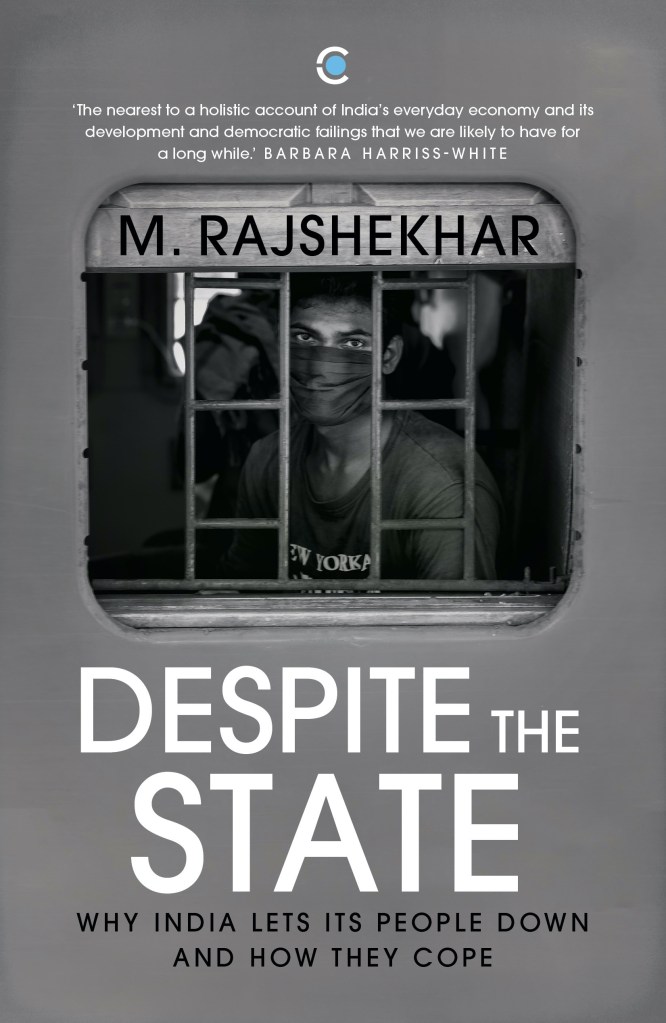
I am an Indian journalist with interests in energy, environment, climate and India’s ongoing slide into right-wing authoritarianism. My book, Despite the State, an examination of pervasive state failure and democratic decay in India, was published by Westland Publications, India, in January 2021. My work has won the Bala Kailasam Memorial Award; the Ramnath Goenka Excellence in Journalism Award; five Shriram Awards for Excellence in Financial Journalism; and, more recently, been a finalist at the True Story Award and GIJN’s Global Shining Light Awards. Write to me at despitethestate@protonmail.com.
Reviews
“…une plongée dans les failles béantes de la démocratie indienne, un compte rendu implacable du dysfonctionnement des Etats fédérés, minés par la corruption, le clientélisme, le culte de la personnalité des élus et le capitalisme de connivence. (…a dive into the gaping holes in Indian democracy, a relentless account of the dysfunction of the federated states, undermined by corruption, clientelism, the cult of the personality of elected officials and crony capitalism).” Le Monde
“…a critical enquiry into why representative government in India is flagging.” Biblio
“…strives for an understanding of the factors that enable governments and political parties to function in a way that is seemingly hostile to the interests of the very public they have been elected to serve, a gross anomaly in an electoral democracy.” Scroll.in
“M. Rajshekhar’s deeply researched book… holds a mirror to Indian democracy, and finds several cracks.” The Hindu
“…excels at connecting the local to the national.” Open
“…refreshingly new writing on the play between India’s dysfunctional democracy and its development challenges…” Seminar
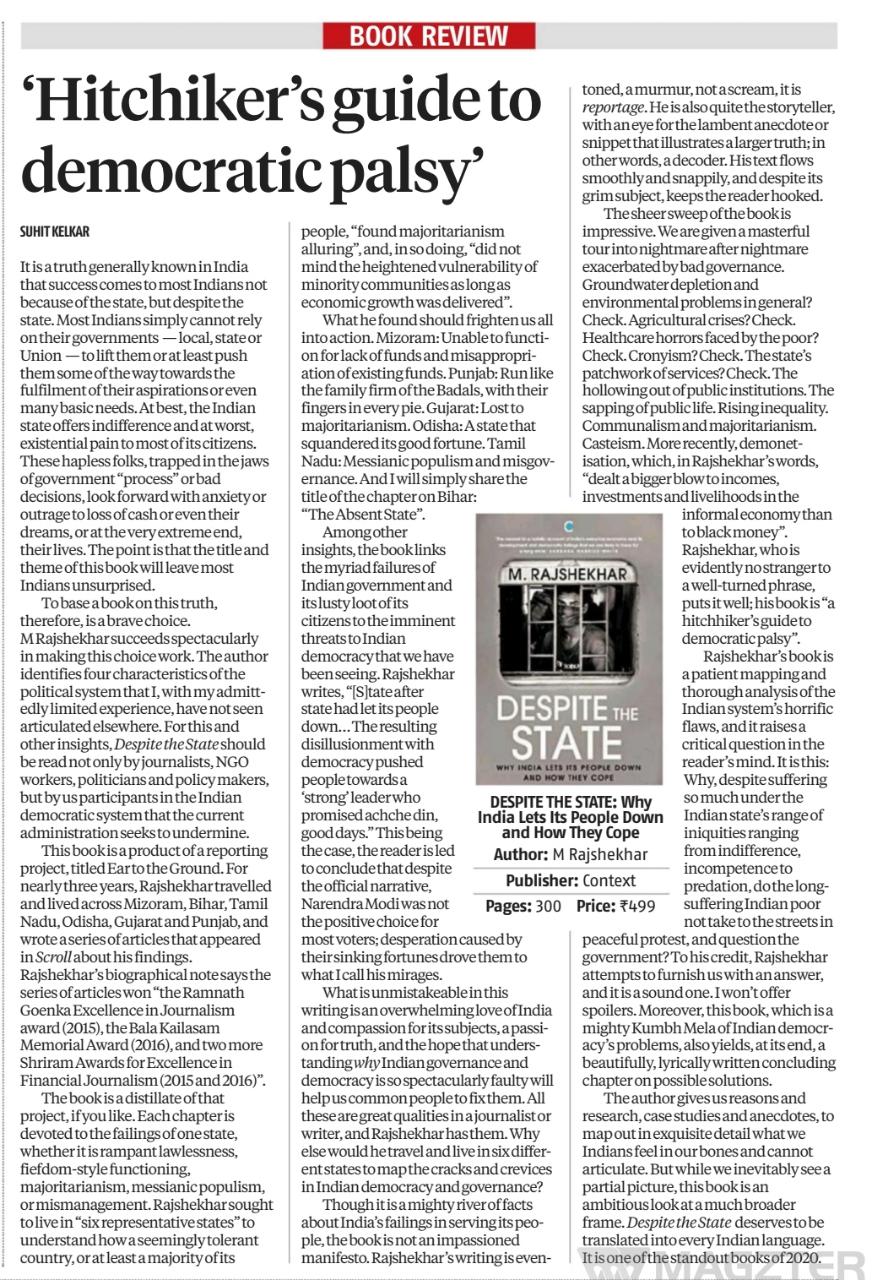
“A patient mapping and thorough analysis of the Indian system’s horrific flaws…” Business Standard (Image here)
“33 മാസം, 6 സംസ്ഥാനങ്ങൾ, 120 റിപ്പോർട്ടുകൾ: ജനാധിപത്യം തേടി മഹത്തായ ഇന്ത്യൻ യാത്ര… (33 months, 6 states, 120 reports: Great Indian journey in search of democracy…)” Malayala Manorama
“Hindustan ki maujooda siyasi wa maaashi soorat e hal.” QindeelOnline
“What emerges is the image of a state that is extractive, dominant, casteist and clientelist.” Tribune
“…reporting at its best. The picture that emerges is of a democracy that has been hijacked by vested interests, interested only in power and pelf.” Moneycontrol.com
Book lists
“Ten best non-fiction books of the year“, The Hindu.
“Twenty-One Notable Books From 2021“, The Wire.
“What has South Asia been reading: 2021 edition“, Himal Southasian
Interviews
“Journalism is a social enterprise…,” Booksfirst.in.
“Democratic decay at state level: Journalist M Rajshekhar on book ‘Despite the State’,” The News Minute.
“Covid-19 en Inde : “des décès de masse” dont un “État obscurantiste est responsable,” Asialyst.
Allusions/Mentions
“JP to BJP: The Unanswered Questions“.
Mahtab Alam’s review of “JP to BJP: Bihar After Lalu and Nitish”.
“Urban History of Atmospheric Modernity in Colonial India“. Mohammad Sajjad’s review of “Dust and Smoke: Air Pollution and Colonial Urbanism, India, c1860-c1940”.
“Westland closure: Titles that are selling fast and a few personal recommendations,” by Chetana Divya Vasudev, Moneycontrol. (Because this happened too. In February, a year after DtS was released, Amazon decided to shutter Westland, which published the book. The announcement saw folks rushing to buy copies of Westland books before stocks run out.)
“Time to change tack on counterinsurgency” by TK Arun, The Federal.
“All Things Policy: The Challenges of Governing States” by Suman Joshi and Sarthak Pradhan, Takshashila Institute (podcast).
“The Future of Entertainment“, Kaveree Bamzai in Open.
“On What India’s Watching“, Prathyush Parasuraman on Substack.
“The puppeteers around us“, Karthik Venkatesh in Deccan Herald.
“Will TN election manifestos continue ‘populist’ welfare schemes?“, Anna Isaac for The News Minute.
“Why wages-for-housework won’t help women“, V Geetha in Indian Express.
“The poor state of the Indian state“, Arun Maira in The Hindu.
Book discussions
14 April, 2024: The costs of political corruption, Bangalore International Centre.
27 May, 2023: Safe Spaces/Why Indians live despite the state. TEDx Bangalore.
12 November, 2022: Stop Loss: Overcoming the systemic failures of the Indian State. Tata Literature Festival, Mumbai.
26 December, 2021: Rangashankara, Bangalore, a discussion with Dhanya Rajendran.
16 November: Rachna Books, Gangtok, a discussion with Pema Wangchuk.
29 August: Books In The Time of Chaos, with Ujwal Kumar.
21 May: Hyderabad Lit Fest with Kaveree Bamzai and Aniruddha Bahal.
28 March: Paalam Books, Salem, Tamil Nadu.
19 March: The News Minute, “Citizens, the State, and the idea of India“
6 March: Pen@Prithvi, with Suhit Kelkar
20 February: A discussion between scholars Usha Ramanathan, Tridip Suhrud, MS Sriram and me to formally launch Despite the State.
6 February: DogEars Bookshop, Margoa.
5 February: The Polis Project, Dispatches with Suchitra Vijayan.
30 January: Founding Fuel, “Systems Thinking, State Capacity and Grassroots Development“.
25 January: Miranda House Literary Society
- March 2026
- January 2026
- December 2025
- November 2025
- October 2025
- September 2025
- August 2025
- May 2025
- April 2025
- March 2025
- February 2025
- January 2025
- December 2024
- November 2024
- October 2024
- August 2024
- June 2024
- May 2024
- March 2024
- February 2024
- January 2024
- November 2023
- August 2023
- July 2023
- March 2023
- February 2023
- January 2023
- October 2022
- September 2022
- July 2022
- June 2022
- May 2022
- April 2022
- March 2022
- February 2022
- December 2021
- November 2021
- October 2021
- August 2021
- July 2021
- June 2021
- May 2021
- April 2021
- March 2021
- January 2021
- October 2020
- September 2020
- August 2020
- July 2020
- June 2020
- May 2019
- March 2019
- February 2019
- January 2019
- December 2018
- November 2018
- October 2018
- July 2018
- June 2018
- April 2018
- January 2018
- December 2017
- November 2017
- October 2017
- September 2017
- July 2017
- June 2017
- May 2017
- April 2017
- January 2017
- December 2016
- November 2016
- October 2016
- September 2016
- August 2016
- July 2016
- June 2016
- May 2016
- April 2016
- March 2016
- January 2016
- December 2015
- November 2015
- October 2015
- September 2015
- August 2015
- July 2015
- June 2015
- May 2015
- April 2015
- March 2015
- January 2015
- December 2014
- November 2014
- October 2014
- September 2014
- August 2014
- July 2014
- June 2014
- May 2014
- April 2014
- March 2014
- February 2014
- January 2014
- December 2013
- November 2013
- October 2013
- September 2013
- August 2013
- July 2013
- June 2013
- May 2013
- April 2013
- March 2013
- February 2013
- January 2013
- December 2012
- November 2012
- October 2012
- September 2012
- August 2012
- July 2012
- June 2012
- May 2012
- April 2012
- March 2012
- February 2012
- January 2012
- December 2011
- November 2011
- October 2011
- September 2011
- August 2011
- July 2011
- June 2011
- May 2011
- April 2011
- March 2011
- February 2011
- January 2011
- December 2010
- November 2010
- October 2010
- September 2010
- August 2010
- July 2010
- June 2010
- May 2010
- April 2010
- March 2010
- February 2010
- January 2010
- December 2009
- November 2009
- September 2008
- February 2008
- December 2007
- November 2007
- May 2007
- April 2007
- March 2007
- February 2007
- January 2007
- September 2006
- August 2006
- July 2006
- June 2006
- May 2006
- March 2006
- January 2006
- September 2005
- March 2005
- January 2005
- September 2003
- December 2002
Aadhaar Agriculture Banking correspondents Bihar BJP Books Cash transfers Climate change Coal Coalscam Common BC Auctions Corruption Demonetisation Ear To The Ground Energy Energy Transition Environmental governance Financial Inclusion Forests Gujarat Healthcare Idiocy India Informal economy Journalism Madhya Pradesh Mandis Microfinance Mining Mizoram MoEF NDA NREGA Odisha Oligarchy Pollution Privacy Punjab Reserve Bank of India Rivers Tamil Nadu Tribals UIDAI UPA Welfare Programmes
 Fractured/Earth