Personal
-
fixing india’s agri crisis. option one. turn to conservation agriculture.
after the stories on dryland agriculture and the crisis in indian agricultural soils, there is this… It’s incontrovertible that Indian agriculture needs an overhaul. Yields are plateauing. Agricultural soils are weakening. Groundwater levels are collapsing. Farmers are leading lives of increasing desperation. The big question is: how do we fix agriculture? Does the answer lie… Continue reading
-
India’s soil crisis
In his fields, Badhia Naval Singh , a farmer tilling 8 bighas of land in the Bagli tehsil in Madhya Pradesh, has been seeing something strange for a while now. Earlier, if he pulled out a tuft of grass, he would see earthworms . “Ab woh dikhna bandh ho gaye hain (they don’t show up… Continue reading
-
on the draft bill that seeks to set microfinance right
With the Finance Ministry completing its draft Microfinance Institutions (Development and Regulation) Bill, another large piece of the puzzle on how to regulate Microfinance Institutions has fallen into place. It has been a tough puzzle to crack. In the beginning of last year, when complaints about women being pushed into debt traps were gathering pace,… Continue reading
-
It’s here. drumroll. the draft microfinance bill.
the draft microfinance bill is up on the finmin website for comments. a look at what it says. Continue reading
-
the importance of hedging despite the alleged incorruptibility of the lokpal
What is the best institutional architecture for fighting corruption? Should India have one, all-powerful anti-corruption watchdog or should it have several smaller ones? What if the Lokpal gets corrupted the way other institutions have? Are we better off with a strong Lokpal? Or are we better off making the CBI more independent of the government,… Continue reading
-
Cash Trance
In his speech this year, the Indian finance minister announced that India would deliver the fertiliser subsidy directly to farmers from next year onwards. Shortly after the budget, the government’s National Informatics Centre insisted that it be allowed to develop the necessary software. A small update from the trenches here. This software, sources in the… Continue reading
-
On the crisis in India’s dryland areas…
The green revolution came in the sixties. Tasked with ensuring food security, it pushed high-yielding varieties (HYVs) of wheat and rice over jowar, bajra et al. It began in the floodplains of the north. Where, as canals came up, farmers, realising rainfall risk was a thing of the past, switched to HYVs. In the drylands,… Continue reading
-
MFI regulation: Part Three
With SKS Microfinance challenging Andhra Pradesh’s controversial microfinance law in the Supreme Court, India might soon have an answer to the question: who should regulate microfinance institutions (MFIs), the Centre or the states? This is a question that needs an immediate answer. As non-banking finance companies (NBFCs), MFIs are regulated by the RBI. Being financial… Continue reading
-
Baba Ramdev sets out to cure corruption
On Thursday, more out of curiosity than anything else, I tagged along with a friend who was heading to Delhi’s Ram Lila Maidan. Baba Ramdev who was, till now, trying to clean the body through yoga, is now out to cleanse the body politic (thanks for the line, rama). And has consequently announced that he… Continue reading
-
From Majority to Minority Shareholders
and a look at what debt restructuring means for mfi promoters. “I have a 45% stake,” says a promoter of a leading MFI. “If we restructure Rs 1,000 crore of debt, my stake will drop to about 1%.” This will be a setback for promoters of MFIs such as Spandana Spoorthy and Share Microfin, which… Continue reading
-
MFIs, The Andhra Crisis and Attempts to Restructure Debt
the mfi story continues to unfold. in this story, my colleague john samuel and i look at why mfis’ attempts to restructure their debt are off to a poor start. Continue reading
-
RBI broadly accepts the Malegam report
In the middle of this week, the RBI broadly accepted the reccos of the malegam committee report. With that, India’s beleaguered MFIs finally have a regulatory framework under which to operate. In this quick and dirty story, I try to understand what the new framework means for the MFIs. Continue reading
-
Cash Transfers + Fertiliser Subsidy + Impatience = ???
And this is the second story in the fertiliser package that the Economic Times published. The ministry of fertilisers is planning to migrate to cash transfers in three phases. In the first phase, to be completed by December, it will extend its fertiliser management software beyond the 30,000 fertiliser warehouses to 230,000 licenced retailers. In… Continue reading
-
Changes In India’s Fertiliser Policy. Circa 2010
Every year, Lakshminarayan Sharma, a sharecropper in a village about 30 kilometres off the ancient town of Vidisha, Madhya Pradesh, rents 10 bighas of land from a bigger farmer and plants soya and wheat. For several years now, he has been seeing a worrying trend. The soil is weakening. Traditional crops, he says, do not… Continue reading
-
On Ruing Missed Chances
Sometime this month, Justice N Ramamohana Rao of the Andhra Pradesh High Court will deliver a verdict that will directly impact earnings of the 114 million people who work under the National Rural Employment Guarantee Scheme (NREGS), the Central government’s work guarantee programme. The verdict will also indirectly impact earnings of the 400 million workers… Continue reading
-
India And Her Myriad Responses to NREGA
the third of three stories for et 50. It will probably take a big, fat book to describe the myriad impacts the National Rural Employment Guarantee Act (NREGA ) has had on India. At one level, it has created a safety net for rural folks during summer months when employment is scarce. It has improved… Continue reading
-
Apres Le Green Revolution
this is the second of three stories i wrote for et’s 50th anniversary. on what should succeed the green revolution. i cannot find the link on the website. till i find that, here is the text. This happened three years ago. At that time, this reporter was doing rural research in Madhya Pradesh. And he… Continue reading
-
Union Carbide. Reflections
this is the first of three opinionated stories i wrote for et’s 50th anniversary. i cannot find the links to these on the website, and so am pasting the raw text itself. Blackened and twisted from the heat of the reaction, tank 610 lies on its side. Twenty-six years ago, on the night of 2nd-3rd… Continue reading
-
Rural Healthcare Delivery
SughaVazhvu is testing a radical idea: can technology replace doctors with nurses, human judgement with software solutions? “It is difficult to expect doctors to stay in villages,” explains Mor. “So, we are asking if a combination of technology and a reasonable amount of training (to local nurses), under the supervision of a doctor, can deliver… Continue reading
-
Arcadia, Utopia…
It’s a polarised debate. Always has been. Those who make a living expanding the possibilities of technology feel it can solve many economic ills, even those of the India that lives on 20 a day under the trembling glow of a lantern. And those who engage with that very India say technology solutions are fine,… Continue reading
-
The High Priest of Indian Microfinance takes a walk
You could say he has found a whole new way to walk the talk. And Vijay Mahajan, considered by many to be the high priest of Indian microfinance, is taking it quite literally—some 5,000 km across rural hinterlands. The chairman of Basix, a microfinance institution (MFI), began a quiet 75-day journey on January 30 from… Continue reading
-
Malegam-med
a day after after the initial optimism, the mfis figure that the old adage of ‘what one hand giveth, the other taketh away’ fits the malegam committee report perfectly. A day after a central bank appointed committee submitted its report, small microfinance institutions (MFIs) say the recommendations if accepted would wipe away their presence in… Continue reading
-
The curious lack of fiction set in rural India
during my tihi days, i felt for the first time that only fiction could do justice to the immense changes that this village was seeing. it is a feeling that has been reinforced over time. for instance, at the contested site where posco’s industrial complex is supposed to come up, only two of the three panchayats whose… Continue reading
-
The Andhra crisis starts to hurt MFIs…
after three months of low repayments, mfis in andhra are staring down the barrel of a gun, says this story by my colleague john samuel raja d and me. Continue reading
-
Making The Indian Government More Accountable
december has been a slow month. i kept falling ill. anyway, here is a small (and guardedly optimistic) story on how to make the indian state more accountable. …a clutch of new laws, like the Right To Information Act (RTI) and the National Rural Employment Guarantee Act (NREGA), are moving the government’s developmental promises beyond… Continue reading
-
Union Carbide Followup. Three
In June this year, responding to the public outcry over the weak judgments handed out by a Bhopal sessions court, the Indian government unveiled a new relief package for the survivors of the Bhopal Gas Tragedy. With the 26th anniversary of the leak around the corner, the Economic Times travelled to Bhopal to take stock of… Continue reading
-
Change in the Air?
This article was written after attending the hearing where Amicus Harish Salve suggested that the Supreme Court direct the Centre to set up one or more statutory authorities to ensure the country’s forest policy is implemented “in letter and spirit”. If Mr Salve’s suggestion is accepted by the bench, it would represent nothing less than the… Continue reading
-
MFIs seek a Rs 1,000 crore helpline
The Microfinance Institutions Network (MFIN), a self-regulatory body of a clutch of 44 NBFC MFIs, has asked for Rs 1,000 crore in the form of business continuity facility, an euphemism for emergency money, to ensure survival. In an email to fellow MFIN members, Vijay Mahajan, the president of the NBFC-MFI association, said the loan has… Continue reading
-
On the AP Microfinance crisis
a few months ago, papers and tv channels in andhra pradesh began reporting that women who had taken loans from microfinance companies were killing themselves. after 2005-06, when there had been similar reports of suicides amongst MFI borrowers back in 2005-06 (see this), this was the second such outbreak. the whole thing was surprising. while media… Continue reading
-
Another riff on why…
…why development programmes rarely work. also see this. Continue reading
-
NAC finalises its Food Security Bill
The National Advisory Council, headed by Sonia Gandhi, has worked out a compromise formula for the food security act on Saturday. Keeping in mind the budgetary and the foodgrain constraints of the government the council has proposed “near universal with differential entitlements” food security programme. Under the compromised formula, 90% of the rural households and… Continue reading
-
On Shashi Rajagopalan
one of the most remarkable people i have met this year is shashi rajagopalan. a member of the Nabard and RBI boards, she has worked with credit cooperatives and farmers’ agri-processing units through much of her life. in this chat, she talks about why cooperatives are needed, and how to revive them. (this follows the interview with the… Continue reading
-
SIDBI hauled up by RBI et al
In the past two months, RBI has informally directed Sidbi to not invest in any non-banking finance companies without its approval… Sidbi has also been told by the finance ministry to ensure that Indias MFIs do not levy onerous interest rates. Further,it has been told to commission a study on interest rates and to start… Continue reading
-
Inside the mysterious world of the microfinance agents
this is the draft of a story on microfinance agents that never got published. i could not conclusively prove the existence of these microfinance agents. but it is an interesting read nonetheless, on how the informal economy subverts the formal sector’s best laid plans. take a look. In xx, while auditing the books of an… Continue reading
-
SKS/Gurumani
An investigative ET report on why Suresh Gurumani had to go. (see this article for context) Continue reading
-
And out went Gurumani
on the fourth of october, sks microfinance surprised all and sundry by announcing it had fired CEO Suresh Gurumani. Continue reading
-
More Trouble for Lafarge
Lafarge’s plan to set up a Rs 900-crore cement plant in Himachal has run into environmental trouble with the National Environmental Appellate Authority quashing the clearance granted to the project by environment ministry in June 2009. More here. The curious thing is this. The NEAA order quashing the clearance said Lafarge erroneously represented the mining area as… Continue reading
-
My first book review in Seminar!!!! Yay!!!!
the september issue of seminar (issue #613, titled ‘nature without borders’) has this book review by me. **** INDIA’S NOTIFIED ECOLOGICALLY SENSITIVE AREAS (ESAs): The Story So Far by Meenakshi Kapoor, Kanchi Kohli and Manju Menon. Kalpavriksh and WWF-India, Delhi, 2009. THE draft National Environmental Tribunal Bill prepared in 2008 sought to dissolve all authorities set up… Continue reading
-
Farmer Indebtedness in India
Despite the doubling of agricultural credit in recent years and several efforts from the government towards financial inclusion, the number of farmers borrowing from moneylenders has risen to levels not seen since independence, says a task force headed by Nabard chairman U C Sarangi. Continue reading
-
MFIs and the Priority Sector
A Reserve Bank of India committee headed by executive director VK Sharma, in its draft report, has recommended that the priority sector status, which is accorded now to banks’ exposure to Non-Banking Finance Companies, or NBFCs, should be withdrawn. More, here. Continue reading
-
A thought exercise on what near universal food security has meant for Chhattisgarh…
The proposed National Food Security Bill could change rural India even more profoundly than the National Rural Employment Guarentee Act has. The Bill is expected to push India’s grain procurement up from the current 45 million tons to 80 million tons. It will also, depending on the approach the National Advisory Council recommends, provide 35… Continue reading
-
NC Saxena committee says “No!”
It’s very easy to mine in this country once you take the consent of the local communities. They are rational people. If the project is beneficial for them, they will agree. But, look at the development tribals get from these projects. Local communities get less than 5% of the jobs created by these projects. In… Continue reading
-
The puzzling case of Unitus’ nonprofit ops
Roughly a month before the SKS Microfinance IPO , the Seattle-based charity Unitus, a large investor in the firm, unexpectedly announced it was shuttering its non-profit operations in micro-credit and laying off more than 40 employees. The decision sparked a controversy because Unitus stood to make $70-80 million from the sale of its shares in… Continue reading
-
Regulating the MFIs. Part deux.
more brainstorming on how to regulate chez mfis. Continue reading
-
The Thanjavur Pilots
for two years now, a quiet experiment on how to deliver financial services to india’s rural masses has been underway in and around the ancient temple town of thanjavur, tamil nadu. travel through the villages of pattukottai, thanjavur and kumbakonam and you will see branches — 57 of them — of a local “bank” called… Continue reading
-
financial inclusion puzzles
Three decades after Independence, most poor Indians still lack institutionalised access to insurance, savings, remittances and loans. The outcomes are predictable. Migrant labour, carrying hard cash when they head back home, run the risk of being robbed. The poor rely excessively on loans to cope with a crisis — accidents, unpredictable weather, sick cattle —… Continue reading
-
Food Security Bill in for a radical rewrite?
THE National Advisory Council (NAC), it appears, is set to radically rewrite the the Food Security Bill. The meeting of the NAC, which discussed the draft bill prepared by the government, was of the view that the Centre should move beyond the traditional APL-BPL faultline and aim for an inclusive Bill… The members also agreed… Continue reading
-
India, China and the (bedraggled) state of their environments.
Whenever China’s environment is discussed, the narrative that crops up is that its authoritarian government has steamrolled environmental concerns while chasing growth. And so, fittingly, when Jianguo Liu and Jared Diamond rate 15 of the world’s most populous countries on environmental sustainability, China is the second worst with a score of 129 (on a 142 point scale).… Continue reading
-
The New Committee to Study Vedanta
THE Anil Agarwal promoted Vedanta Aluminas plans for sourcing bauxite from the Niyamgiri hills in the Kalahandi district of Orissa will have to wait.The environment ministry has set up a four-member committee headed by National Advisory Council member NC Saxena.The other three members of the committee are Dr S Parasuraman,director,Tata Institute of Social Sciences;retired IFS… Continue reading
-
The story taketh a turn…
The Prime Minister’s Office (PMO) has written to the environment ministry to give clearance to the (Vedanta) project after “a thorough scrutiny by the expert appraisal committee and due consideration of all aspects”, a top government official said. the story indeed takes a turn. Continue reading
-
Union Carbide Followup. Two
and what the GoM recommended. Continue reading
-
Union Carbide followup. One.
after the outcry, a meeting by the GoM (group of ministers). Continue reading
-
A tragedy that looks like it will never end
eleven days earlier, a Bhopal sessions court had handed down measly sentences to seven people accused in the bhopal gas leak. in the resulting cries for revenge and demands for the extradition of warren andersen, a big point was ignored. the tragedy at bhopal did not just occur 25 years ago, it continues to unfold. Widespread… Continue reading
-
MFIs, their regulation and other intractable puzzles
on why complexity is bedevilling the indian government’s plans to regulate microfinance. Continue reading
-
The incredible Mitanins of Chhattisgarh
On the 23rd of January, Savitri Sahu was woken up by the family of a woman who had gone into labour. We borrowed a tractor, she says, took her to the primary health centre, woke up the doctor and the nurses, got the delivery done. Given that most rural clinics we hear about lack doctors, nurses,… Continue reading
-
The problem of U without Q
India has seen a rise in social sector spending since 2004. The outcomes, however, have been underwhelming. The best-known illustration of this phenomenon is the National Rural Employment Guarantee Act (NREGA) where the quality of assets and the number of jobdays created are far below expectations. It is the same story across programmes in health,… Continue reading
-
NEPA (Contd)
another update on how the proposed National Environmental Protection Authority is coming along. for background, see this. Continue reading
-
The Rule of Law as an Optional Extra
And then, there is Lafarge. The issue is whether Lafarge Umiam Mining should have sought a forest clearance while seeking environmental clearance in 2000 to mine limestone in the East Khasi Hills to feed a Lafarge cement plant in Bangladesh. Critics, like the SC’s Central Empowered Committee, say the company submitted a misleading Environmental Impact Assessment… Continue reading
-
sense and nonsense in the debate over vedanta’s lanjigarh plans
for the longest time, vedanta’s bauxite mining plans in lanjigarh, orissa, have been a lightening rod for criticism. earlier this year, the environment ministry abruptly turned against it. one reason cited for this switch was the congress’ need to hold onto the tribal vote. but things had been simmering at the ground as well. and so, in… Continue reading
-
Le Puzzling Transaction
sks microfinance bosses sell shares in the company before its IPO. Continue reading
-
Vedanta, Niyamgiri and the Congress
Plans by Vedanta Resources to mine bauxite in Niyamgiri in Orissa, already delayed by vehement protests from non-governmental organisations, seem likely to suffer further damage—quite possibly terminal—as the Congress reaches out to India’s tribal population, sections of which have come under the influence of the grand old party’s arch rival BJP while others have fallen… Continue reading
-
Vedanta, Dongria Kondhs and the fight over natural resources.
The plan by the London-based Vedanta Resources to mine bauxite in Orissa a key part of a giant aluminium complex which the company is building in the mineral-rich eastern state could be jeopardised if the Environment Ministry accepts the findings of a report by a government appointed committee. The complete story, here. Continue reading
-
Microfinance Messiahs?
On the ground… the MFIs’ growth is creating an unnerving situation. Even among those in the industry, there are fears of a mass-delinquency. In fact, Andhra is the most penetrated market in the world, on par with Bangladesh, says Daniel Rozas, a contributor at industry blog Microfinacefocus.com. “The state was already at 6% overcapacity a… Continue reading
-
Or what the development mafia could learn from hackers
why do most development programmes result in unforeseen outcomes? because… Interventions in rural India — by companies and government — are surrounded by tens of thousands (if not lakhs and millions) of people looking for ways to improve their lot in life. As they try to use these interventions in a manner that will maximise… Continue reading
-
Through the scanner darkly
India’s booming microfinance segment is under the scanner, with the Reserve Bank of India (RBI) issuing a veiled warning that it could be taken off the priority sector lending list of banks if the industry fails to improve its governance standards… The RBI officials reportedly told MFI executives that the central bank was aware of the… Continue reading
-
Santosh Hegde, Karnataka and the Illegal Mining Machinery
In 2007, the Karnataka Lokayukta, established to investigate grievances with administrative actions, was asked by the state government to study rampant illegal mining in the state. Though this report, finalised as early as December, 2008, has been doing surreptitious rounds in government, legal and mining circles, it is yet to be made public. This document, a… Continue reading
-
Enter, NEPA
The environment ministry will, in the coming monsoon session, place a Bill for creating the National Environment Protection Authority (Nepa), an authority modelled on the lines of the US Environmental Protection Agency. What is less clear is whether this body will be a powerful watchdog, or a toothless old hound. environmental governance in India has… Continue reading
-
tihi
(am writing this post in 2014 but retrospectively dating it back to dec 28, 2009. this, as things stand, is the very first set of stories i wrote for the economic times — they appeared three days before i joined the paper. the paper was bringing out an year end issue, and i wrote about… Continue reading
-
A puzzling assertion on climate change
In November 2009, the ministry of environment and forests released a discussion paper that argues there is no sign of any abnormal retreat among Indian glaciers. And says instead that it is “premature to make a statement that glaciers in the Himalayas are retreating abnormally because of … global warming”. This was a baffling statement.… Continue reading
-
More observations from Tihi et al
a small update from me. when the previous post was written, i was in the middle of the itc project — living in two villages, studying the impact this agribusiness was having on village india. that project is over now. i am back in starvation gully looking for a job. needless to say, the village… Continue reading
-
a development chronology of tihi
since the 12th of january, i have been living in tihi, a village of 300-odd households in the central indian state of madhya pradesh (more specifically, in malwa). six years ago, itc-ibd, an indian agribusiness, set up an ict kiosk in the house of one of the larger farmers in this village, began using that… Continue reading
-
a problem with multilateral environmental agreements
i read a very interesting paper this morning on the weaknesses of multilateral environmental agreements like CITES, the montreal protocol (think ozone) and the convention on biological diversity. as david humphreys, the author of forest politics and logjam, points out in a paper called public goods, neoliberalism and the crisis of deforestation (pdf), multilateral agreements view the… Continue reading
-
A process of confrontation: An enquiry into the processes of environmental policy-making in India.
i cannot but marvel at the 45 days gone by. i submitted my dissertation. with that, my year long stint at sussex ended. between wrenching goodbyes to my friends there, i spent a week rambling around london trying to sate the hick tourist in me. i saw, among other things, darwin’s grave, the terracotta army… Continue reading
-
Chickenwire and Chewing Gum
Over the past few weeks, Barun Mitra, a director of the Liberty Institute, has been endorsing a possible move by China to lift its ban on trade in tiger parts. It is, he argues, the only way to save wild tigers — tiger farms in China have no less than 5,000 tigers in captivity; given… Continue reading
-
RIP. David Halberstam
learnt this morning that david halberstam, pulitzer-winning journalist, author of books like ‘the best and the brightest’, ‘war in a time of peace’, ‘the reckoning’, ‘the powers that be’, and ‘the fifties’, a man whose reporting on the war in vietnam vexed john f kennedy so much that he tried to get halberstam’s publisher, arthur… Continue reading
-
Aberration or Synecdoche: Reflections on suicides amongst microfinance borrowers in Andhra Pradesh. Circa 2006.
right. continuing with my highly successful strategy of driving readers away by never posting anything less than 5,000 words long, here is the term paper i just submitted on the microfinance suicides that india saw in march last year. as ever, comments welcome. “One Rennu Chandramma of Chenchu colony on the Chandraiah drain bund in… Continue reading
-
street sexual harassment
i have tracked blank noise for about a year now. what jasmeen, hemangini, annie and chinmayee are doing, follows in the finest tradition of art — using it to hold up a mirror to society, forcing us to examine ourselves. and so, this blog would like to be counted as one supporting the blank noise 2007 blogathon.… Continue reading
-
On Alfred Russell Wallace
When he was twenty-four years old, Alfred Russel Wallace, the greatest field biologist of the nineteenth century, had his head examined by a phrenologist who determined that, while his “organ of wonder” was very big, his “organ of veneration,” representing respect for authority, was noticeably small. Wallace was so struck with the accuracy of this… Continue reading
-
Resilience Thinking
it is a litany of familiar glooms. the earth is in a mess. once productive agricultural lands are dogged by unforeseen problems — salinisation, erosion, desertification, pollution. lake systems and rivers everywhere are experiencing algal blooms and a host of other problems associated with nutrient oversupply. productive rangelands are turning into unproductive expanses of woody… Continue reading
-
can companies reduce poverty
the aneel karnani and ck prahalad flare-up (which atanu has covered here and here) has piqued my interest in an old question. how can companies reduce poverty? according to karnani, ck prahalad’s fellow professor at the university of michigan, the BOP proposition that selling to the poor can simultaneously be profitable and help eradicate poverty is “at best a harmless… Continue reading
-
a history of indian environmentalism
yesterday’s hindustan times printed my review of ram guha’s newest book, “how much should a person consume?” here, with massive tweaks and additions, is it again. …After chronicling the Chipko movement, the life of Verrier Elwin and the history of environmentalism, Guha is now chasing a larger, grander question. In his promisingly titled How much should a person… Continue reading
-
a snake called boiga irregularis
the latest issue of businessworld features my book review of out of eden. am posting the original draft here. take a look. i hope it makes you want to go and read this somewhat philosophical book on conservation biology. Have you heard of a gifted survivor called the Brown Tree Snake? Boiga Irregularis, as it is known, reached Guam about… Continue reading
-
and now for something completely different
i have been selected by the university of sussex for a one year ma in environment, development and policy. am off this fall. Continue reading
-
arcadia and utopia
“Three years after the end of World War II, the poet W.H. Auden wrote an essay called ‘Arcadia and Utopia” in which he proposed the two places as categories of belief. Arcadians believe that paradise was in the past; propose that we return to a simpler state, a lost state of grace, and distrust government,… Continue reading
-
A Disagreement In Andhra
Between November and December 2005, I worked as a consultant on a World Bank project to create market linkages for self help groups in Andhra Pradesh through the private sector. What follows is a story I wrote about that experience. **** eleven in the morning. the tired, dessicated landscape of telengana, its aged, withered hills,… Continue reading
-
the evolution of china’s environmental policy
The latest issue of Conservation and Society is out. And it contains an interesting account of the evolution of China’s environment policy by the Peking University’s Maohong Bao. For instance, did you know that… “Since China’s leadership purported to employ the mechanism of unified planning with due consideration for all aspects of the economy and the society, which was… Continue reading
-
Saving India’s Ridleys
The subtext here is interesting. Conservation in India, built around exclusionary principles that try to protect biodiversity by blocking people’s access to natural resources, is seen as anti-poor. When environment NGOs insist that the state patrol more, or that the fishermen install turtle excluder devices (essentially, a trapdoor at the end of the net that… Continue reading
-
A backpacking trip to Orissa
(this post was initially written for http://www.theotherindia.org. that site has since been shuttered. and i thought i would repost this article here. the year spent freelancing was the start of my introduction to india. and this was one of the more seminal trips. backpacking across the mining districts of orissa taking a first-hand look at… Continue reading
-
Naivete, Idealism and SOP Stories
(as with other older — anything over three years old — posts on this blog, the statement of purpose i wrote while applying for higher studies too is being uploaded post facto) In Robert Fisk’s The Great War For Civilisation, Amira Hass, an Israeli journalist who has voluntarily embedded herself in the occupied territories to… Continue reading
-
Sponge Bath Nation
The Indian state of Maharashtra has taken a step towards using water more sustainably. Will the rest of India follow? Unlikely. If you ever need to understand the water crisis that looms over Maharashtra, Jayakwadi dam in Marathwada, built on the Godavari river near a town called Paithan, is a great place to start. Its… Continue reading
-
and now for something completely different
note: like several other posts on this site, this one is also being uploaded post facto. briefly, in august 2005, i quit businessworld and business journalism and made a long-desired switch to writing on environment, development and suchlike. to celebrate this move, i took my bike, bucephalus, to ladakh. as it turned out, we set… Continue reading
-
Fixing India’s Mandis
note: this is the first article i wrote on agriculture. years later, after the village stay at tihi, i read this story again and found it embarrassingly technocratic in its outlook. anyway, do take a look. **** Jawaharlal Nehru had once described agriculture as “India’s greatest living industry”. Yet, 60 years after Independence, the country is… Continue reading
-
Om Economics
note: over the past ten or so years, india has seen religious tv channels mushroom. this article, written in 2003 during the businessworld years, took a walk through the business underpinnings of india’s religious television. **** Sadar Bazaar. One of the older markets in Delhi. Look around and you see buildings worn and tired with age. On the streets below,… Continue reading
-
forest trump
this is the first story i wrote on environment. i was in businessworld where, for the yearend issue, we were left loose to write on anything that took our fancy. and i had reported on ecodevelopment — a world bank assisted programme to create alternative livelihoods for villagers living in the periphery of forests, in… Continue reading
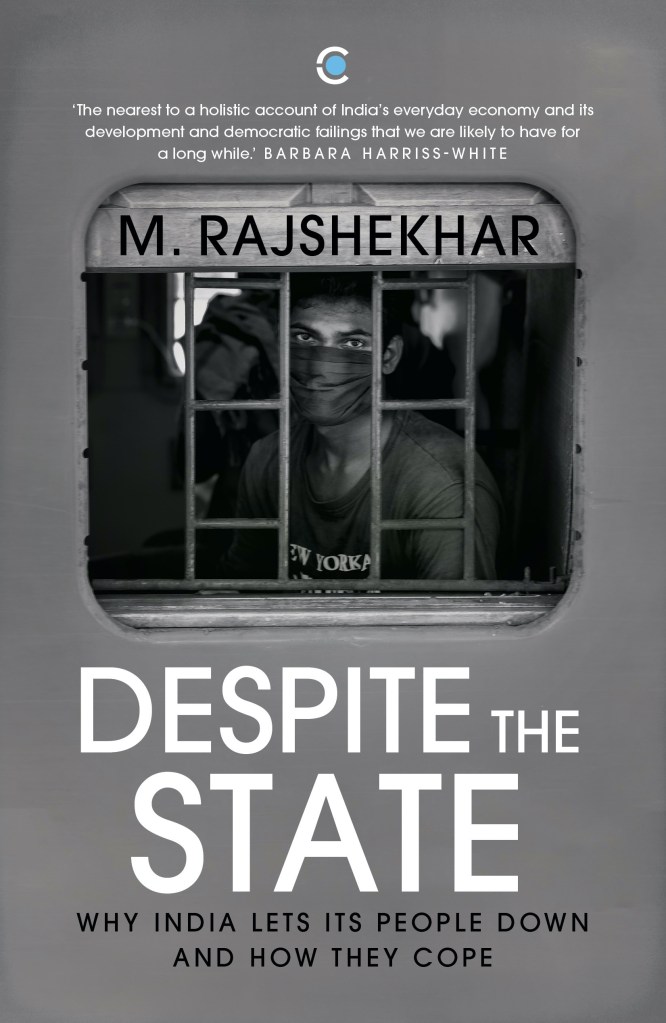
I am an Indian journalist with interests in energy, environment, climate and India’s ongoing slide into right-wing authoritarianism. My book, Despite the State, an examination of pervasive state failure and democratic decay in India, was published by Westland Publications, India, in January 2021. My work has won the Bala Kailasam Memorial Award; the Ramnath Goenka Excellence in Journalism Award; five Shriram Awards for Excellence in Financial Journalism; and, more recently, been a finalist at the True Story Award and GIJN’s Global Shining Light Awards. Write to me at despitethestate@protonmail.com.
Reviews
“…une plongée dans les failles béantes de la démocratie indienne, un compte rendu implacable du dysfonctionnement des Etats fédérés, minés par la corruption, le clientélisme, le culte de la personnalité des élus et le capitalisme de connivence. (…a dive into the gaping holes in Indian democracy, a relentless account of the dysfunction of the federated states, undermined by corruption, clientelism, the cult of the personality of elected officials and crony capitalism).” Le Monde
“…a critical enquiry into why representative government in India is flagging.” Biblio
“…strives for an understanding of the factors that enable governments and political parties to function in a way that is seemingly hostile to the interests of the very public they have been elected to serve, a gross anomaly in an electoral democracy.” Scroll.in
“M. Rajshekhar’s deeply researched book… holds a mirror to Indian democracy, and finds several cracks.” The Hindu
“…excels at connecting the local to the national.” Open
“…refreshingly new writing on the play between India’s dysfunctional democracy and its development challenges…” Seminar
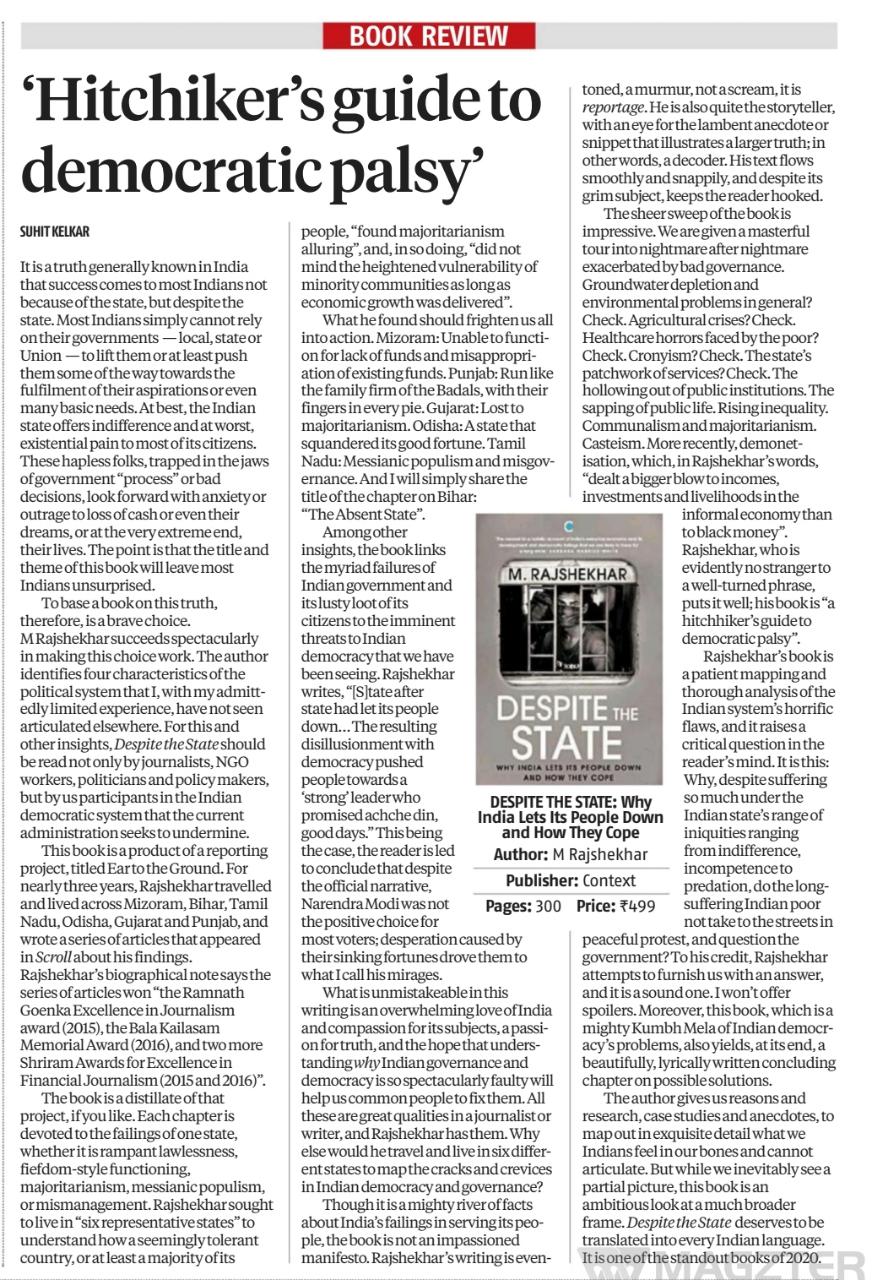
“A patient mapping and thorough analysis of the Indian system’s horrific flaws…” Business Standard (Image here)
“33 മാസം, 6 സംസ്ഥാനങ്ങൾ, 120 റിപ്പോർട്ടുകൾ: ജനാധിപത്യം തേടി മഹത്തായ ഇന്ത്യൻ യാത്ര… (33 months, 6 states, 120 reports: Great Indian journey in search of democracy…)” Malayala Manorama
“Hindustan ki maujooda siyasi wa maaashi soorat e hal.” QindeelOnline
“What emerges is the image of a state that is extractive, dominant, casteist and clientelist.” Tribune
“…reporting at its best. The picture that emerges is of a democracy that has been hijacked by vested interests, interested only in power and pelf.” Moneycontrol.com
Book lists
“Ten best non-fiction books of the year“, The Hindu.
“Twenty-One Notable Books From 2021“, The Wire.
“What has South Asia been reading: 2021 edition“, Himal Southasian
Interviews
“Journalism is a social enterprise…,” Booksfirst.in.
“Democratic decay at state level: Journalist M Rajshekhar on book ‘Despite the State’,” The News Minute.
“Covid-19 en Inde : “des décès de masse” dont un “État obscurantiste est responsable,” Asialyst.
Allusions/Mentions
“JP to BJP: The Unanswered Questions“.
Mahtab Alam’s review of “JP to BJP: Bihar After Lalu and Nitish”.
“Urban History of Atmospheric Modernity in Colonial India“. Mohammad Sajjad’s review of “Dust and Smoke: Air Pollution and Colonial Urbanism, India, c1860-c1940”.
“Westland closure: Titles that are selling fast and a few personal recommendations,” by Chetana Divya Vasudev, Moneycontrol. (Because this happened too. In February, a year after DtS was released, Amazon decided to shutter Westland, which published the book. The announcement saw folks rushing to buy copies of Westland books before stocks run out.)
“Time to change tack on counterinsurgency” by TK Arun, The Federal.
“All Things Policy: The Challenges of Governing States” by Suman Joshi and Sarthak Pradhan, Takshashila Institute (podcast).
“The Future of Entertainment“, Kaveree Bamzai in Open.
“On What India’s Watching“, Prathyush Parasuraman on Substack.
“The puppeteers around us“, Karthik Venkatesh in Deccan Herald.
“Will TN election manifestos continue ‘populist’ welfare schemes?“, Anna Isaac for The News Minute.
“Why wages-for-housework won’t help women“, V Geetha in Indian Express.
“The poor state of the Indian state“, Arun Maira in The Hindu.
Book discussions
14 April, 2024: The costs of political corruption, Bangalore International Centre.
27 May, 2023: Safe Spaces/Why Indians live despite the state. TEDx Bangalore.
12 November, 2022: Stop Loss: Overcoming the systemic failures of the Indian State. Tata Literature Festival, Mumbai.
26 December, 2021: Rangashankara, Bangalore, a discussion with Dhanya Rajendran.
16 November: Rachna Books, Gangtok, a discussion with Pema Wangchuk.
29 August: Books In The Time of Chaos, with Ujwal Kumar.
21 May: Hyderabad Lit Fest with Kaveree Bamzai and Aniruddha Bahal.
28 March: Paalam Books, Salem, Tamil Nadu.
19 March: The News Minute, “Citizens, the State, and the idea of India“
6 March: Pen@Prithvi, with Suhit Kelkar
20 February: A discussion between scholars Usha Ramanathan, Tridip Suhrud, MS Sriram and me to formally launch Despite the State.
6 February: DogEars Bookshop, Margoa.
5 February: The Polis Project, Dispatches with Suchitra Vijayan.
30 January: Founding Fuel, “Systems Thinking, State Capacity and Grassroots Development“.
25 January: Miranda House Literary Society
- March 2026
- January 2026
- December 2025
- November 2025
- October 2025
- September 2025
- August 2025
- May 2025
- April 2025
- March 2025
- February 2025
- January 2025
- December 2024
- November 2024
- October 2024
- August 2024
- June 2024
- May 2024
- March 2024
- February 2024
- January 2024
- November 2023
- August 2023
- July 2023
- March 2023
- February 2023
- January 2023
- October 2022
- September 2022
- July 2022
- June 2022
- May 2022
- April 2022
- March 2022
- February 2022
- December 2021
- November 2021
- October 2021
- August 2021
- July 2021
- June 2021
- May 2021
- April 2021
- March 2021
- January 2021
- October 2020
- September 2020
- August 2020
- July 2020
- June 2020
- May 2019
- March 2019
- February 2019
- January 2019
- December 2018
- November 2018
- October 2018
- July 2018
- June 2018
- April 2018
- January 2018
- December 2017
- November 2017
- October 2017
- September 2017
- July 2017
- June 2017
- May 2017
- April 2017
- January 2017
- December 2016
- November 2016
- October 2016
- September 2016
- August 2016
- July 2016
- June 2016
- May 2016
- April 2016
- March 2016
- January 2016
- December 2015
- November 2015
- October 2015
- September 2015
- August 2015
- July 2015
- June 2015
- May 2015
- April 2015
- March 2015
- January 2015
- December 2014
- November 2014
- October 2014
- September 2014
- August 2014
- July 2014
- June 2014
- May 2014
- April 2014
- March 2014
- February 2014
- January 2014
- December 2013
- November 2013
- October 2013
- September 2013
- August 2013
- July 2013
- June 2013
- May 2013
- April 2013
- March 2013
- February 2013
- January 2013
- December 2012
- November 2012
- October 2012
- September 2012
- August 2012
- July 2012
- June 2012
- May 2012
- April 2012
- March 2012
- February 2012
- January 2012
- December 2011
- November 2011
- October 2011
- September 2011
- August 2011
- July 2011
- June 2011
- May 2011
- April 2011
- March 2011
- February 2011
- January 2011
- December 2010
- November 2010
- October 2010
- September 2010
- August 2010
- July 2010
- June 2010
- May 2010
- April 2010
- March 2010
- February 2010
- January 2010
- December 2009
- November 2009
- September 2008
- February 2008
- December 2007
- November 2007
- May 2007
- April 2007
- March 2007
- February 2007
- January 2007
- September 2006
- August 2006
- July 2006
- June 2006
- May 2006
- March 2006
- January 2006
- September 2005
- March 2005
- January 2005
- September 2003
- December 2002
Aadhaar Agriculture Banking correspondents Bihar BJP Books Cash transfers Climate change Coal Coalscam Common BC Auctions Corruption Demonetisation Ear To The Ground Energy Energy Transition Environmental governance Financial Inclusion Forests Gujarat Healthcare Idiocy India Informal economy Journalism Madhya Pradesh Mandis Microfinance Mining Mizoram MoEF NDA NREGA Odisha Oligarchy Pollution Privacy Punjab Reserve Bank of India Rivers Tamil Nadu Tribals UIDAI UPA Welfare Programmes
 Fractured/Earth