Privacy
-
What happens to privacy when companies have your Aadhaar number?
Out today, the second part of my story on companies, aadhaar and privacy. As the previous story in this series reported, some companies are using Aadhaar to share customer and business partner information. This could aid the rise of data-broking companies like Acziom in the United States that hold ever more detailed profiles of people.… Continue reading
-
How private companies are using Aadhaar to try to deliver better services (but there’s a catch)
Aadhaar, as India’s Unique Identity Project is called, aims to give a 12-digit unique identity number to all residents by collecting their fingerprint and iris scans. As of September, its database, maintained by the Unique Identity Authority of India, held the names, addresses and biometric information of more than 105 crore people. The project was… Continue reading
-
why we need to talk about the companies building authentication apps off the aadhaar database
Monika Chowdhry, who heads the marketing division of Swabhimaan Distribution Services, the company that created TrustID, defended the app, saying it offers the valuable service of verifying people’s identities. “In our day to day life, we do a lot of transactions with people – like maids or plumbers. Till now, you would have to trust… Continue reading
-
By limiting Aadhaar, Supreme Court may have given government a way to expand its reach
By now the contours of the events are known. On Tuesday morning, the Supreme Court referred to a Constitution Bench the question of whether Indians have a fundamental right to privacy. The same afternoon, when the judges reconvened, they restricted the use of the government’s biometrics-based identity project Aadhaar to only the public distribution system… Continue reading
-
should aadhaar be junked?
The last 60 days have not been good to India’s much-feted Aadhaar project. On the 30th of January, the UPA pressed the pause button on direct benefits transfer for cooking gas. On 26 February, the Mumbai High Court directed Aadhaar to share its biometrics database with the CBI. A year earlier, a seven year old… Continue reading
-
the follies of rushing in…
yesterday was profoundly anomalous. i filed two stories. both, as it were, on aadhaar. one on a sting by cobrapost which flagged faulty enrolments. and the other where the supreme court said aadhaar cannot share its database with anyone without consent from the number holders. this is a significant development. over the last five years,… Continue reading
-
old enrolment concerns resurface re aadhaar
Investigative journalism portal Cobrapost has aired videos of sting operations that allegedly show the Unique Identification Authority of India (UIDAI) conducting a flawed enrolment process that allows people from even neighbouring countries to get an Aadhaar number after paying bribes. it is hard to escape a sense of deja vu. these complaints — about poor… Continue reading
-
on nandan nilekani’s stint with the upa…
out today, this quick and dirty story on nandan nilekani’s stint in upa2. it was a part of a larger package profiling some of the technocrats leaving office along with the upa — c rangarajan, montek singh ahluwalia, the member of the national advisory council, and nilekani. Continue reading
-
the promises and perils of using databases for welfare delivery
Imagine a database that contains the following data about your family. Household level information like address, caste, asset ownership, the kind of house you live in, when you came to the city/village where you now stay, ration card number, etc. And individual level information about including names, ages, educational background, occupation, incomes, bank accounts, existing… Continue reading
-
india’s developing biometrics mess
today’s ET carries a story that i had written a while ago. essentially, a rising number of government agencies and private companies are moving around collecting fingerprints and iris scans. you always had the UIDAI and NPR. now, you also have different states’ PDS departments, NREGS, banks and their banking correspondent companies, post offices, pension… Continue reading
-
biometrics, banks and this seemingly ignored question of data security
In the beginning, only the National Population Register – and, a little later, Nandan Nilekani’s Unique Identification Authority of India – were supposed to capture and store biometrics. However, over the past few months, India has come to a point where myriad central ministeries, state departments and others are camping in the country’s villages and… Continue reading
-
On the draft privacy bill…
There is some good news for those who are worried about the impact of UID on privacy. A senior bureaucrat in the department of personnel and training told ET that the draft bill on privacy, currently being drafted by the DoPT, makes it clear that no institution can share a person’s data with a third… Continue reading
-
Civil Liberties in an Age of Biometrics
Biometrics are the latest craze in Delhi’s crumbling corridors of power. The census department is capturing them. So is the Unique Identification Authority of India (UIDAI). As are a myriad others – banking correspondents, state governments, government programmes like the Rashtriya Swasthya Bima Yojana, the ministry of rural development for NREGA workers, the home ministry… Continue reading
-
UIDAI runs into flak
as a followup to last week’s story about india’s spectacularly uncoordinated lurch towards cash transfers, my colleague vikas (dhoot) and i wrote this story about why nandan nilekani’s much-feted uidai is running into fresh opposition. opposition, interestingly, coming from an unexpected quarter — other government departments. the complete story, here. Continue reading
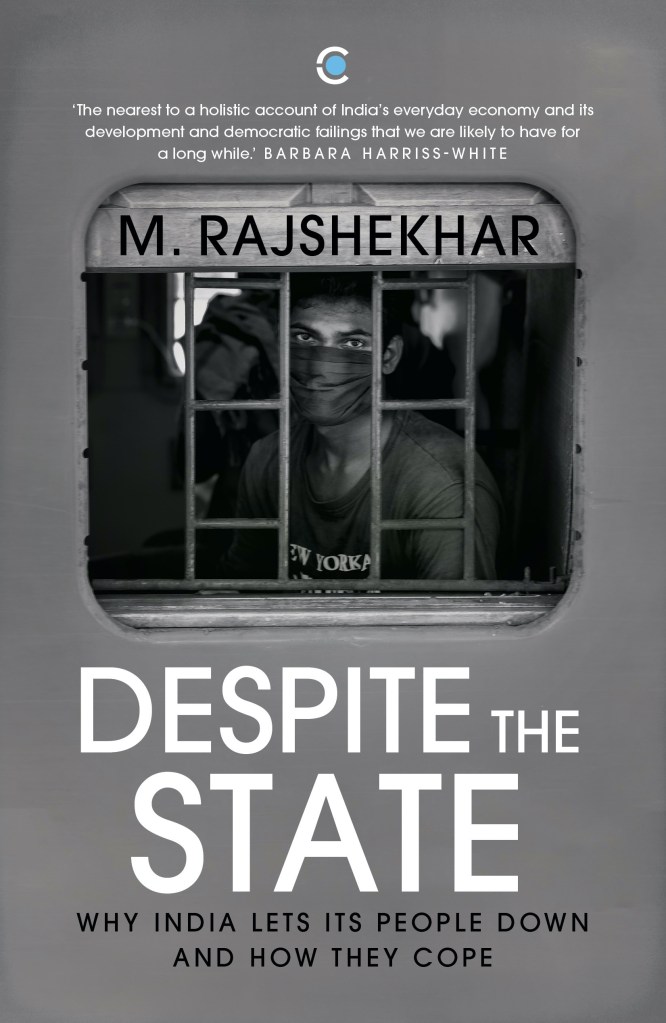
I am an Indian journalist with interests in energy, environment, climate and India’s ongoing slide into right-wing authoritarianism. My book, Despite the State, an examination of pervasive state failure and democratic decay in India, was published by Westland Publications, India, in January 2021. My work has won the Bala Kailasam Memorial Award; the Ramnath Goenka Excellence in Journalism Award; five Shriram Awards for Excellence in Financial Journalism; and, more recently, been a finalist at the True Story Award and GIJN’s Global Shining Light Awards. Write to me at despitethestate@protonmail.com.
Reviews
“…une plongée dans les failles béantes de la démocratie indienne, un compte rendu implacable du dysfonctionnement des Etats fédérés, minés par la corruption, le clientélisme, le culte de la personnalité des élus et le capitalisme de connivence. (…a dive into the gaping holes in Indian democracy, a relentless account of the dysfunction of the federated states, undermined by corruption, clientelism, the cult of the personality of elected officials and crony capitalism).” Le Monde
“…a critical enquiry into why representative government in India is flagging.” Biblio
“…strives for an understanding of the factors that enable governments and political parties to function in a way that is seemingly hostile to the interests of the very public they have been elected to serve, a gross anomaly in an electoral democracy.” Scroll.in
“M. Rajshekhar’s deeply researched book… holds a mirror to Indian democracy, and finds several cracks.” The Hindu
“…excels at connecting the local to the national.” Open
“…refreshingly new writing on the play between India’s dysfunctional democracy and its development challenges…” Seminar
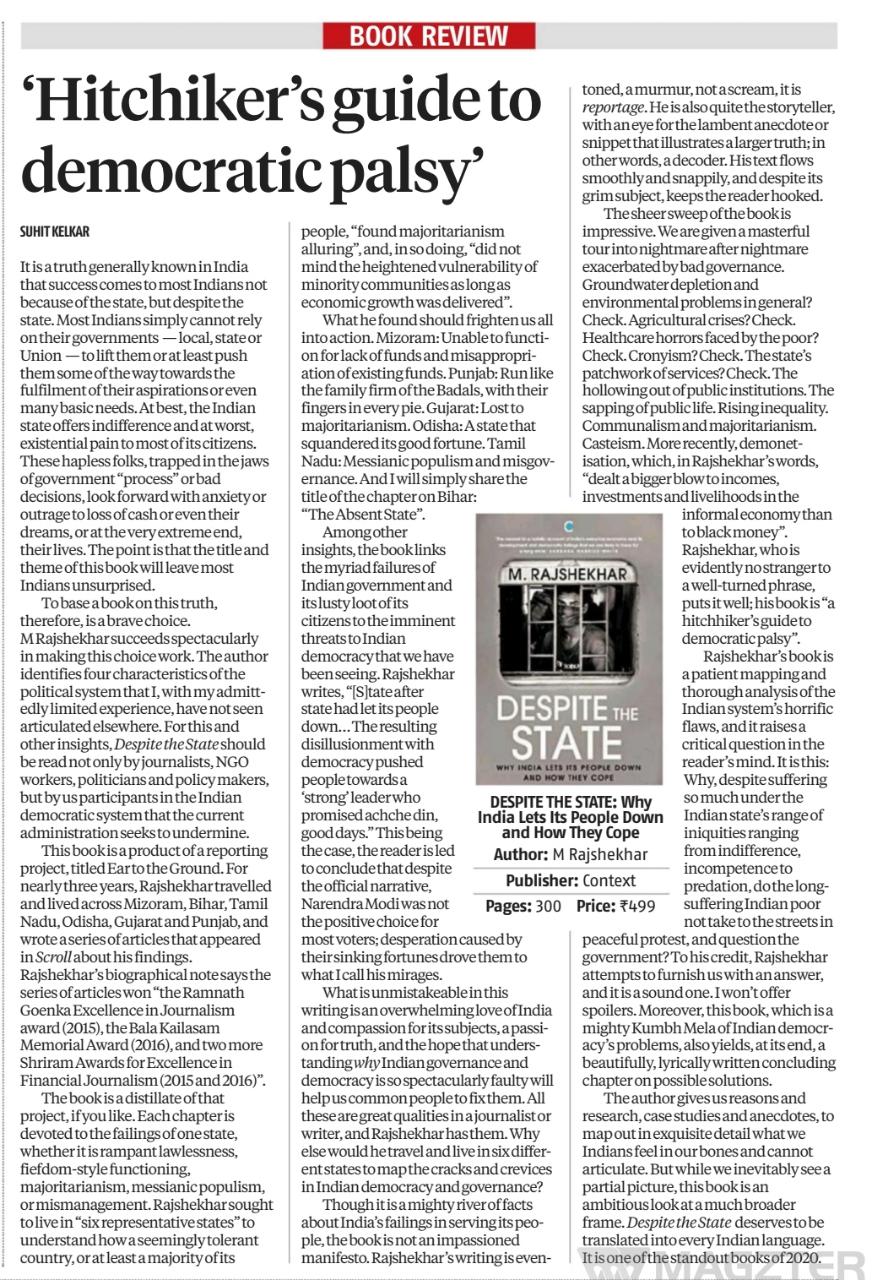
“A patient mapping and thorough analysis of the Indian system’s horrific flaws…” Business Standard (Image here)
“33 മാസം, 6 സംസ്ഥാനങ്ങൾ, 120 റിപ്പോർട്ടുകൾ: ജനാധിപത്യം തേടി മഹത്തായ ഇന്ത്യൻ യാത്ര… (33 months, 6 states, 120 reports: Great Indian journey in search of democracy…)” Malayala Manorama
“Hindustan ki maujooda siyasi wa maaashi soorat e hal.” QindeelOnline
“What emerges is the image of a state that is extractive, dominant, casteist and clientelist.” Tribune
“…reporting at its best. The picture that emerges is of a democracy that has been hijacked by vested interests, interested only in power and pelf.” Moneycontrol.com
Book lists
“Ten best non-fiction books of the year“, The Hindu.
“Twenty-One Notable Books From 2021“, The Wire.
“What has South Asia been reading: 2021 edition“, Himal Southasian
Interviews
“Journalism is a social enterprise…,” Booksfirst.in.
“Democratic decay at state level: Journalist M Rajshekhar on book ‘Despite the State’,” The News Minute.
“Covid-19 en Inde : “des décès de masse” dont un “État obscurantiste est responsable,” Asialyst.
Allusions/Mentions
“JP to BJP: The Unanswered Questions“.
Mahtab Alam’s review of “JP to BJP: Bihar After Lalu and Nitish”.
“Urban History of Atmospheric Modernity in Colonial India“. Mohammad Sajjad’s review of “Dust and Smoke: Air Pollution and Colonial Urbanism, India, c1860-c1940”.
“Westland closure: Titles that are selling fast and a few personal recommendations,” by Chetana Divya Vasudev, Moneycontrol. (Because this happened too. In February, a year after DtS was released, Amazon decided to shutter Westland, which published the book. The announcement saw folks rushing to buy copies of Westland books before stocks run out.)
“Time to change tack on counterinsurgency” by TK Arun, The Federal.
“All Things Policy: The Challenges of Governing States” by Suman Joshi and Sarthak Pradhan, Takshashila Institute (podcast).
“The Future of Entertainment“, Kaveree Bamzai in Open.
“On What India’s Watching“, Prathyush Parasuraman on Substack.
“The puppeteers around us“, Karthik Venkatesh in Deccan Herald.
“Will TN election manifestos continue ‘populist’ welfare schemes?“, Anna Isaac for The News Minute.
“Why wages-for-housework won’t help women“, V Geetha in Indian Express.
“The poor state of the Indian state“, Arun Maira in The Hindu.
Book discussions
14 April, 2024: The costs of political corruption, Bangalore International Centre.
27 May, 2023: Safe Spaces/Why Indians live despite the state. TEDx Bangalore.
12 November, 2022: Stop Loss: Overcoming the systemic failures of the Indian State. Tata Literature Festival, Mumbai.
26 December, 2021: Rangashankara, Bangalore, a discussion with Dhanya Rajendran.
16 November: Rachna Books, Gangtok, a discussion with Pema Wangchuk.
29 August: Books In The Time of Chaos, with Ujwal Kumar.
21 May: Hyderabad Lit Fest with Kaveree Bamzai and Aniruddha Bahal.
28 March: Paalam Books, Salem, Tamil Nadu.
19 March: The News Minute, “Citizens, the State, and the idea of India“
6 March: Pen@Prithvi, with Suhit Kelkar
20 February: A discussion between scholars Usha Ramanathan, Tridip Suhrud, MS Sriram and me to formally launch Despite the State.
6 February: DogEars Bookshop, Margoa.
5 February: The Polis Project, Dispatches with Suchitra Vijayan.
30 January: Founding Fuel, “Systems Thinking, State Capacity and Grassroots Development“.
25 January: Miranda House Literary Society
- March 2026
- January 2026
- December 2025
- November 2025
- October 2025
- September 2025
- August 2025
- May 2025
- April 2025
- March 2025
- February 2025
- January 2025
- December 2024
- November 2024
- October 2024
- August 2024
- June 2024
- May 2024
- March 2024
- February 2024
- January 2024
- November 2023
- August 2023
- July 2023
- March 2023
- February 2023
- January 2023
- October 2022
- September 2022
- July 2022
- June 2022
- May 2022
- April 2022
- March 2022
- February 2022
- December 2021
- November 2021
- October 2021
- August 2021
- July 2021
- June 2021
- May 2021
- April 2021
- March 2021
- January 2021
- October 2020
- September 2020
- August 2020
- July 2020
- June 2020
- May 2019
- March 2019
- February 2019
- January 2019
- December 2018
- November 2018
- October 2018
- July 2018
- June 2018
- April 2018
- January 2018
- December 2017
- November 2017
- October 2017
- September 2017
- July 2017
- June 2017
- May 2017
- April 2017
- January 2017
- December 2016
- November 2016
- October 2016
- September 2016
- August 2016
- July 2016
- June 2016
- May 2016
- April 2016
- March 2016
- January 2016
- December 2015
- November 2015
- October 2015
- September 2015
- August 2015
- July 2015
- June 2015
- May 2015
- April 2015
- March 2015
- January 2015
- December 2014
- November 2014
- October 2014
- September 2014
- August 2014
- July 2014
- June 2014
- May 2014
- April 2014
- March 2014
- February 2014
- January 2014
- December 2013
- November 2013
- October 2013
- September 2013
- August 2013
- July 2013
- June 2013
- May 2013
- April 2013
- March 2013
- February 2013
- January 2013
- December 2012
- November 2012
- October 2012
- September 2012
- August 2012
- July 2012
- June 2012
- May 2012
- April 2012
- March 2012
- February 2012
- January 2012
- December 2011
- November 2011
- October 2011
- September 2011
- August 2011
- July 2011
- June 2011
- May 2011
- April 2011
- March 2011
- February 2011
- January 2011
- December 2010
- November 2010
- October 2010
- September 2010
- August 2010
- July 2010
- June 2010
- May 2010
- April 2010
- March 2010
- February 2010
- January 2010
- December 2009
- November 2009
- September 2008
- February 2008
- December 2007
- November 2007
- May 2007
- April 2007
- March 2007
- February 2007
- January 2007
- September 2006
- August 2006
- July 2006
- June 2006
- May 2006
- March 2006
- January 2006
- September 2005
- March 2005
- January 2005
- September 2003
- December 2002
Aadhaar Agriculture Banking correspondents Bihar BJP Books Cash transfers Climate change Coal Coalscam Common BC Auctions Corruption Demonetisation Ear To The Ground Energy Energy Transition Environmental governance Financial Inclusion Forests Gujarat Healthcare Idiocy India Informal economy Journalism Madhya Pradesh Mandis Microfinance Mining Mizoram MoEF NDA NREGA Odisha Oligarchy Pollution Privacy Punjab Reserve Bank of India Rivers Tamil Nadu Tribals UIDAI UPA Welfare Programmes
 Fractured/Earth