dov ospovat and the development of darwin’s theory

i am finally reading dov ospovat’s the development of darwin’s theory. back in 2009 when i was studying the drafting of the forest rights act, i had read the origin of species. interspersed in that book were little paragraphs where darwin described numerous experiments he had conducted in the years after he got off the beagle, testing out answers to different puzzles thrown up by biogeography — the science which studies the distribution of species.

for instance, to understand why similar trees are found in coastal areas, he left a bunch of their seeds in sea water for weeks and months and then planted them and tried to see how many blossomed into plants — this was his test to see whether seeds could be dispersed by oceanic currents, and then take root on farflung shores. similarly, as he says in the book…

I suspended a duck’s feet, which might represent those of a bird sleeping in a natural pond, in an aquarium, where many ova of fresh-water shells were hatching; and I found that numbers of the extremely minute and just hatched shells crawled on the feet, and clung to them so firmly that when taken out of the water they could not be jarred off, though at a somewhat more advanced age they would voluntarily drop off. These just hatched molluscs, though aquatic in their nature, survived on the duck’s feet, in damp air, from twelve to twenty hours; and in this length of time a duck or heron might fly at least six or seven hundred miles, and would be sure to alight on a pool or rivulet, if blown across sea to an oceanic island or to any other distant point.

the book is filled with accounts of similar experiments. passages like this must have filled everyone who read the origin… with wonderment. 18 years lapsed between darwin getting off the beagle and the publication of the origin of species. in this period, he was obviously very busy, fastidiously thinking through the question of how life evolved and spread across the planet, and testing myriad hypotheses.

and then, while reading janet browne’s the secular ark, which traces the — well — evolution of our thinking on evolution, i came across a reference to ospovat’s book.

and guess what it focuses on — on that 18 year period! a history of science, the book painstaking reconstructs the development of darwin’s thinking on what david quammen called the question of questions — the distribution of life on the planet — and locates darwin amongst his peers.

some weeks ago, i finally began reading this book in earnest. i am about two chapters down. i am reading slowly. underlining and scribbling with gusto. this is such a lovely, careful, magisterial book. one filled with such gentle epiphanies that it summons the title of a book by richard feynman to mind — the pleasure of finding things out.

it is also a poignant book to read. dov ospovat died of cancer shortly after finishing the manuscript of this book. he was 33. such a shame that is. such a brilliant, pathbreaking book. and the author taken from our midst so young.

i am thinking that i will finish this book and then start work on a chronology on how human thought on evolution developed. might be an interesting way to trace the incremental, collaborative manner in which ideas — again — evolve and take root. hmmm.

ps – while we are talking of darwin, the last paragraph in the origin has to rank among the finest pieces of science writing ever. it gives me goosebumps.

It is interesting to contemplate an entangled bank, clothed with many plants of many kinds, with birds singing on the bushes, with various insects flitting about, and with worms crawling through the damp earth, and to reflect that these elaborately constructed forms, so different from each other, and dependent on each other in so complex a manner, have all been produced by laws acting around us. These laws, taken in the largest sense, being Growth with Reproduction; inheritance which is almost implied by reproduction; Variability from the indirect and direct action of the external conditions of life, and from use and disuse; a Ratio of Increase so high as to lead to a Struggle for Life, and as a consequence to Natural Selection, entailing Divergence of Character and the Extinction of less-improved forms. Thus, from the war of nature, from famine and death, the most exalted object which we are capable of conceiving, namely, the production of the higher animals, directly follows. There is grandeur in this view of life, with its several powers, having been originally breathed into a few forms or into one; and that, whilst this planet has gone cycling on according to the fixed law of gravity, from so simple a beginning endless forms most beautiful and most wonderful have been, and are being, evolved.

ps – indeed. “There is grandeur in this view of life, with its several powers, having been originally breathed into a few forms or into one; and that, whilst this planet has gone cycling on according to the fixed law of gravity, from so simple a beginning endless forms most beautiful and most wonderful have been, and are being, evolved.” Amen.


One response to “dov ospovat and the development of darwin’s theory”

  1. Lovely post! I will put Origin of the species and Ospovat’s books on my reading wish list

Leave a reply to Kannan Kasturi Cancel reply

This site uses Akismet to reduce spam. Learn how your comment data is processed.


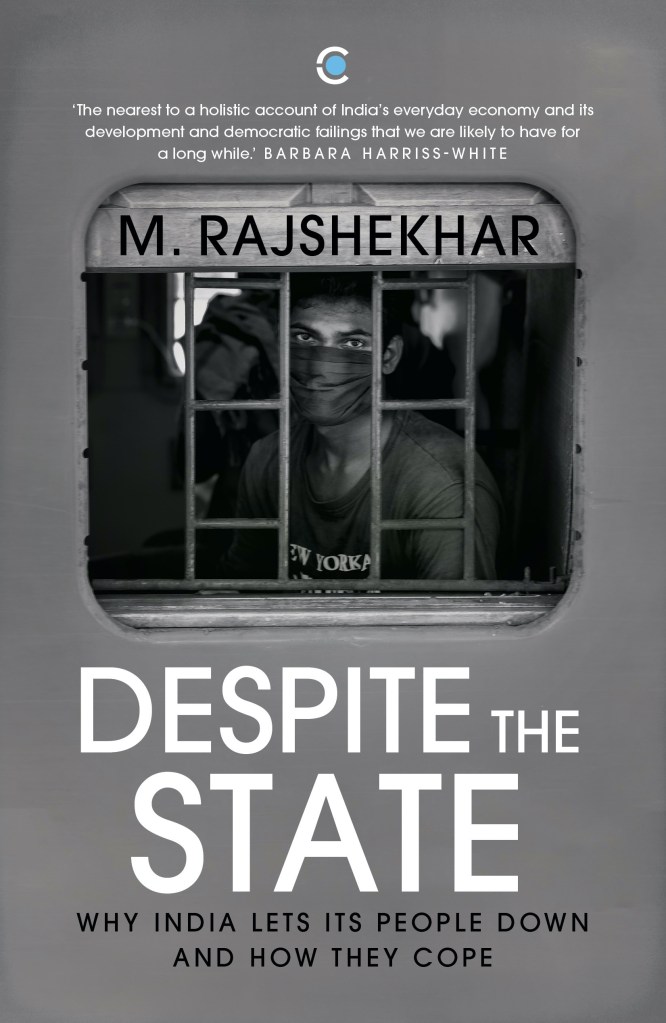
I am an Indian journalist with interests in energy, environment, climate and India’s ongoing slide into right-wing authoritarianism. My book, Despite the State, an examination of pervasive state failure and democratic decay in India, was published by Westland Publications, India, in January 2021. My work has won the Bala Kailasam Memorial Award; the Ramnath Goenka Excellence in Journalism Award; five Shriram Awards for Excellence in Financial Journalism; and, more recently, been a finalist at the True Story Award and GIJN’s Global Shining Light Awards. Write to me at despitethestate@protonmail.com.

Reviews

…une plongée dans les failles béantes de la démocratie indienne, un compte rendu implacable du dysfonctionnement des Etats fédérés, minés par la corruption, le clientélisme, le culte de la personnalité des élus et le capitalisme de connivence. (…a dive into the gaping holes in Indian democracy, a relentless account of the dysfunction of the federated states, undermined by corruption, clientelism, the cult of the personality of elected officials and crony capitalism).” Le Monde

…a critical enquiry into why representative government in India is flagging.Biblio

…strives for an understanding of the factors that enable governments and political parties to function in a way that is seemingly hostile to the interests of the very public they have been elected to serve, a gross anomaly in an electoral democracy.” Scroll.in

M. Rajshekhar’s deeply researched book… holds a mirror to Indian democracy, and finds several cracks.The Hindu

…excels at connecting the local to the national.Open

…refreshingly new writing on the play between India’s dysfunctional democracy and its development challenges…Seminar

A patient mapping and thorough analysis of the Indian system’s horrific flaws…” Business Standard (Image here)

33 മാസം, 6 സംസ്ഥാനങ്ങൾ, 120 റിപ്പോർട്ടുകൾ: ജനാധിപത്യം തേടി മഹത്തായ ഇന്ത്യൻ യാത്ര… (33 months, 6 states, 120 reports: Great Indian journey in search of democracy…)” Malayala Manorama

Hindustan ki maujooda siyasi wa maaashi soorat e hal.” QindeelOnline

What emerges is the image of a state that is extractive, dominant, casteist and clientelist.Tribune

…reporting at its best. The picture that emerges is of a democracy that has been hijacked by vested interests, interested only in power and pelf.Moneycontrol.com

Book lists

Ten best non-fiction books of the year“, The Hindu.

Twenty-One Notable Books From 2021“, The Wire.

What has South Asia been reading: 2021 edition“, Himal Southasian

Interviews

Journalism is a social enterprise…,” Booksfirst.in.

Democratic decay at state level: Journalist M Rajshekhar on book ‘Despite the State’,” The News Minute.

Covid-19 en Inde : “des décès de masse” dont un “État obscurantiste est responsable,” Asialyst.

Allusions/Mentions

JP to BJP: The Unanswered Questions“.
Mahtab Alam’s review of “JP to BJP: Bihar After Lalu and Nitish”.

Urban History of Atmospheric Modernity in Colonial India“. Mohammad Sajjad’s review of “Dust and Smoke: Air Pollution and Colonial Urbanism, India, c1860-c1940”.

Westland closure: Titles that are selling fast and a few personal recommendations,” by Chetana Divya Vasudev, Moneycontrol. (Because this happened too. In February, a year after DtS was released, Amazon decided to shutter Westland, which published the book. The announcement saw folks rushing to buy copies of Westland books before stocks run out.)

Time to change tack on counterinsurgency” by TK Arun, The Federal.

All Things Policy: The Challenges of Governing States” by Suman Joshi and Sarthak Pradhan, Takshashila Institute (podcast).

The Future of Entertainment“, Kaveree Bamzai in Open.

On What India’s Watching“, Prathyush Parasuraman on Substack.

The puppeteers around us“, Karthik Venkatesh in Deccan Herald.

Will TN election manifestos continue ‘populist’ welfare schemes?“, Anna Isaac for The News Minute.

Why wages-for-housework won’t help women“, V Geetha in Indian Express.

The poor state of the Indian state“, Arun Maira in The Hindu.

Book discussions

14 April, 2024: The costs of political corruption, Bangalore International Centre.

27 May, 2023: Safe Spaces/Why Indians live despite the state. TEDx Bangalore.

12 November, 2022: Stop Loss: Overcoming the systemic failures of the Indian State. Tata Literature Festival, Mumbai.

26 December, 2021: Rangashankara, Bangalore, a discussion with Dhanya Rajendran.

16 November: Rachna Books, Gangtok, a discussion with Pema Wangchuk.

29 August: Books In The Time of Chaos, with Ujwal Kumar.

21 May: Hyderabad Lit Fest with Kaveree Bamzai and Aniruddha Bahal.

28 March: Paalam Books, Salem, Tamil Nadu.

19 March: The News Minute, “Citizens, the State, and the idea of India

6 March: Pen@Prithvi, with Suhit Kelkar

20 February: A discussion between scholars Usha Ramanathan, Tridip Suhrud, MS Sriram and me to formally launch Despite the State.

6 February: DogEars Bookshop, Margoa.

5 February: The Polis Project, Dispatches with Suchitra Vijayan.

30 January: Founding Fuel, “Systems Thinking, State Capacity and Grassroots Development“.

25 January: Miranda House Literary Society

Aadhaar Agriculture Banking correspondents Bihar BJP Books Cash transfers Climate change Coal Coalscam Common BC Auctions Corruption Demonetisation Ear To The Ground Energy Energy Transition Environmental governance Financial Inclusion Forests Gujarat Healthcare Idiocy India Informal economy Journalism Madhya Pradesh Mandis Microfinance Mining Mizoram MoEF NDA NREGA Odisha Oligarchy Pollution Privacy Punjab Reserve Bank of India Rivers Tamil Nadu Tribals UIDAI UPA Welfare Programmes