NDA
-
Why Did India Need a Fresh Ministry for Cooperatives?
A day before the reshuffle, Narendra Modi’s National Democratic Alliance government created a new Ministry of Cooperation.It would provide, said its statement, a separate administrative, legal and policy framework for strengthening the cooperative movement in India.A day later, it announced Union home minister Amit Shah would also head the new ministry.Singly and together, these announcements… Continue reading
-
The four hidden risks lurking in India’s gas expansion plans
India’s plans to remake itself into a gas-based economy are floundering. As the previous story in this series described, not only is the fuel controlled so tightly by the government that players struggle for viability, India is also running out of cheap domestic gas. The country’s new gas finds – in deepwater fields – and… Continue reading
-
Why India’s gas boom is running out of steam
Seen from a distance, India’s gas sector seems to have everything going for it. Given how energy-starved India is – not to mention climate commitments to reduce its economy’s carbon intensity – there is abundant demand. Given the global surge in gas production even as traditional markets slow, supply is not a problem either. Helping… Continue reading
-
Can Gas Account for 15% of India’s Energy Mix?
In March this year, union minister Dharmendra Pradhan published an article. Most of the piece, titled Why India Needs A New Energy Roadmap, listed the Bharatiya Janata Party-led National Democratic Alliance (NDA) government’s efforts to make India a gas-based economy. The government, wrote India’s petroleum and natural gas minister, wants to take India towards renewables.… Continue reading
-
On the mechanics of Gautam Adani’s extraordinary expansion across India
For a long while now — ever since my colleagues at Economic Times and I profiled Gautam Adani in 2013 — some of my friends and I have been wondering how the Adani Group funds its growth. Is there a mismatch between the quantum of its balance sheet and the quantum of its investments? That… Continue reading
-
More on the asymmetry that rules India’s business insolvency process
Since October last year, Scroll has been (intermittently) reporting on how India’s insolvency proceedings are coming along. Cumulatively, these reports flag a couple of peculiar patterns. A lot of companies are up for sale — In a country with 7500 companies with a topline over Rs 250 crore, 2511 companies are slated for insolvency proceedings.… Continue reading
-
Five reasons why claims by forest dwellers for their land are low – and rejections are high
On February 13, the Supreme Court ordered the eviction of more than 10 lakh families of Adivasis and other forest-dwellers from forestlands across 16 states. The order came while the court was hearing petitions challenging the constitutional validity of the Forest Rights Act, 2006. The petitioners had demanded that state governments evict those forest dwellers… Continue reading
-
Interview: ‘We have underestimated the extent of India’s jobs crisis. It is far more serious’
and gosh. one more frikking q&a. On Thursday, a political storm boiled over after Business Standard reported that, between 2017-’18, unemployment numbers in India reached a 45-year high. The newspaper based its report on a survey, conducted by the National Sample Survey Organisation, called the Periodic Labour Force Survey that the government had not made public. According to… Continue reading
-
Reviving the Ganga #3. Three ways in which the Modi government is adding fresh stresses to the river
A century ago, the gharial could be found all the way from the Indus to the Irrawady. The thin-snouted, fish-eating member of the crocodile family was spread out over 20,000 sq km at the time, studies estimate, and numbered between 5,000 and 10,000. Now, no more than 200 breeding adults survive in the wild. The… Continue reading
-
Reviving the Ganga #2 Modi said he would revive Ganga but his government is doing the opposite by reviving dams
The focus of their anger lay 400 kilometres to the north. Since 2002, Uttarakhand, where the Ganga originates, has been on a drive to build hydel power projects. The state, which currently produces 4,000 MW of hydel power from 98-odd projects, has since 2009 signed agreements to build another 350 dams. Most of these are… Continue reading
-
Reviving the Ganga #1. Modi’s clean Ganga plan hinges on private companies tackling sewage. Will it work?
In September 2014, shortly after coming to power, Prime Minister Narendra Modi held his first meeting on the Ganga. The river had featured prominently in the Bharatiya Janata Party’s election manifesto. The Ganga was both jeevan dayini, the giver of life, and mukti dayini, which sets the soul free, the document said. But all was… Continue reading
-
Biggest winner of Modi’s loan-in-59-minutes plan for small companies is an Ahmedabad fintech startup
On November 2, Prime Minister Narendra Modi made a slew of announcements aimed at reviving India’s faltering micro, small and medium enterprises. One of these was about a dedicated digital platform – www.psbloansin59minutes.com – to enable them to access loans of upto Rs 1 crore in just 59 minutes. Unlike their larger counterparts, India’s smaller… Continue reading
-
Arun Jaitley is being disingenuous in blaming RBI for the troubles of India’s small and medium firms
What India’s Finance Minister says… The finance minister this week criticised the central bank for failing to check indiscriminate bank lending from 2008 to 2014 which has now ripened into a bad loan crisis. The attack was accompanied by the government invoking never-used powers under the Reserve Bank Act to issue directions to the bank’s… Continue reading
-
On the six factors which cumulatively added up to India’s unprecedented cash squeeze
India’s current cash crunch is a real enigma. To begin with, there is its sheer unprecedented nature. In all the years since Independence, India has never seen something like it. “We have heard of coin shortages but never a cash shortage,” said MS Sriram, visiting faculty at the Indian Institute of Management-Bangalore’s Centre for Public… Continue reading
-
15 theories about why India is facing a cash crunch a year and a half after demonetisation
atms are again running dry in india. and theories claiming to explain why are doubling every day. out today, a quick report with my colleague rohan which seeks to separate plausible theories from the disingenuous (or just plain stupid) ones. Continue reading
-
Aadhaar shows India’s governance is susceptible to poorly tested ideas pushed by powerful people
This series has flagged a puzzling trend. State governments are struggling to use Aadhaar-based fingerprint authentication in ration shops. At the same time, a rising number of companies are integrating Aadhaar into their databases. This is puzzling because from its inception, Aadhaar, India’s Unique Identification project, was pitched as integral to the modernisation of social… Continue reading
-
Samajwadi Party leader shot, injured in Mainpuri
20 days after false allegations of cow slaughter almost saw two muslims get lynched, the town of karhal in uttar pradesh’s manipuri district is on the boil again. this time because 3 goons shot and wounded a local muslim leader. Continue reading
-
why people in Nagaland and Manipur are responding cautiously to the new Naga peace accord
A day after the NDA announced its “historic” peace accord with the National Socialist Council of Nagaland (Isak-Muivah), speculation is rife in the two states affected most by the agreement – Nagaland and Manipur. What is the shape of the agreement hammered out by government and the rebel group? After all, the NSCN was formed… Continue reading
-
Mr Environment Minister, India is carrying out deforestation, not reforestation
On Wednesday morning, Environment Minister Prakash Javadekar gave India one more reason to think of him as among the country’s worst environment ministers till date. As the Indian Express reported, the minister sent out an intra-ministry letter on July 16 asking bureaucrats to replace the term “diversion” of forest land with “reforestation” in their communications. When asked about… Continue reading
-
Will India’s recent coal block auctions actually burden banks and skew the fuel market?
The first part of Scroll’s analysis of the coal block auctions took a close look at the auctions for the steel, cement and aluminium sectors. It found an extremely wide divergence in the winning bids. Some blocks went for twice the notified price of coal, or the price at which the bulk of India’s coal is… Continue reading
-
Are the coal block auctions as successful as the Modi government claims?
At a gathering in Paris last month, drawing attention to the coal block auctions that have taken place under his government, Prime Minister Narendra Modi boasted, “Twenty coal blocks out of 204 have been auctioned so far and we got more than Rs. 2 lakh crore from them.” The factual error in the statement –… Continue reading
-
Mizoram governor’s sacking is BJP’s latest misstep in a state it is trying to woo
When Bharatiya Janata Party president Amit Shah makes his planned visit to Mizoram this month, officials of his organisation’s state unit have arranged for him to meet with church elders and receive a memorandum from them. Their note will remind the BJP that “India is a secular state, that the people of Mizoram are against the… Continue reading
-
Ambiguous drafting continues to dog the NDA’s coalblock auction plans
After the Coal Bill, it is the turn of the Coal Mines (Special Provisions) Rules, 2014. Rules say the central government can allot a coalblock where mining has already started to any company recommended by the ministry of power which “henceforth may be awarded a power project based on competitive bids for tariff”. The phrasing,… Continue reading
-
an iffy clause in India’s new coal bill
The new coal bill may allow the discretionary allotment of mines, as experts say a new clause in the proposed law can be interpreted as facilitating such action. However, coal ministry officials say the clause has been inserted only to allow tariff-based bidding. Section 5(1) of The Coal Mines (Special Provisions) Bill, 2014, says the… Continue reading
-
day one of jan dhan yojana
i reported for this story on the first day of jan dhan yojana. while the media exults over its success in opening over a crore accounts on day one, cracks in the model are already visible. cynical tokenism, all this. Continue reading
-
modi sarkar and its env/dev record
and then, there is this story on its environmental track record till now. If environment minister Prakash Javadekar’s tweets are anything to go by, India is treading a fine balance between development and environmental protection. For instance, on May 31, shortly after taking charge at Paryavaran Bhawan, he tweeted: “The government believes in #environment and… Continue reading
-
On cleaning the ganges
from an et special issue on modi sarkar completing 100 days, this report on its election promise to clean the ganga. Continue reading
-
is the forest rights act being implemented well? (the answer is ‘no’)
Last month, union tribal Minister Jual Oram told the Lok Sabha that India is making “satisfactory progress” implementing the “Forest Rights Act” (FRA). However, a closer look at the numbers he submitted in the house indicates otherwise. my story on how the government’s claims about “satisfactory” implementation of the forest rights act are garbage. what… Continue reading
-
modi. dbt. jayalalitha. tn.
Resisting Prime Minister Narendra Modi’s push for direct benefits transfer using Aadhaar, Tamil Nadu has refused to share list of its welfare scheme beneficiaries for matching with Aadhaar numbers, saying a hasty cross-checking exercise could end up denying benefits to hundreds of poor. Continue reading
-
a big setback for aadhaar
The finance ministry has decided to limit Aadhaar’s role in its welfare scheme payments and, instead, use ATM-enabled RuPay cards for last-mile authentication to withdraw money. While it will continue to use Aadhaar for opening accounts and to eliminate ghosts and duplicates from beneficiary rolls, the ministry has decided to give RuPay ATM cards with… Continue reading
-
RBI opposes NDA financial inclusion plan
The new financial inclusion push, Sampoorn Vittiyea Samaveshan, which Prime Minister Narendra Modi is widely expected to unveil on August 15 does not quite have the central bank on its side. Top government sources told ET that the Reserve Bank of India (RBI) was in disagreement with three critical elements of the drive. it opposed… Continue reading
-
the latest question on aadhaar
…While researching this story, ET reviewed two drafts produced by the Department of Financial Services – one in June, and the second in July. The draft dated 8 July, 2014, says: “This account would be linked with the Aadhaar number of the account holder and would become the single point for receipt of Direct Benefit… Continue reading
-
nilekani meets modi, saves aadhaar
There is enough evidence to suggest that the crucial July 1 meeting between Nilekani, the prime minister and the FM, brought forth a volte face in the government stand on UIDAI. Only two days before this, on July 3, Home Minister Rajnath Singh, Telecom, IT and Law Minister Ravi Shankar Prasad and Planning Minister Rao… Continue reading
-
MGNREGA ver 2.0
out today, this story on the changes planned by the nda for nrega. Sanitation projects to reduce open defecation, increasing green cover and emphasis on creating assets form the crux of the Narendra Modi-led government’s blueprint for redeploying UPA’s flagship social sector programme — the Mahatma Gandhi National Rural Employment Guarantee Act or MGNREGA.Top officials… Continue reading
-
on aadhaar, npr and the nda
my colleague and friend vikas dhoot and i have this update on the continuing aadhaar and npr saga. Prime Minister Narendra Modi has backed the UPA’s Aadhaar programme for now, but that may not be the final word on whether it will be retained. The government has asked the Unique Identification Authority of India (UIDAI),… Continue reading
I am an Indian journalist with interests in energy, environment, climate and India’s ongoing slide into right-wing authoritarianism. My book, Despite the State, an examination of pervasive state failure and democratic decay in India, was published by Westland Publications, India, in January 2021. My work has won the Bala Kailasam Memorial Award; the Ramnath Goenka Excellence in Journalism Award; five Shriram Awards for Excellence in Financial Journalism; and, more recently, been a finalist at the True Story Award and GIJN’s Global Shining Light Awards. Write to me at despitethestate@protonmail.com.
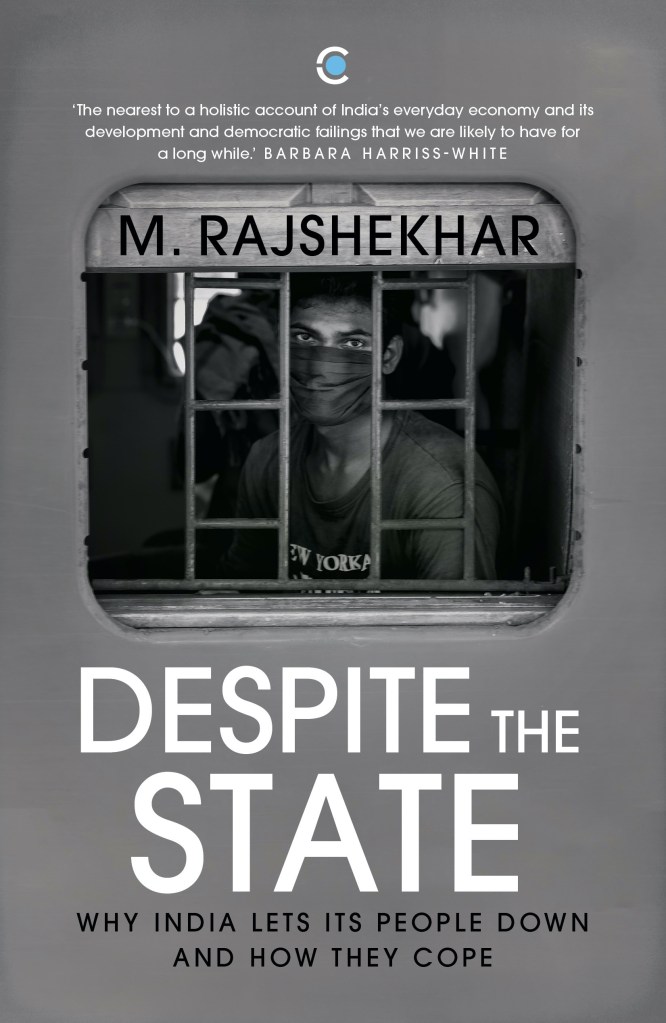
Reviews
“…une plongée dans les failles béantes de la démocratie indienne, un compte rendu implacable du dysfonctionnement des Etats fédérés, minés par la corruption, le clientélisme, le culte de la personnalité des élus et le capitalisme de connivence. (…a dive into the gaping holes in Indian democracy, a relentless account of the dysfunction of the federated states, undermined by corruption, clientelism, the cult of the personality of elected officials and crony capitalism).” Le Monde
“…a critical enquiry into why representative government in India is flagging.” Biblio
“…strives for an understanding of the factors that enable governments and political parties to function in a way that is seemingly hostile to the interests of the very public they have been elected to serve, a gross anomaly in an electoral democracy.” Scroll.in
“M. Rajshekhar’s deeply researched book… holds a mirror to Indian democracy, and finds several cracks.” The Hindu
“…excels at connecting the local to the national.” Open
“…refreshingly new writing on the play between India’s dysfunctional democracy and its development challenges…” Seminar
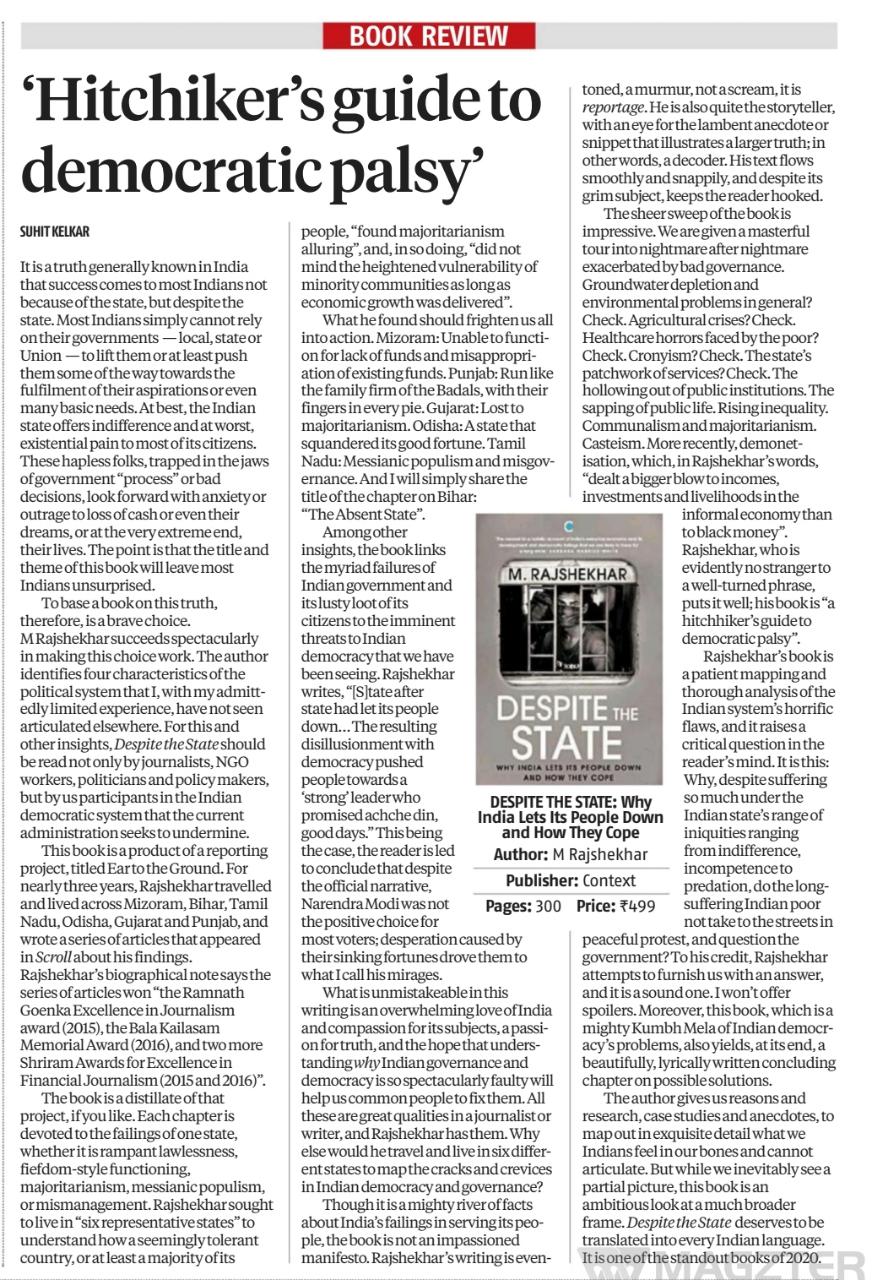
“A patient mapping and thorough analysis of the Indian system’s horrific flaws…” Business Standard (Image here)
“33 മാസം, 6 സംസ്ഥാനങ്ങൾ, 120 റിപ്പോർട്ടുകൾ: ജനാധിപത്യം തേടി മഹത്തായ ഇന്ത്യൻ യാത്ര… (33 months, 6 states, 120 reports: Great Indian journey in search of democracy…)” Malayala Manorama
“Hindustan ki maujooda siyasi wa maaashi soorat e hal.” QindeelOnline
“What emerges is the image of a state that is extractive, dominant, casteist and clientelist.” Tribune
“…reporting at its best. The picture that emerges is of a democracy that has been hijacked by vested interests, interested only in power and pelf.” Moneycontrol.com
Book lists
“Ten best non-fiction books of the year“, The Hindu.
“Twenty-One Notable Books From 2021“, The Wire.
“What has South Asia been reading: 2021 edition“, Himal Southasian
Interviews
“Journalism is a social enterprise…,” Booksfirst.in.
“Democratic decay at state level: Journalist M Rajshekhar on book ‘Despite the State’,” The News Minute.
“Covid-19 en Inde : “des décès de masse” dont un “État obscurantiste est responsable,” Asialyst.
Allusions/Mentions
“JP to BJP: The Unanswered Questions“.
Mahtab Alam’s review of “JP to BJP: Bihar After Lalu and Nitish”.
“Urban History of Atmospheric Modernity in Colonial India“. Mohammad Sajjad’s review of “Dust and Smoke: Air Pollution and Colonial Urbanism, India, c1860-c1940”.
“Westland closure: Titles that are selling fast and a few personal recommendations,” by Chetana Divya Vasudev, Moneycontrol. (Because this happened too. In February, a year after DtS was released, Amazon decided to shutter Westland, which published the book. The announcement saw folks rushing to buy copies of Westland books before stocks run out.)
“Time to change tack on counterinsurgency” by TK Arun, The Federal.
“All Things Policy: The Challenges of Governing States” by Suman Joshi and Sarthak Pradhan, Takshashila Institute (podcast).
“The Future of Entertainment“, Kaveree Bamzai in Open.
“On What India’s Watching“, Prathyush Parasuraman on Substack.
“The puppeteers around us“, Karthik Venkatesh in Deccan Herald.
“Will TN election manifestos continue ‘populist’ welfare schemes?“, Anna Isaac for The News Minute.
“Why wages-for-housework won’t help women“, V Geetha in Indian Express.
“The poor state of the Indian state“, Arun Maira in The Hindu.
Book discussions
14 April, 2024: The costs of political corruption, Bangalore International Centre.
27 May, 2023: Safe Spaces/Why Indians live despite the state. TEDx Bangalore.
12 November, 2022: Stop Loss: Overcoming the systemic failures of the Indian State. Tata Literature Festival, Mumbai.
26 December, 2021: Rangashankara, Bangalore, a discussion with Dhanya Rajendran.
16 November: Rachna Books, Gangtok, a discussion with Pema Wangchuk.
29 August: Books In The Time of Chaos, with Ujwal Kumar.
21 May: Hyderabad Lit Fest with Kaveree Bamzai and Aniruddha Bahal.
28 March: Paalam Books, Salem, Tamil Nadu.
19 March: The News Minute, “Citizens, the State, and the idea of India“
6 March: Pen@Prithvi, with Suhit Kelkar
20 February: A discussion between scholars Usha Ramanathan, Tridip Suhrud, MS Sriram and me to formally launch Despite the State.
6 February: DogEars Bookshop, Margoa.
5 February: The Polis Project, Dispatches with Suchitra Vijayan.
30 January: Founding Fuel, “Systems Thinking, State Capacity and Grassroots Development“.
25 January: Miranda House Literary Society
- March 2026
- January 2026
- December 2025
- November 2025
- October 2025
- September 2025
- August 2025
- May 2025
- April 2025
- March 2025
- February 2025
- January 2025
- December 2024
- November 2024
- October 2024
- August 2024
- June 2024
- May 2024
- March 2024
- February 2024
- January 2024
- November 2023
- August 2023
- July 2023
- March 2023
- February 2023
- January 2023
- October 2022
- September 2022
- July 2022
- June 2022
- May 2022
- April 2022
- March 2022
- February 2022
- December 2021
- November 2021
- October 2021
- August 2021
- July 2021
- June 2021
- May 2021
- April 2021
- March 2021
- January 2021
- October 2020
- September 2020
- August 2020
- July 2020
- June 2020
- May 2019
- March 2019
- February 2019
- January 2019
- December 2018
- November 2018
- October 2018
- July 2018
- June 2018
- April 2018
- January 2018
- December 2017
- November 2017
- October 2017
- September 2017
- July 2017
- June 2017
- May 2017
- April 2017
- January 2017
- December 2016
- November 2016
- October 2016
- September 2016
- August 2016
- July 2016
- June 2016
- May 2016
- April 2016
- March 2016
- January 2016
- December 2015
- November 2015
- October 2015
- September 2015
- August 2015
- July 2015
- June 2015
- May 2015
- April 2015
- March 2015
- January 2015
- December 2014
- November 2014
- October 2014
- September 2014
- August 2014
- July 2014
- June 2014
- May 2014
- April 2014
- March 2014
- February 2014
- January 2014
- December 2013
- November 2013
- October 2013
- September 2013
- August 2013
- July 2013
- June 2013
- May 2013
- April 2013
- March 2013
- February 2013
- January 2013
- December 2012
- November 2012
- October 2012
- September 2012
- August 2012
- July 2012
- June 2012
- May 2012
- April 2012
- March 2012
- February 2012
- January 2012
- December 2011
- November 2011
- October 2011
- September 2011
- August 2011
- July 2011
- June 2011
- May 2011
- April 2011
- March 2011
- February 2011
- January 2011
- December 2010
- November 2010
- October 2010
- September 2010
- August 2010
- July 2010
- June 2010
- May 2010
- April 2010
- March 2010
- February 2010
- January 2010
- December 2009
- November 2009
- September 2008
- February 2008
- December 2007
- November 2007
- May 2007
- April 2007
- March 2007
- February 2007
- January 2007
- September 2006
- August 2006
- July 2006
- June 2006
- May 2006
- March 2006
- January 2006
- September 2005
- March 2005
- January 2005
- September 2003
- December 2002
Aadhaar Agriculture Banking correspondents Bihar BJP Books Cash transfers Climate change Coal Coalscam Common BC Auctions Corruption Demonetisation Ear To The Ground Energy Energy Transition Environmental governance Financial Inclusion Forests Gujarat Healthcare Idiocy India Informal economy Journalism Madhya Pradesh Mandis Microfinance Mining Mizoram MoEF NDA NREGA Odisha Oligarchy Pollution Privacy Punjab Reserve Bank of India Rivers Tamil Nadu Tribals UIDAI UPA Welfare Programmes
 Fractured/Earth