What Explains the Union Government’s U-Turn on Online Money Gaming?

About two years ago, I had sought an appointment with veteran sports reporter Sharda Ugra to discuss a story idea around cricket. In that chat, after answering my questions, she also told me about online gaming apps like Dream11 and My11Circle.

They were getting Indians to wager money on real world matches, promising them huge money if they correctly predicted the 11 players who would make the biggest dent on the match, the works. Thoughts thereafter about the potential size of the market — between cheap cellphones, cheaper data, desperation due to joblessness, the lure of quick money, and the conviction that Indians get cricket — had left me reeling.

A huge story in a country with no dearth of huge stories. And so, work on this proceeded in bits and pieces. And then, the government outlawed online money gaming, the usual avalanche of misinformation — lost GST revenues, lost jobs — began. And it felt like an idea to write about the huge sociological shift triggered by this pointless industry.

Much has been written about how India’s small businessmen, in the wake of dropping revenues, switched to stock trading in the hope of higher returns. Similarly, crores of Indians (especially those from poorer families), faced with dwindling opportunities but aided by the spread of UPI, cheap smartphones, cheaper data and familiarity with games like cricket, have turned to online real money games.” Along the way, India became a land of speculators.”

This industry, which styles itself as ‘sports’, leaves me marvelling. They are no different from the bankers who inflicted the subprime crisis on Americans — both profited through the immiserisation of others. I am going to leave you with the lyrics to Bruce Springsteen’s “Death To My Hometown”. Nothing sounds as apposite.

Oh, no cannonballs did fly, no rifles cut us down
No bombs fell from the sky, no blood soaked the ground
No powder flash blinded the eye, no deathly thunder sound
But just as sure as the hand of God, they brought death to my hometown
They brought death to my hometown
No shells ripped the evening sky, no cities burning down
No armies stormed the shores for which we’d die
No dictators were crowned
I awoke from a quite night, I never heard a sound
Marauders raided in the dark and brought death to my hometown, buys
Death to my hometown

They destroyed our families’ factories and they took our homes
They left our bodies on the plains, the vultures picked our bones

So listen up, my sonny boy, be ready for when they come
For they’ll be returning sure as the rising sun
Now get yourself a song to sing and sing it ’til you’re done
Yeah, sing it hard and sing it well
Send the robber barons straight to hell
The greedy thieves who came around
And ate the flesh of everything they found
Whose crimes have gone unpunished now
Who walk the streets as free men now

Ah, they brought death to our hometown, boys
Death to our hometown, boys
Death to our hometown, whoa!

(The song itself, here).


Leave a comment

This site uses Akismet to reduce spam. Learn how your comment data is processed.


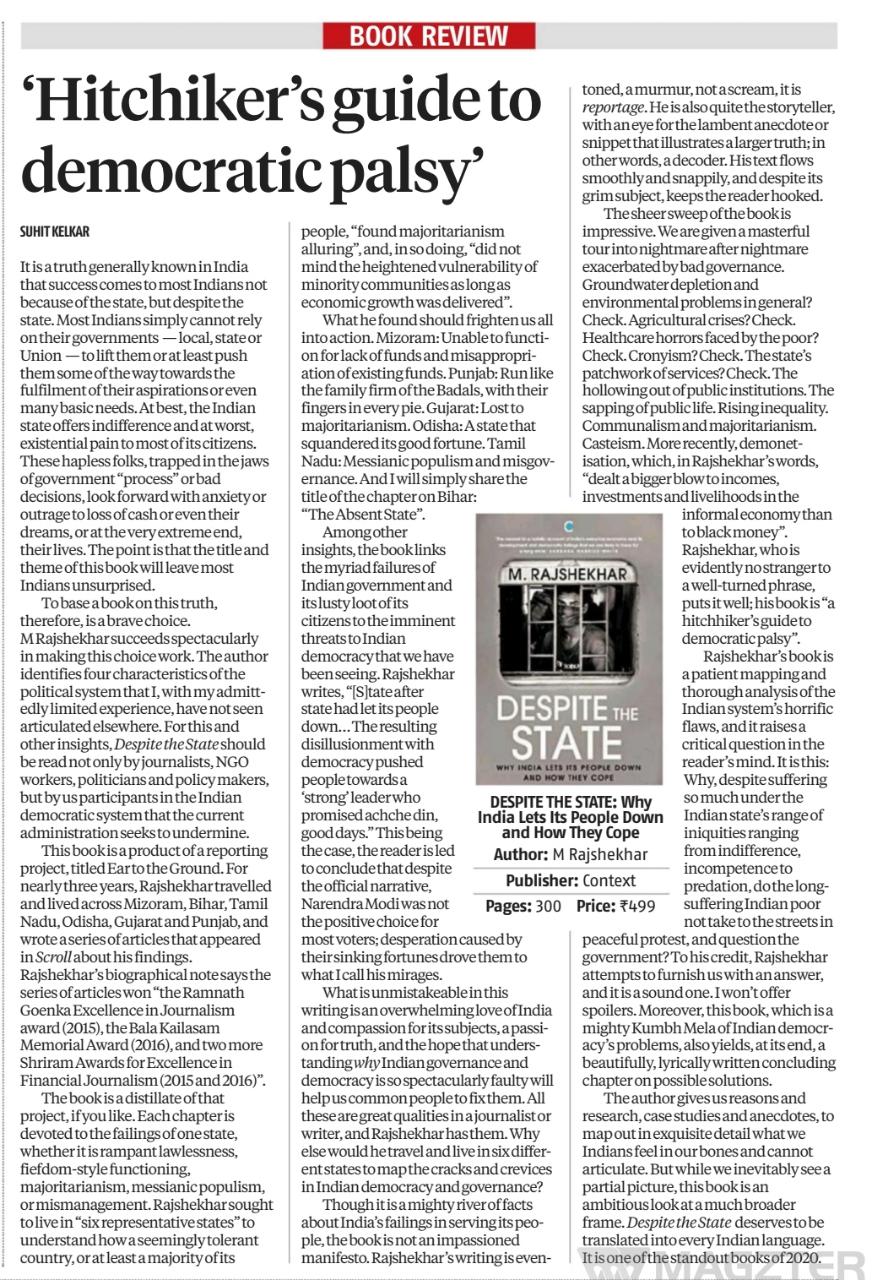
I am an Indian journalist with interests in energy, environment, climate and India’s ongoing slide into right-wing authoritarianism. My book, Despite the State, an examination of pervasive state failure and democratic decay in India, was published by Westland Publications, India, in January 2021. My work has won the Bala Kailasam Memorial Award; the Ramnath Goenka Excellence in Journalism Award; five Shriram Awards for Excellence in Financial Journalism; and, more recently, been a finalist at the True Story Award and GIJN’s Global Shining Light Awards. Write to me at despitethestate@protonmail.com.

Reviews

…une plongée dans les failles béantes de la démocratie indienne, un compte rendu implacable du dysfonctionnement des Etats fédérés, minés par la corruption, le clientélisme, le culte de la personnalité des élus et le capitalisme de connivence. (…a dive into the gaping holes in Indian democracy, a relentless account of the dysfunction of the federated states, undermined by corruption, clientelism, the cult of the personality of elected officials and crony capitalism).” Le Monde

…a critical enquiry into why representative government in India is flagging.Biblio

…strives for an understanding of the factors that enable governments and political parties to function in a way that is seemingly hostile to the interests of the very public they have been elected to serve, a gross anomaly in an electoral democracy.” Scroll.in

M. Rajshekhar’s deeply researched book… holds a mirror to Indian democracy, and finds several cracks.The Hindu

…excels at connecting the local to the national.Open

…refreshingly new writing on the play between India’s dysfunctional democracy and its development challenges…Seminar

A patient mapping and thorough analysis of the Indian system’s horrific flaws…” Business Standard (Image here)

33 മാസം, 6 സംസ്ഥാനങ്ങൾ, 120 റിപ്പോർട്ടുകൾ: ജനാധിപത്യം തേടി മഹത്തായ ഇന്ത്യൻ യാത്ര… (33 months, 6 states, 120 reports: Great Indian journey in search of democracy…)” Malayala Manorama

Hindustan ki maujooda siyasi wa maaashi soorat e hal.” QindeelOnline

What emerges is the image of a state that is extractive, dominant, casteist and clientelist.Tribune

…reporting at its best. The picture that emerges is of a democracy that has been hijacked by vested interests, interested only in power and pelf.Moneycontrol.com

Book lists

Ten best non-fiction books of the year“, The Hindu.

Twenty-One Notable Books From 2021“, The Wire.

What has South Asia been reading: 2021 edition“, Himal Southasian

Interviews

Journalism is a social enterprise…,” Booksfirst.in.

Democratic decay at state level: Journalist M Rajshekhar on book ‘Despite the State’,” The News Minute.

Covid-19 en Inde : “des décès de masse” dont un “État obscurantiste est responsable,” Asialyst.

Allusions/Mentions

JP to BJP: The Unanswered Questions“.
Mahtab Alam’s review of “JP to BJP: Bihar After Lalu and Nitish”.

Urban History of Atmospheric Modernity in Colonial India“. Mohammad Sajjad’s review of “Dust and Smoke: Air Pollution and Colonial Urbanism, India, c1860-c1940”.

Westland closure: Titles that are selling fast and a few personal recommendations,” by Chetana Divya Vasudev, Moneycontrol. (Because this happened too. In February, a year after DtS was released, Amazon decided to shutter Westland, which published the book. The announcement saw folks rushing to buy copies of Westland books before stocks run out.)

Time to change tack on counterinsurgency” by TK Arun, The Federal.

All Things Policy: The Challenges of Governing States” by Suman Joshi and Sarthak Pradhan, Takshashila Institute (podcast).

The Future of Entertainment“, Kaveree Bamzai in Open.

On What India’s Watching“, Prathyush Parasuraman on Substack.

The puppeteers around us“, Karthik Venkatesh in Deccan Herald.

Will TN election manifestos continue ‘populist’ welfare schemes?“, Anna Isaac for The News Minute.

Why wages-for-housework won’t help women“, V Geetha in Indian Express.

The poor state of the Indian state“, Arun Maira in The Hindu.

Book discussions

14 April, 2024: The costs of political corruption, Bangalore International Centre.

27 May, 2023: Safe Spaces/Why Indians live despite the state. TEDx Bangalore.

12 November, 2022: Stop Loss: Overcoming the systemic failures of the Indian State. Tata Literature Festival, Mumbai.

26 December, 2021: Rangashankara, Bangalore, a discussion with Dhanya Rajendran.

16 November: Rachna Books, Gangtok, a discussion with Pema Wangchuk.

29 August: Books In The Time of Chaos, with Ujwal Kumar.

21 May: Hyderabad Lit Fest with Kaveree Bamzai and Aniruddha Bahal.

28 March: Paalam Books, Salem, Tamil Nadu.

19 March: The News Minute, “Citizens, the State, and the idea of India

6 March: Pen@Prithvi, with Suhit Kelkar

20 February: A discussion between scholars Usha Ramanathan, Tridip Suhrud, MS Sriram and me to formally launch Despite the State.

6 February: DogEars Bookshop, Margoa.

5 February: The Polis Project, Dispatches with Suchitra Vijayan.

30 January: Founding Fuel, “Systems Thinking, State Capacity and Grassroots Development“.

25 January: Miranda House Literary Society

Aadhaar Agriculture Banking correspondents Bihar BJP Books Cash transfers Climate change Coal Coalscam Common BC Auctions Corruption Demonetisation Ear To The Ground Energy Energy Transition Environmental governance Financial Inclusion Forests Gujarat Healthcare Idiocy India Informal economy Journalism Madhya Pradesh Mandis Microfinance Mining Mizoram MoEF NDA NREGA Odisha Oligarchy Pollution Privacy Punjab Reserve Bank of India Rivers Tamil Nadu Tribals UIDAI UPA Welfare Programmes