What we talk about when we talk about Great Nicobar

Last week, Frontline hosted a discussion between Pankaj Sekhsaria and me about the Great Nicobar project. Here is a video.

You know the backstory to this. As I have written last month — and several others have before me — Great Nicobar is being flipped from an island untouched by modernity to a resource frontier.

It was a fun discussion. Much of government policy would be a laughing stock if not for secrecy and the veneer of authority. In this discussion, we looked at the project from first principles and eyerolling followed — as it was bound to. What sort of a half-wit proposes coral reef relocation? Or casinos around a defence base? Or mega infrastructures in a seismic zone?

PS: The report got published. I posted it on social media (twitter, in my case) and stepped back to see the report’s journey into the world. Hardly any traction. After a week of promotions, the report has been received less than 100 retweets. It makes one pause. Ours is a time of marginalisation. Great Nicobar (to say nothing of the government’s larger plans for Andaman and Nicobar) have not received due attention from legacy newsrooms. As for the independent portals, their capacity to get the word out is limited by both social media algorithms and their own paywalls.

There are hard questions here. How do we spread the word about our reports if the social media platforms discriminate against news links? How does one respond to this marginalisation within the discourse? And then, there is access to information. While I wouldn’t have seen Gazans’ reality if not for social media, there is too much misinformation/disinformation + echo chambers here.

I am mulishly unwilling to switch to another social media platform. It takes long to build a following + the same faultiness of algos and echo chambers exist there as well. Maybe the answer is to go old-fashioned, focus on the work, and leave amplification to the readers. But readers are changing too. People are reading less; consuming more video which, however, is not great at getting details out plus there is shitloads of video out there. On the whole, I have to rethink both my consumption and propagation of news.

For now, I think, I will decouple from wretched, ugly twitter and refocus more on the good newspapers and websites that still exist. On amplification too, I think, I have to hope that good reporting will travel on its own.


Leave a comment

This site uses Akismet to reduce spam. Learn how your comment data is processed.


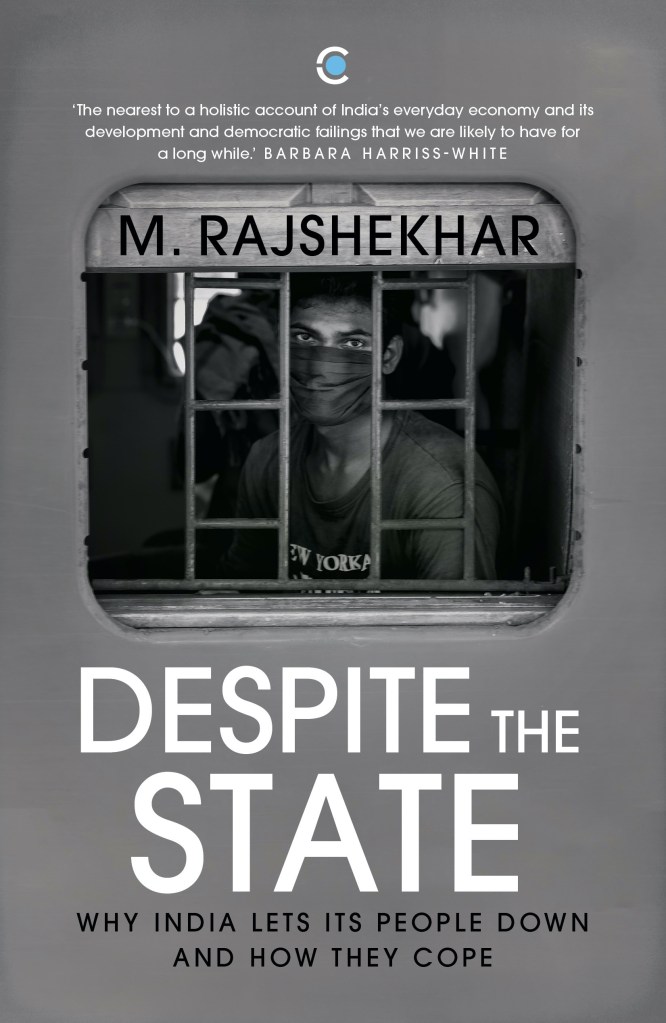
I am an Indian journalist with interests in energy, environment, climate and India’s ongoing slide into right-wing authoritarianism. My book, Despite the State, an examination of pervasive state failure and democratic decay in India, was published by Westland Publications, India, in January 2021. My work has won the Bala Kailasam Memorial Award; the Ramnath Goenka Excellence in Journalism Award; five Shriram Awards for Excellence in Financial Journalism; and, more recently, been a finalist at the True Story Award and GIJN’s Global Shining Light Awards. Write to me at despitethestate@protonmail.com.

Reviews

…une plongée dans les failles béantes de la démocratie indienne, un compte rendu implacable du dysfonctionnement des Etats fédérés, minés par la corruption, le clientélisme, le culte de la personnalité des élus et le capitalisme de connivence. (…a dive into the gaping holes in Indian democracy, a relentless account of the dysfunction of the federated states, undermined by corruption, clientelism, the cult of the personality of elected officials and crony capitalism).” Le Monde

…a critical enquiry into why representative government in India is flagging.Biblio

…strives for an understanding of the factors that enable governments and political parties to function in a way that is seemingly hostile to the interests of the very public they have been elected to serve, a gross anomaly in an electoral democracy.” Scroll.in

M. Rajshekhar’s deeply researched book… holds a mirror to Indian democracy, and finds several cracks.The Hindu

…excels at connecting the local to the national.Open

…refreshingly new writing on the play between India’s dysfunctional democracy and its development challenges…Seminar

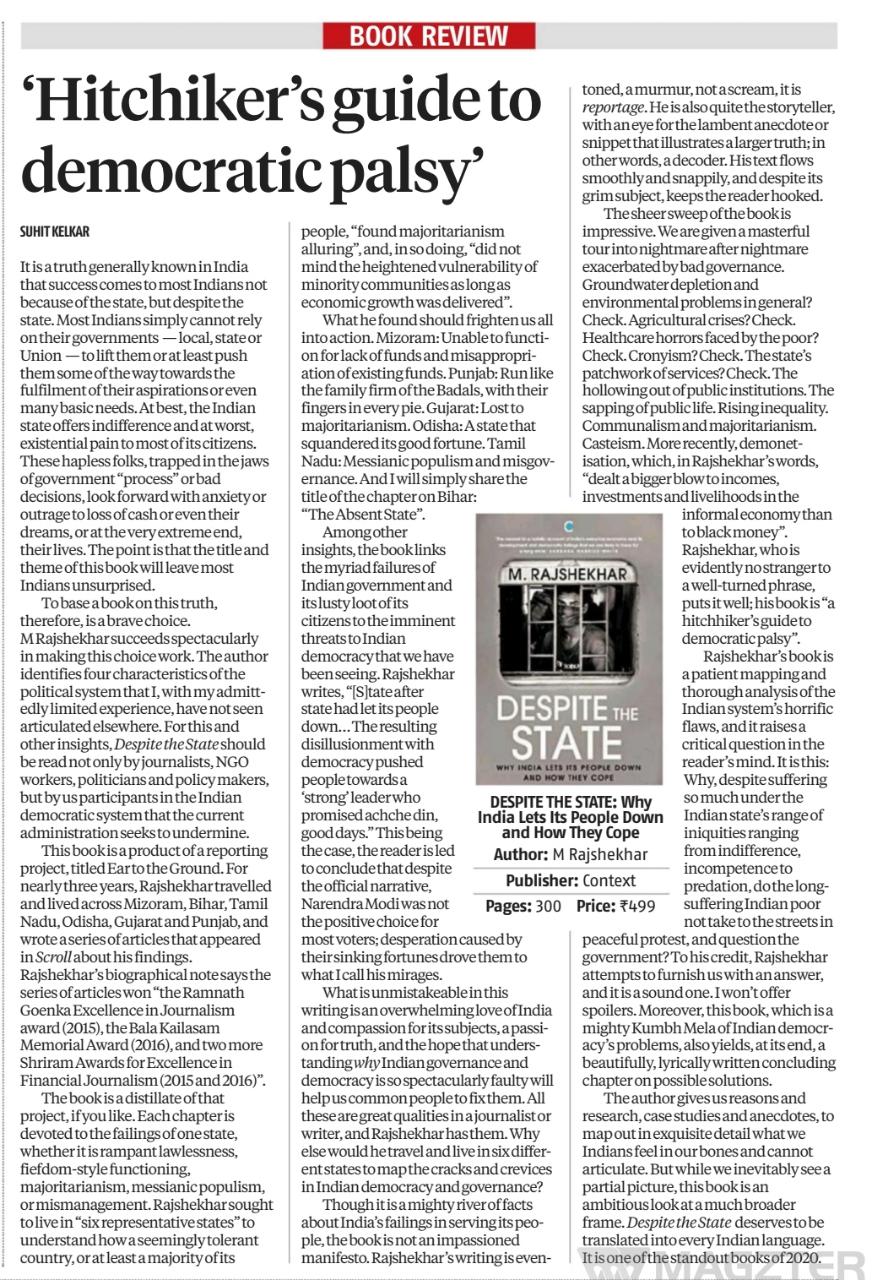
A patient mapping and thorough analysis of the Indian system’s horrific flaws…” Business Standard (Image here)

33 മാസം, 6 സംസ്ഥാനങ്ങൾ, 120 റിപ്പോർട്ടുകൾ: ജനാധിപത്യം തേടി മഹത്തായ ഇന്ത്യൻ യാത്ര… (33 months, 6 states, 120 reports: Great Indian journey in search of democracy…)” Malayala Manorama

Hindustan ki maujooda siyasi wa maaashi soorat e hal.” QindeelOnline

What emerges is the image of a state that is extractive, dominant, casteist and clientelist.Tribune

…reporting at its best. The picture that emerges is of a democracy that has been hijacked by vested interests, interested only in power and pelf.Moneycontrol.com

Book lists

Ten best non-fiction books of the year“, The Hindu.

Twenty-One Notable Books From 2021“, The Wire.

What has South Asia been reading: 2021 edition“, Himal Southasian

Interviews

Journalism is a social enterprise…,” Booksfirst.in.

Democratic decay at state level: Journalist M Rajshekhar on book ‘Despite the State’,” The News Minute.

Covid-19 en Inde : “des décès de masse” dont un “État obscurantiste est responsable,” Asialyst.

Allusions/Mentions

JP to BJP: The Unanswered Questions“.
Mahtab Alam’s review of “JP to BJP: Bihar After Lalu and Nitish”.

Urban History of Atmospheric Modernity in Colonial India“. Mohammad Sajjad’s review of “Dust and Smoke: Air Pollution and Colonial Urbanism, India, c1860-c1940”.

Westland closure: Titles that are selling fast and a few personal recommendations,” by Chetana Divya Vasudev, Moneycontrol. (Because this happened too. In February, a year after DtS was released, Amazon decided to shutter Westland, which published the book. The announcement saw folks rushing to buy copies of Westland books before stocks run out.)

Time to change tack on counterinsurgency” by TK Arun, The Federal.

All Things Policy: The Challenges of Governing States” by Suman Joshi and Sarthak Pradhan, Takshashila Institute (podcast).

The Future of Entertainment“, Kaveree Bamzai in Open.

On What India’s Watching“, Prathyush Parasuraman on Substack.

The puppeteers around us“, Karthik Venkatesh in Deccan Herald.

Will TN election manifestos continue ‘populist’ welfare schemes?“, Anna Isaac for The News Minute.

Why wages-for-housework won’t help women“, V Geetha in Indian Express.

The poor state of the Indian state“, Arun Maira in The Hindu.

Book discussions

14 April, 2024: The costs of political corruption, Bangalore International Centre.

27 May, 2023: Safe Spaces/Why Indians live despite the state. TEDx Bangalore.

12 November, 2022: Stop Loss: Overcoming the systemic failures of the Indian State. Tata Literature Festival, Mumbai.

26 December, 2021: Rangashankara, Bangalore, a discussion with Dhanya Rajendran.

16 November: Rachna Books, Gangtok, a discussion with Pema Wangchuk.

29 August: Books In The Time of Chaos, with Ujwal Kumar.

21 May: Hyderabad Lit Fest with Kaveree Bamzai and Aniruddha Bahal.

28 March: Paalam Books, Salem, Tamil Nadu.

19 March: The News Minute, “Citizens, the State, and the idea of India

6 March: Pen@Prithvi, with Suhit Kelkar

20 February: A discussion between scholars Usha Ramanathan, Tridip Suhrud, MS Sriram and me to formally launch Despite the State.

6 February: DogEars Bookshop, Margoa.

5 February: The Polis Project, Dispatches with Suchitra Vijayan.

30 January: Founding Fuel, “Systems Thinking, State Capacity and Grassroots Development“.

25 January: Miranda House Literary Society

Aadhaar Agriculture Banking correspondents Bihar BJP Books Cash transfers Climate change Coal Coalscam Common BC Auctions Corruption Demonetisation Ear To The Ground Energy Energy Transition Environmental governance Financial Inclusion Forests Gujarat Healthcare Idiocy India Informal economy Journalism Madhya Pradesh Mandis Microfinance Mining Mizoram MoEF NDA NREGA Odisha Oligarchy Pollution Privacy Punjab Reserve Bank of India Rivers Tamil Nadu Tribals UIDAI UPA Welfare Programmes