Union Carbide. Reflections

this is the first of three opinionated stories i wrote for et’s 50th anniversary. i cannot find the links to these on the website, and so am pasting the raw text itself.

Blackened and twisted from the heat of the reaction, tank 610 lies on its side. Twenty-six years ago, on the night of 2nd-3rd December, it is from this tank in Union Carbide’s Bhopal factor that Methyl Isocyanate leaked out and spread, cloudlike, across a large part of the city. It was the world’s worst industrial disaster. Official numbers estimate that almost 4,000 people died that night. Tens of thousands were permanently disabled.

It’s an event that exposes a strange paradox about the Indian state. Think about it. On one hand, in the years after the leak, India made radical changes to her environmental law. Till the leak, industrial risk was understood as something confined to the factory. It was not till Bhopal that the definition of the community at risk widened and brought the community living around the project into the calculus of industrial risk.

The legislative response was the Environmental (Protection) Act (1986). It authorizes the central government to protect and improve environmental quality, to control and reduce pollution from all sources, and to prohibit or restrict the setting and/or operation of any industrial facility on environmental grounds. Today, it is an umbrella Act from which myriad other environmental laws, like the Environmental Impact Assessment notification, etc, derive their authority.

Another response came from the Supreme Court where, while ruling on a subsequent Oleum Gas leak in Delhi, Justice PN Bhagwati added the principle of Absolute Liability to India’s legal liability regime. Says environmental lawyer Videh Upadhyay, “When the Indian government tried to hold Union Carbide responsible for the disaster, the best legal principle available to it was the strict liability principle. Derived from British Common Law, this says any industry engaged in hazardous activity is liable for adverse consequences even if the industry/enterprise is not directly responsible for them. However, mitigating conditions could be factored in, like acts of god, acts of strangers, etc.”

While ruling on the Oleum case, Justice Bhagwati did away with the exemptions. His order said: “Where an enterprise is engaged in a hazardous or inherently dangerous activity and harm results to anyone on account of an accident in the operation of such hazardous or inherently dangerous activity resulting, for example, in escape of toxic gas, the enterprise is strictly and absolutely liable to compensate all those who are affected by the accident and such liability is not subject to any of the exceptions which operate vis-à-vis the tortious principle of strict liability.”

This landmark legal principle, says Upadhyay, was developed in the backdrop of Bhopal. Joining other environmental principles like Polluter Pays and the Precautionary Principle, it has been used extensively since then.

It shows the caring side of the Indian state. But, look at how the victims have been treated, and you see something strikingly different.

In all these years, regardless of the party in power, the victims’ struggle for compensation and treatment has continued. A combination of disinterested gas relief hospitals and almost non-existent medical research into the effects of the gas leak on humans has resulted in the gas victims getting little more than palliative treatment for their medical problems. The symptoms get treated but little else more. Poor attempts at social and economic rehabilitation have resulted in them sinking deep into poverty.

Saddest of all, the number of victims has been swelled by a second generation of victims. Some are children born to badly-affected survivors are blind, lame, with limbs twisted or missing, deaf and mute, brain-damaged, with hare-lips, cleft palates, webbed fingers, cerebral palsy or tumours where there should be eyes. Others are those who unknowingly bought land abutting the ponds outside the plant where Carbide used to dump its chemical slurry. This water-affected population, reports Sambhavna Clinic, a charity set up to help gas victims, is showing an incidence of birth defects that is ten times the national average.

A strange paradox, indeed.


Leave a comment

This site uses Akismet to reduce spam. Learn how your comment data is processed.


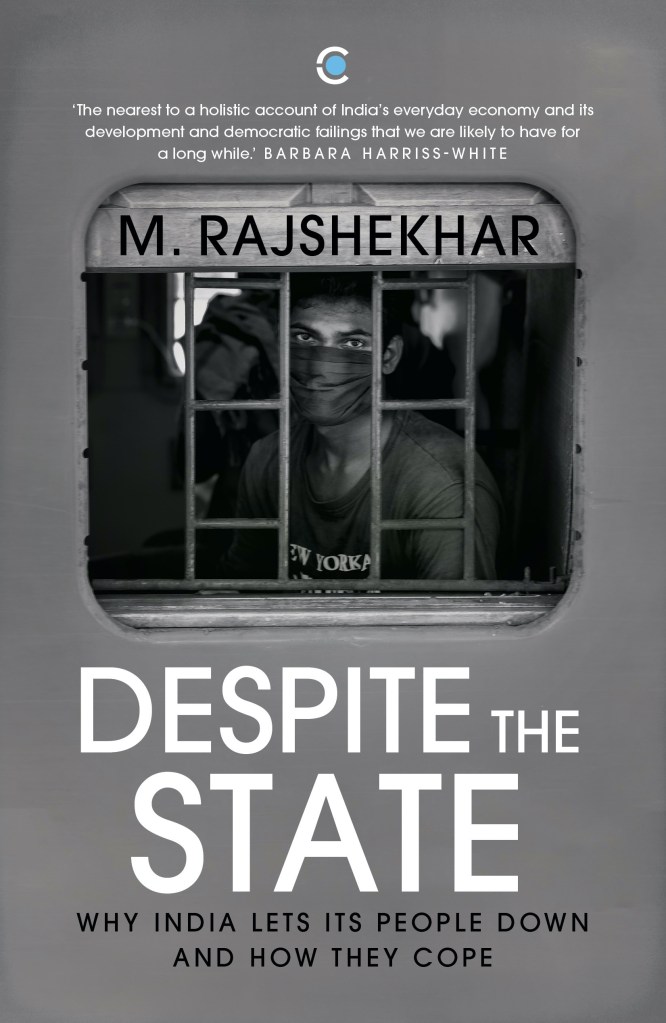
I am an Indian journalist with interests in energy, environment, climate and India’s ongoing slide into right-wing authoritarianism. My book, Despite the State, an examination of pervasive state failure and democratic decay in India, was published by Westland Publications, India, in January 2021. My work has won the Bala Kailasam Memorial Award; the Ramnath Goenka Excellence in Journalism Award; five Shriram Awards for Excellence in Financial Journalism; and, more recently, been a finalist at the True Story Award and GIJN’s Global Shining Light Awards. Write to me at despitethestate@protonmail.com.

Reviews

…une plongée dans les failles béantes de la démocratie indienne, un compte rendu implacable du dysfonctionnement des Etats fédérés, minés par la corruption, le clientélisme, le culte de la personnalité des élus et le capitalisme de connivence. (…a dive into the gaping holes in Indian democracy, a relentless account of the dysfunction of the federated states, undermined by corruption, clientelism, the cult of the personality of elected officials and crony capitalism).” Le Monde

…a critical enquiry into why representative government in India is flagging.Biblio

…strives for an understanding of the factors that enable governments and political parties to function in a way that is seemingly hostile to the interests of the very public they have been elected to serve, a gross anomaly in an electoral democracy.” Scroll.in

M. Rajshekhar’s deeply researched book… holds a mirror to Indian democracy, and finds several cracks.The Hindu

…excels at connecting the local to the national.Open

…refreshingly new writing on the play between India’s dysfunctional democracy and its development challenges…Seminar

A patient mapping and thorough analysis of the Indian system’s horrific flaws…” Business Standard (Image here)

33 മാസം, 6 സംസ്ഥാനങ്ങൾ, 120 റിപ്പോർട്ടുകൾ: ജനാധിപത്യം തേടി മഹത്തായ ഇന്ത്യൻ യാത്ര… (33 months, 6 states, 120 reports: Great Indian journey in search of democracy…)” Malayala Manorama

Hindustan ki maujooda siyasi wa maaashi soorat e hal.” QindeelOnline

What emerges is the image of a state that is extractive, dominant, casteist and clientelist.Tribune

…reporting at its best. The picture that emerges is of a democracy that has been hijacked by vested interests, interested only in power and pelf.Moneycontrol.com

Book lists

Ten best non-fiction books of the year“, The Hindu.

Twenty-One Notable Books From 2021“, The Wire.

What has South Asia been reading: 2021 edition“, Himal Southasian

Interviews

Journalism is a social enterprise…,” Booksfirst.in.

Democratic decay at state level: Journalist M Rajshekhar on book ‘Despite the State’,” The News Minute.

Covid-19 en Inde : “des décès de masse” dont un “État obscurantiste est responsable,” Asialyst.

Allusions/Mentions

JP to BJP: The Unanswered Questions“.
Mahtab Alam’s review of “JP to BJP: Bihar After Lalu and Nitish”.

Urban History of Atmospheric Modernity in Colonial India“. Mohammad Sajjad’s review of “Dust and Smoke: Air Pollution and Colonial Urbanism, India, c1860-c1940”.

Westland closure: Titles that are selling fast and a few personal recommendations,” by Chetana Divya Vasudev, Moneycontrol. (Because this happened too. In February, a year after DtS was released, Amazon decided to shutter Westland, which published the book. The announcement saw folks rushing to buy copies of Westland books before stocks run out.)

Time to change tack on counterinsurgency” by TK Arun, The Federal.

All Things Policy: The Challenges of Governing States” by Suman Joshi and Sarthak Pradhan, Takshashila Institute (podcast).

The Future of Entertainment“, Kaveree Bamzai in Open.

On What India’s Watching“, Prathyush Parasuraman on Substack.

The puppeteers around us“, Karthik Venkatesh in Deccan Herald.

Will TN election manifestos continue ‘populist’ welfare schemes?“, Anna Isaac for The News Minute.

Why wages-for-housework won’t help women“, V Geetha in Indian Express.

The poor state of the Indian state“, Arun Maira in The Hindu.

Book discussions

14 April, 2024: The costs of political corruption, Bangalore International Centre.

27 May, 2023: Safe Spaces/Why Indians live despite the state. TEDx Bangalore.

12 November, 2022: Stop Loss: Overcoming the systemic failures of the Indian State. Tata Literature Festival, Mumbai.

26 December, 2021: Rangashankara, Bangalore, a discussion with Dhanya Rajendran.

16 November: Rachna Books, Gangtok, a discussion with Pema Wangchuk.

29 August: Books In The Time of Chaos, with Ujwal Kumar.

21 May: Hyderabad Lit Fest with Kaveree Bamzai and Aniruddha Bahal.

28 March: Paalam Books, Salem, Tamil Nadu.

19 March: The News Minute, “Citizens, the State, and the idea of India

6 March: Pen@Prithvi, with Suhit Kelkar

20 February: A discussion between scholars Usha Ramanathan, Tridip Suhrud, MS Sriram and me to formally launch Despite the State.

6 February: DogEars Bookshop, Margoa.

5 February: The Polis Project, Dispatches with Suchitra Vijayan.

30 January: Founding Fuel, “Systems Thinking, State Capacity and Grassroots Development“.

25 January: Miranda House Literary Society

Aadhaar Agriculture Banking correspondents Bihar BJP Books Cash transfers Climate change Coal Coalscam Common BC Auctions Corruption Demonetisation Ear To The Ground Energy Energy Transition Environmental governance Financial Inclusion Forests Gujarat Healthcare Idiocy India Informal economy Journalism Madhya Pradesh Mandis Microfinance Mining Mizoram MoEF NDA NREGA Odisha Oligarchy Pollution Privacy Punjab Reserve Bank of India Rivers Tamil Nadu Tribals UIDAI UPA Welfare Programmes