Apres Le Green Revolution

this is the second of three stories i wrote for et’s 50th anniversary. on what should succeed the green revolution. i cannot find the link on the website. till i find that, here is the text.

This happened three years ago. At that time, this reporter was doing rural research in Madhya Pradesh. And he had chanced to speak to four farmers growing soya in Malwa. What were their earnings like, he had asked, from the cash crop?

The answer was illuminating. Five acres will yield 20-25 sacks of soya. Five acres need 2 bags of seeds, 3 bags of fertilizer, pesticide, labour for weeding, sowing, harvesting and threshing. Add

all that up and you get input costs of Rs 12,000. At Rs 1,500 for each of the 25 sacks, the farmers were making Rs 37,500. Take out the costs. And they were left with 25,000. Or, Rs 5,000 per acre. Further, thanks to electrification and the advent of groundwater pumps, this part of malwa plants two crops a year. Wheat is usually the second crop. Its yields range between 18-20 sacks per acre. Each sack fetches between Rs 1,100-1,200. Which translated, in a best case scenario, into a gross income per acre of Rs 24,000. Costs ranged between Rs 12,000-14,000. So, say, a net income of Rs 12,000 per acre. Add earnings from soya to this, and you have farmers making Rs 17,000 per acre per year!

Now, in their village, 25 farmers had less than one acre. 75 had between 1-2 acres. Another 180 had between 2-5 acres. 20 had between 5-7 acres. Just 5-7 farmers had over 7 acres of land. It didn’t paint a very affluent picture. Further, none of that arithmetic factors risk in. Rs 17,000 an acre was something of a best case scenario — if rain and global commodity markets behaved themselves.

On the whole, marginal existence appeared to be the objective reality in the village. In response, farmers were diversifying livelihoods. Most households in their village had at least one member working in the industrial township of Pithampur, a mere six kilometres away.

In the last two years, travelling on work, this reporter has heard similar tales from other parts of the country. In Thanjavur, the rice bowl of Tamil Nadu, a groundwater crisis and a labour shortage have resulted in farmers starting to move away from the crop they have grown for generations. Farmers blame the current economics of paddy — with its need for lots of labour, chemical inputs and water. The result? The area under tree crops (like coconut) is rising. The area under rice is falling. Travel to chhattisgarh and you hear a similar refrain of steady impoverishment. In Punjab, farmers have begun selling their land to settle in UP and MP. Land in their state is becoming too saline, too infertile.

That is the first point I wanted to make. The benefits from the green revolution — which, at one time, with its emphasis on higher-yielding varieties, irrigation and chemical inputs, made this country food secure — are winding down.

Periodically, alluding to this, our statemanesque leaders say the country needs a second green revolution. Yes, but the question is: what form should it take?

One option leads us further down the path we have been travelling since the green revolution began — more technology. higher yielding varieties, hybrids, genetically-engineered crops, and so on. The other road, embraced by the minority, advocates a return to natural farming — to indigenous crops like jowar and bajra, natural fertiliser, what have you.

What should we do? It is a question that takes my mind towards the exciting emergent discipline of resilience. Every natural system, it says, has the ability to withstand a certain amount of shock and survive unchanged. Take a grassland. It will have two sorts of species. Some that grow slowly but can withstand harsh conditions.

And, another lot which is more efficient at converting, say, the sun’s rays into biomass, and consequently can grow faster, etc. However, as resilience theory says, there is a tradeoff between efficiency and flexibility (or dealing with external change). And that ecosystems are shaped by fast, intermediate and slow variables. The second set of species, while efficient, are not capable of handling changes in slow variables. For instance, if all the grass species in a rangeland were replaced by one species with the highest growth rate, production would be higher and more efficient in normal years, but the system itself would be much more vulnerable to droughts, pests, fire and so on. The system might be stable. But that stability is narrow.

The analogy with Indian agriculture is perfect. Bajra and Jowar are hardy crops. Even if the rains are poor, they will still yield something. The high yielding varieties, on the other hand, cannot. In good times, of course, the HYVs will vastly outperform the millets. On the whole, given the advent of increasingly mercurial weather patterns, commonly blamed on climate change, it is time we took a second look at whether millets et al can indeed feed this burgeoning nation.

In the budget this year, the FM finally expanded the government’s grain policy beyond rice and wheat to include millets. The amounts are modest. But it is a start.


Leave a comment

This site uses Akismet to reduce spam. Learn how your comment data is processed.


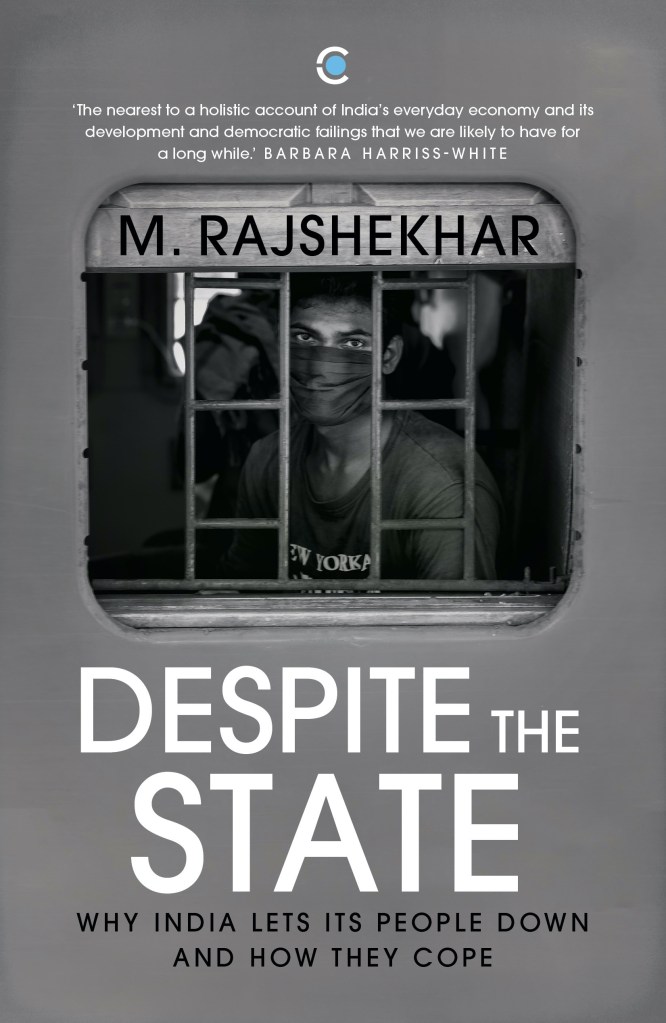
I am an Indian journalist with interests in energy, environment, climate and India’s ongoing slide into right-wing authoritarianism. My book, Despite the State, an examination of pervasive state failure and democratic decay in India, was published by Westland Publications, India, in January 2021. My work has won the Bala Kailasam Memorial Award; the Ramnath Goenka Excellence in Journalism Award; five Shriram Awards for Excellence in Financial Journalism; and, more recently, been a finalist at the True Story Award and GIJN’s Global Shining Light Awards. Write to me at despitethestate@protonmail.com.

Reviews

…une plongée dans les failles béantes de la démocratie indienne, un compte rendu implacable du dysfonctionnement des Etats fédérés, minés par la corruption, le clientélisme, le culte de la personnalité des élus et le capitalisme de connivence. (…a dive into the gaping holes in Indian democracy, a relentless account of the dysfunction of the federated states, undermined by corruption, clientelism, the cult of the personality of elected officials and crony capitalism).” Le Monde

…a critical enquiry into why representative government in India is flagging.Biblio

…strives for an understanding of the factors that enable governments and political parties to function in a way that is seemingly hostile to the interests of the very public they have been elected to serve, a gross anomaly in an electoral democracy.” Scroll.in

M. Rajshekhar’s deeply researched book… holds a mirror to Indian democracy, and finds several cracks.The Hindu

…excels at connecting the local to the national.Open

…refreshingly new writing on the play between India’s dysfunctional democracy and its development challenges…Seminar

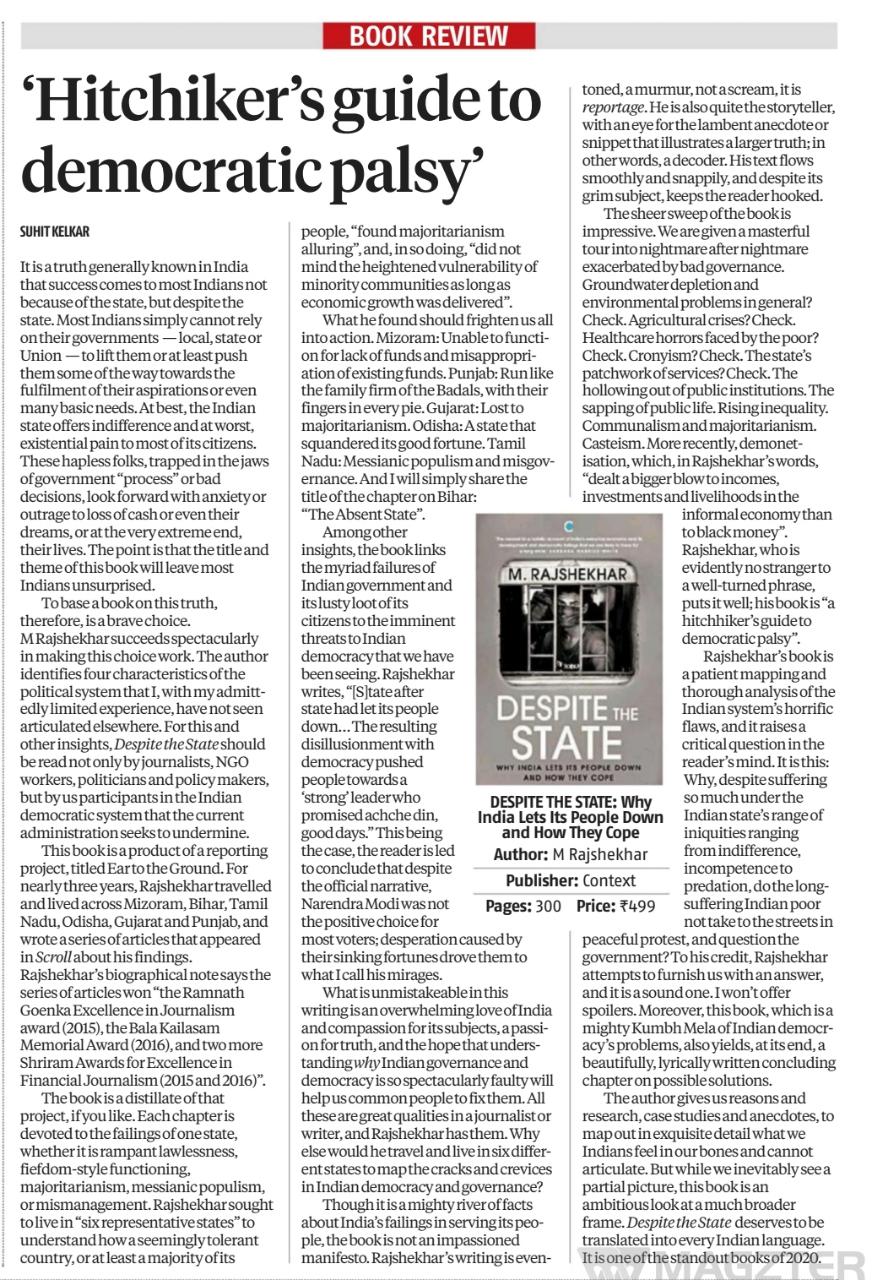
A patient mapping and thorough analysis of the Indian system’s horrific flaws…” Business Standard (Image here)

33 മാസം, 6 സംസ്ഥാനങ്ങൾ, 120 റിപ്പോർട്ടുകൾ: ജനാധിപത്യം തേടി മഹത്തായ ഇന്ത്യൻ യാത്ര… (33 months, 6 states, 120 reports: Great Indian journey in search of democracy…)” Malayala Manorama

Hindustan ki maujooda siyasi wa maaashi soorat e hal.” QindeelOnline

What emerges is the image of a state that is extractive, dominant, casteist and clientelist.Tribune

…reporting at its best. The picture that emerges is of a democracy that has been hijacked by vested interests, interested only in power and pelf.Moneycontrol.com

Book lists

Ten best non-fiction books of the year“, The Hindu.

Twenty-One Notable Books From 2021“, The Wire.

What has South Asia been reading: 2021 edition“, Himal Southasian

Interviews

Journalism is a social enterprise…,” Booksfirst.in.

Democratic decay at state level: Journalist M Rajshekhar on book ‘Despite the State’,” The News Minute.

Covid-19 en Inde : “des décès de masse” dont un “État obscurantiste est responsable,” Asialyst.

Allusions/Mentions

JP to BJP: The Unanswered Questions“.
Mahtab Alam’s review of “JP to BJP: Bihar After Lalu and Nitish”.

Urban History of Atmospheric Modernity in Colonial India“. Mohammad Sajjad’s review of “Dust and Smoke: Air Pollution and Colonial Urbanism, India, c1860-c1940”.

Westland closure: Titles that are selling fast and a few personal recommendations,” by Chetana Divya Vasudev, Moneycontrol. (Because this happened too. In February, a year after DtS was released, Amazon decided to shutter Westland, which published the book. The announcement saw folks rushing to buy copies of Westland books before stocks run out.)

Time to change tack on counterinsurgency” by TK Arun, The Federal.

All Things Policy: The Challenges of Governing States” by Suman Joshi and Sarthak Pradhan, Takshashila Institute (podcast).

The Future of Entertainment“, Kaveree Bamzai in Open.

On What India’s Watching“, Prathyush Parasuraman on Substack.

The puppeteers around us“, Karthik Venkatesh in Deccan Herald.

Will TN election manifestos continue ‘populist’ welfare schemes?“, Anna Isaac for The News Minute.

Why wages-for-housework won’t help women“, V Geetha in Indian Express.

The poor state of the Indian state“, Arun Maira in The Hindu.

Book discussions

14 April, 2024: The costs of political corruption, Bangalore International Centre.

27 May, 2023: Safe Spaces/Why Indians live despite the state. TEDx Bangalore.

12 November, 2022: Stop Loss: Overcoming the systemic failures of the Indian State. Tata Literature Festival, Mumbai.

26 December, 2021: Rangashankara, Bangalore, a discussion with Dhanya Rajendran.

16 November: Rachna Books, Gangtok, a discussion with Pema Wangchuk.

29 August: Books In The Time of Chaos, with Ujwal Kumar.

21 May: Hyderabad Lit Fest with Kaveree Bamzai and Aniruddha Bahal.

28 March: Paalam Books, Salem, Tamil Nadu.

19 March: The News Minute, “Citizens, the State, and the idea of India

6 March: Pen@Prithvi, with Suhit Kelkar

20 February: A discussion between scholars Usha Ramanathan, Tridip Suhrud, MS Sriram and me to formally launch Despite the State.

6 February: DogEars Bookshop, Margoa.

5 February: The Polis Project, Dispatches with Suchitra Vijayan.

30 January: Founding Fuel, “Systems Thinking, State Capacity and Grassroots Development“.

25 January: Miranda House Literary Society

Aadhaar Agriculture Banking correspondents Bihar BJP Books Cash transfers Climate change Coal Coalscam Common BC Auctions Corruption Demonetisation Ear To The Ground Energy Energy Transition Environmental governance Financial Inclusion Forests Gujarat Healthcare Idiocy India Informal economy Journalism Madhya Pradesh Mandis Microfinance Mining Mizoram MoEF NDA NREGA Odisha Oligarchy Pollution Privacy Punjab Reserve Bank of India Rivers Tamil Nadu Tribals UIDAI UPA Welfare Programmes